A book would have been better : Un libro sarebbe stato meglio !!!
ASCONA — THE HIDDEN SHORE
Production & Financing Concept
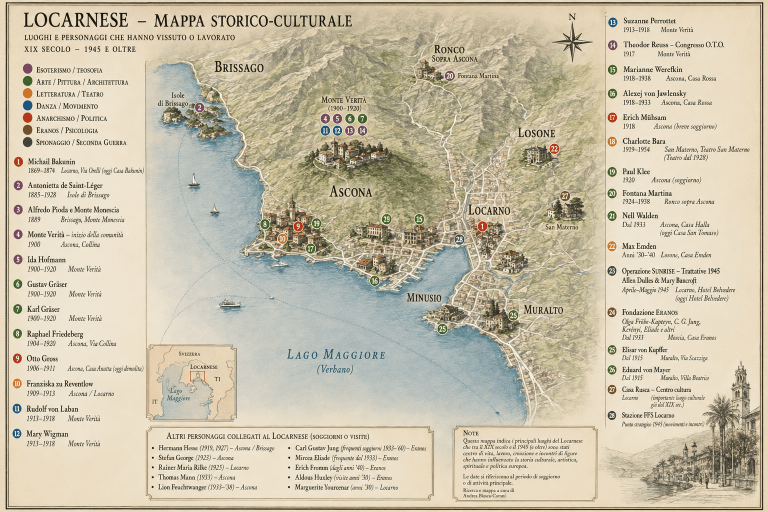
The Hidden Shore is conceived as a non-profit, internationally crowdfunded premium series about Ascona as a hidden crossroads of twentieth-century culture: Monte Verità, utopians, artists, Jung and Eranos, political exiles, spies, counterculture and Luigi Pericle.
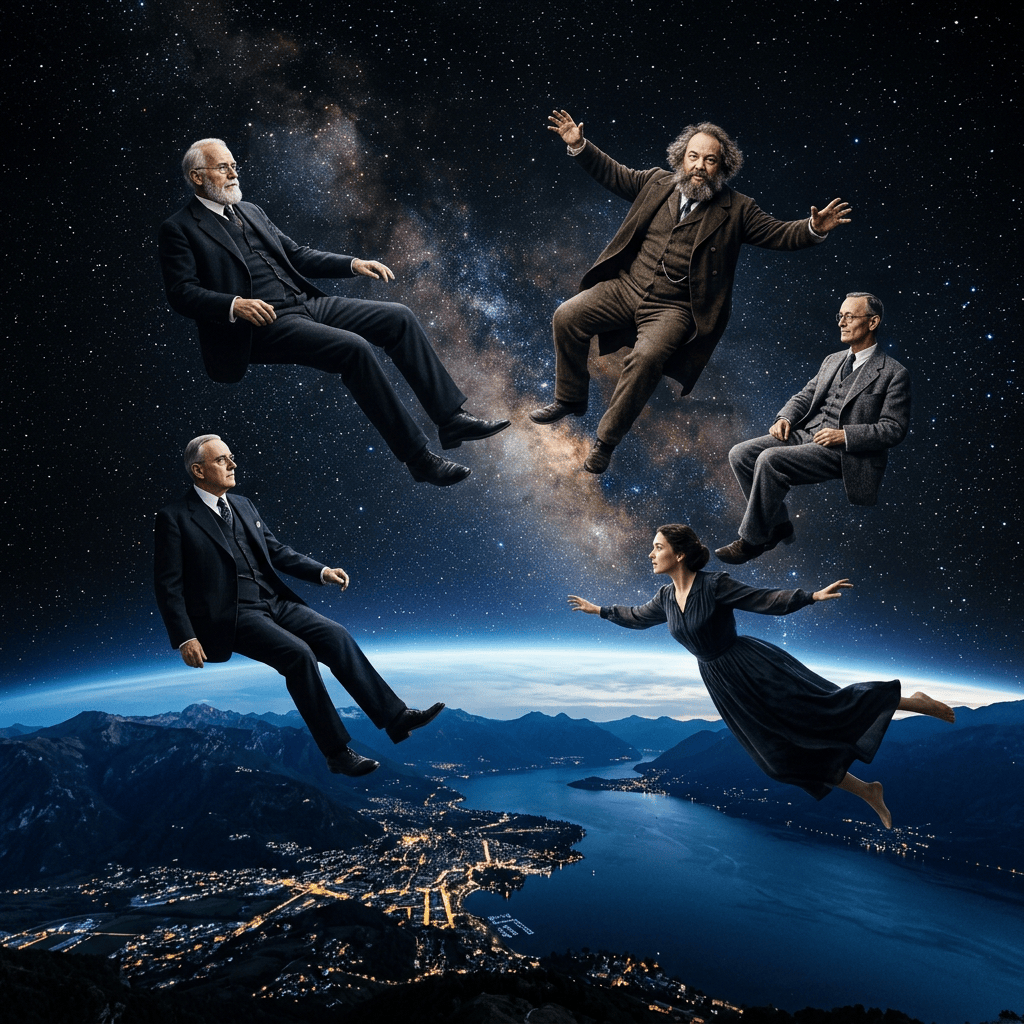
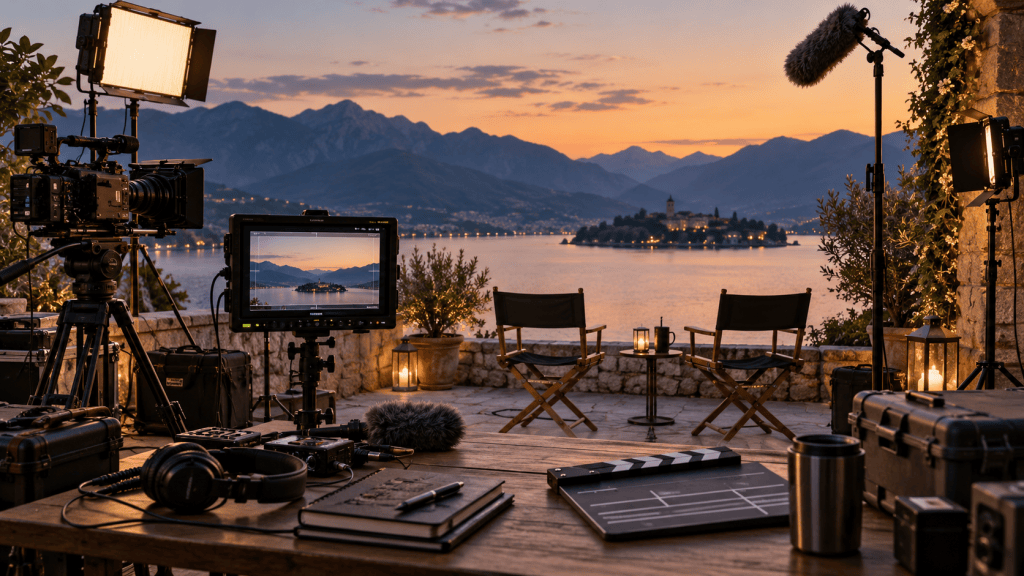
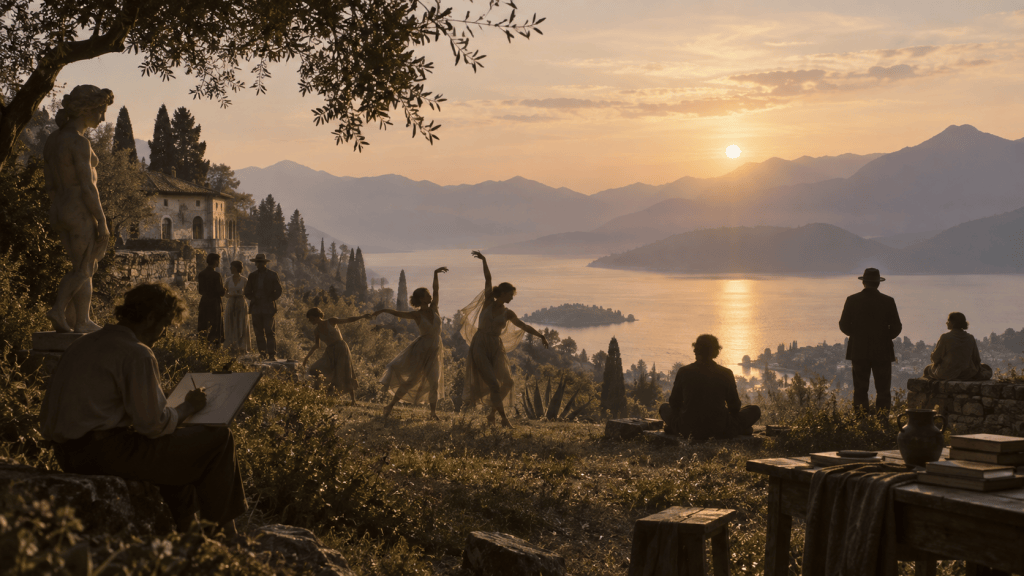
Hotel Ascona becomes the production headquarters and the narrative machine of the series. International actors live together at the hotel. We see them as themselves, then entering make-up and costume. They walk through a corridor, open a door — and emerge into another century as Jung, Bakunin, Hesse, Dulles, Werefkin or other historical figures.
The distinction between present, filmmaking and historical reality gradually dissolves. The production of the series becomes part of the series itself.
Production model
Real actors + real locations + real costumes + AI/VFX historical reconstruction.
AI would primarily recreate lost environments, architecture, crowds and period landscapes rather than replace human performances. Hotel Ascona provides accommodation, production headquarters and recurring sets, substantially reducing production costs.
Talent strategy
The aim is to attract internationally recognised actors as artistic patrons, asking them to contribute a limited number of shooting days for nominal fees or expenses rather than conventional star salaries.
The proposition:
No one comes to Ascona for the paycheck. They come for the story.
Each star could make a concentrated special appearance as one major historical figure.
Financing : https://www.indiegogo.com/admin/project/andrea-biasca-caroni/Ascona-hidden-shore/dashboard
Launch an international Kickstarter campaign, initially targeting approximately CHF 300–500K for development and a high-quality proof of concept/pilot.
Possible stretch goals:
CHF 300K — cinematic proof of concept
CHF 500K — full pilot
CHF 750K — expanded historical production
CHF 1M+ — international cast and further episodes
Ideally, secure one internationally recognised actor before launching the campaign. A confirmed name gives the crowdfunding campaign credibility and media potential.
The proposition to the public
The actors donate their talent. Hotel Ascona opens its doors. Historians and archives open the past. Technology rebuilds the lost world. The audience makes the series possible.
The crowdfunding campaign itself can become part of the contemporary storyline: Andrea, Jacopo and Jordan attempt to make the impossible series, the international community responds, actors arrive, and the fictional reconstruction begins.
The central creative promise remains:
EVERY MORNING, THE HOTEL WAKES UP IN ANOTHER CENTURY.
File della versione in Italiano :
A Secret History of Modernity
Part I — The Refuge
Every place has a history. Some places seem to have several histories layered one upon another, like paintings executed on the same canvas. Ascona is one of them. Seen from the lake, there is little to suggest what happened here. The mountains descend toward the water, the roofs gather around the bell tower, palms grow where one expects alpine vegetation, and the light reflected from Lago Maggiore gives the landscape the deceptive tranquillity of a place outside history. Yet for more than a century people arrived on these shores precisely because history had become unbearable elsewhere. Revolutionaries came after failed revolutions. Aristocrats came after abandoning society. Vegetarians and anarchists came to invent another civilization. Psychiatrists came carrying new theories of the unconscious. Dancers came to liberate the body. Occultists came looking for hidden traditions. Painters came when the European avant-garde began to fracture. Jews and political refugees came when Germany became dangerous. Scholars came to compare religions while Europe prepared for war. Spies came when that war approached its end. Afterwards came collectors, mystics, writers, musicians, eccentrics and men who simply wished to disappear. They did not belong to one movement. They did not share a secret doctrine. There was no hidden organization directing them. What existed was stranger and historically more interesting: networks. People knew people. Books travelled. Letters crossed borders. Ideas changed names. Political catastrophes displaced entire communities. A painter introduced a collector to another painter. A psychiatrist recommended an alchemical book to an American heiress. A theosophist who had lived in India appeared in Switzerland. An occult order founded in Europe acquired an American disciple who helped pioneer rocket propulsion. A German art movement crossed the Atlantic and helped form the collections of a New York museum. A school closed by the Nazis reappeared, transformed, in North Carolina. A conversation beside a Swiss lake eventually entered American publishing houses and university libraries. Again and again, inexplicably at first, Ascona appears somewhere on the map. This book begins with that recurrence. It is also the story of making a film about it. The present therefore never disappears. Actors sleep in a hotel above Ascona. Costumes hang in rooms where tourists eat breakfast. A man dressed as an anarchist revolutionary waits for an elevator beside a businessman attending a seminar. A woman made up as an expressionist painter checks her telephone. Someone walks through the lobby carrying an SS uniform. On a table lie reproductions of alchemical manuscripts, photographs from Monte Verità, intelligence reports from 1945 and drawings by Luigi Pericle. Outside, nothing has changed. The lake is still there. The mountain is still there. The strange thing is that almost everything we are reconstructing happened within sight of it. The story begins before Monte Verità had its name. It begins with a fugitive. Mikhail Bakunin was already one of the most notorious revolutionaries in Europe when he reached the region. He had participated in revolutionary movements, been arrested, imprisoned, handed over to the Russian authorities, confined in the Peter and Paul Fortress and Shlisselburg, exiled to Siberia and finally escaped through Japan and the United States back to Europe. His life had the geography of a nineteenth-century adventure novel, except that almost everything in it was political. Bakunin believed that the existing social order was not something to be repaired but something to be overthrown. Authority corrupted. States oppressed. Revolution could not simply replace one ruling class with another. Freedom had to be built from below. By the late 1860s and early 1870s he had become one of the great antagonists of Karl Marx within the revolutionary movement. Their conflict was ideological, strategic and personal. Marx believed political organization and the struggle for control of economic power were indispensable. Bakunin feared that centralized revolutionary authority would simply produce another form of domination. The quarrel would help divide the First International. Yet the heroic image of Bakunin as an unstoppable revolutionary contains another Bakunin: exhausted, chronically short of money, physically enormous, dependent upon friends, continually writing, plotting, borrowing and attempting to survive. This is the Bakunin who interests our story. Revolutions are expensive. Exile is expensive. Printing is expensive. Travelling across Europe while being watched by police is expensive. Bakunin possessed ideas on a continental scale and finances of almost comic instability. One of the men who repeatedly entered this chaos was Carlo Cafiero, the wealthy Italian revolutionary who initially moved within Marxist circles before becoming close to Bakunin and anarchism. Cafiero’s money helped sustain revolutionary activity and, at times, Bakunin himself. Their relationship embodied one of the paradoxes that will recur throughout this story: radical attempts to abolish bourgeois society were often made possible by people who possessed bourgeois fortunes. The same paradox will return on Monte Verità. It will return with wealthy patrons of avant-garde art. It will return at Eranos. It will return in New York with the Mellons, the Guggenheims and other fortunes that financed movements questioning the civilization that had created those fortunes. Bakunin himself briefly undertook the translation of Marx’s Capital into Russian. The episode is almost too perfect. Two men who would become emblematic enemies of the revolutionary left were connected by a book and by money. Bakunin needed income; the translation offered it. The project did not reach completion under him. Politics, personal difficulties and the increasingly bitter conflict surrounding the revolutionary movement intervened. For the series, however, one image is enough. A table. Papers. Bakunin translating Marx. Outside, Switzerland. The revolutionary who distrusts Marx is trying to earn money translating Marx. Someone knocks. Another letter asking about money. Another creditor. Another political scheme. Another revolution. We should resist the temptation to turn this into comedy, because Bakunin’s financial instability was inseparable from the existence he had chosen. But the contradiction makes him human. Historical figures become boring when they know that they are historical figures. Bakunin did not wake each morning thinking that future generations would study anarchism through his collected works. He woke needing money, food, paper, correspondence, allies and somewhere to live. In 1869 he was in the Locarno area; eventually he established himself at the Baronata near Minusio, a property connected to Cafiero’s support. The villa became entangled with revolutionary plans and Bakunin’s increasingly complicated relationship with Cafiero. The landscape is essential. Imagine arriving here after prisons, Siberia, conspiracies and European capitals. Lago Maggiore opens beneath the mountains. Italy is close. Switzerland offers relative political refuge. The border is simultaneously geographical and psychological. One can disappear without leaving Europe. That characteristic will make the region attractive again and again. Bakunin is therefore not merely our first famous resident. He establishes the first theme of the book: refuge. People arrive here because somewhere else has become impossible. Sometimes the impossibility is political. Sometimes social. Sometimes psychological. Sometimes artistic. Sometimes spiritual. The reasons change. The movement remains. From the hotel in the present, the film crew drives toward Locarno. The actor playing Bakunin sits in the back of a van wearing nineteenth-century clothes beneath a modern winter coat. He looks at his phone. A production assistant tells him they are almost there. The camera looks through the window. Apartment buildings, traffic lights, supermarkets. Then the lake appears. For a second the modern world falls away. Cut. The same road without cars. A carriage. Bakunin arrives. That is how the series will move through time. We do not enter the past through explanatory narration alone. We watch the present become unstable. A costume changes the century. A door opens onto another year. An actor walks through the Hotel Ascona corridor and emerges in 1870. The mechanism is deliberately visible because this is not a costume drama pretending that reconstruction is certainty. We are reconstructing history from fragments. Sometimes the fragments contradict one another. Sometimes an anecdote is irresistible but poorly documented. Sometimes a famous story turns out to have been repeated for decades without a primary source. The investigation therefore becomes part of the drama. What can we prove? What probably happened? What has become legend? The distinction matters particularly in Ascona because the mythology of the place began almost while the events themselves were happening. Utopian communities are unusually good at producing legends about themselves. So are occultists. So are artists. So are intelligence services. The historian therefore encounters an unusual combination: people who wanted to be remembered and people who wanted not to leave evidence. From Bakunin the camera moves west across the lake. The next protagonist could hardly be more different. Antoinette de Saint-Léger was not a proletarian revolutionary. She was a Russian-born baroness who acquired the Brissago Islands and transformed them into an extraordinary cultural and botanical world. If Bakunin represents the political exile, Saint-Léger represents another recurring Asconese type: the aristocrat who uses privilege to escape the conventions of her own class. The islands are physically perfect for this. They lie in the lake, visible from the shore but separated from it. To reach them one must cross water. Geography creates dramaturgy. The mainland is society. The island is experiment. Saint-Léger and her husband acquired the islands in the 1880s. Over time she developed the larger island through exotic planting and cultivated an environment that attracted visitors from the cultural world. Her life later became financially difficult, another motif that appears repeatedly in this landscape: grand visions followed by economic collapse. But before the decline there was the island as salon, refuge and self-created world. We film the actress playing Saint-Léger arriving by boat. The costume department has reconstructed her dress from photographs and period references. The boat engine is switched off before the take. For several seconds there is only water against the hull. Then the assistant director calls action. She looks toward the island. Cut to the nineteenth century. The modern landing stage disappears. Servants wait. Plants unfamiliar to the alpine landscape rise behind them. The baroness steps ashore. We have moved from Bakunin’s revolution against political authority to Saint-Léger’s quieter rebellion against social expectation. The connection is not organizational. There is no evidence that some secret Ascona circle links them. The connection is geographical and thematic: both discover that this peripheral landscape permits forms of life difficult elsewhere. That distinction—between documented relationship and meaningful juxtaposition—will govern the entire book. Otherwise the density of coincidences becomes dangerous. Once one knows that Jung, Crowley, Dulles, Roerich, Bailey, Guggenheim, Campbell and the Bauhaus all belong somewhere in the wider story, it becomes tempting to draw lines between everything. We will not. A line exists only when we can explain what it means. Some lines indicate direct acquaintance. Others institutional membership. Others correspondence. Others intellectual influence. Others merely historical simultaneity. The difference between them is the difference between history and conspiracy theory. Yet historical networks can be astonishing without invention. The next figure proves it. Alfredo Pioda was born into the Ticinese political and intellectual world, educated, cosmopolitan, interested in philosophy and spiritual questions. In the late nineteenth century he became involved in Theosophy, the international movement associated above all with Helena Petrovna Blavatsky and Henry Steel Olcott. To understand why this matters, we must momentarily leave Ascona. New York, 1875. The Theosophical Society is founded amid the extraordinary nineteenth-century fascination with spiritualism, occultism, comparative religion and the possibility that ancient traditions preserved knowledge ignored by modern materialism. Blavatsky is one of the strangest and most influential figures of that century. Russian-born, widely travelled according to a biography in which documented movements and self-created legend are sometimes difficult to disentangle, she becomes the charismatic centre of a movement attempting to synthesize Western esotericism with interpretations of Hindu and Buddhist traditions. The Society later establishes its international headquarters at Adyar, near Madras, now Chennai, in India. This geographical move is historically significant. Western esotericism is no longer merely looking backward toward Renaissance magic, Hermeticism or European secret societies. It is looking east. India becomes, in the Western esoteric imagination, not simply a colonized territory but a source of spiritual authority. The relationship is full of contradictions: admiration and appropriation, genuine scholarly curiosity and romantic projection, anti-colonial sympathies and Orientalist fantasy. Those contradictions will travel with Theosophy everywhere it goes. They will reach Ascona. Two names matter particularly: Franz Hartmann and Constance Wachtmeister. Hartmann, a German physician and Theosophist, had been directly involved in the international Theosophical milieu and spent time at Adyar. Wachtmeister became one of Blavatsky’s close associates. When these figures enter Pioda’s orbit, Ascona is no longer connected merely to a local eccentric interest in occultism. It is connected to an international network stretching from New York and London to India and continental Europe. In 1889 Pioda, Hartmann and Wachtmeister became involved in plans for a theosophically inspired community in the region, associated with the idea of a Fraternitas and land on Monte Monescia above Ascona. The project did not become the later Monte Verità community. This is important. It is tempting to draw a straight line: Pioda invents Monte Verità, therefore the famous colony of 1900 is simply the realization of his project. The evidence supports continuity of place and cultural atmosphere more comfortably than direct institutional continuity. Yet the coincidence of geography is remarkable. Before the hill becomes internationally famous for vegetarian reformers, dancers and anarchists, another group had already imagined the same landscape as the site of a spiritual community. This is the moment when the camera first climbs the mountain. Pioda stands looking across the lake. Hartmann is beside him. Wachtmeister unfolds a document. They discuss what might be built here. Behind them there is almost nothing. Cut. Same camera position, eleven years later. Buildings. Barefoot people. Gardens. Sunlight. A bell. Someone carrying vegetables. Title: 1900. Monte Verità has begun. The people who establish the community at the beginning of the twentieth century are not simply occultists. Their concerns are more bodily and immediate. Henri Oedenkoven, Ida Hofmann and the brothers Karl and Gustav Gräser are among the central figures associated with the founding phase. They are dissatisfied with industrial civilization, bourgeois convention, restrictive clothing, unhealthy food, urban life and inherited social structures. The hill becomes a laboratory of Lebensreform, the broad German-speaking reform culture encompassing vegetarianism, naturism, alternative medicine, physical culture, new clothing, communal experiments and a return to nature. It would be misleading to describe Lebensreform as a single ideology. Its adherents could be anarchists, mystics, nationalists, pacifists, artists, vegetarians, racial theorists, socialists or apolitical seekers. Ideas that later appear politically incompatible could coexist within the larger revolt against industrial modernity. That ambiguity is essential. The desire to return to nature is not automatically progressive. The rejection of modernity can lead toward emancipation or reaction. Monte Verità contains both the beauty and the danger of utopian thinking: once one declares civilization sick, the next question is who possesses the cure. Ida Hofmann writes, organizes and articulates reformist principles. Henri Oedenkoven brings resources and managerial energy. Gustav Gräser becomes something else: prophet, poet, wanderer, outsider. If Oedenkoven helps build a colony, Gräser embodies the refusal to be contained by one. He is the figure who looks most immediately like someone transported from the counterculture of the 1960s: long hair, unconventional clothing, rejection of property and bourgeois life, wandering existence, nature mysticism. Photographs make the temporal dislocation almost comic. Place one beside an image from California half a century later and the eye invents a genealogy before the historian has established it. We must therefore proceed carefully. There is a broad and well-established history connecting German Lebensreform, Naturmensch ideas, vegetarianism and alternative living to later countercultural currents, including emigrant milieus in the United States. But each claimed personal chain must be demonstrated separately. The series can use resemblance as a question, not as proof. Present day. The actor playing Gräser sits barefoot on the hotel terrace. It is November and he is freezing. The costume designer wraps him in a blanket between takes. Someone shows him a photograph of eden ahbez, the American songwriter associated with the Nature Boys of mid-century Los Angeles. They compare the photographs. “He looks like you.” “He looks like everyone here.” Laughter. Then the director asks the historical question: is there actually a line from Monte Verità to California? Cut to Los Angeles. Not yet. We hold the question for later. The hill first has to become famous. People begin arriving because news of the experiment travels through reformist and artistic networks. Some stay. Some visit. Some hate it. Some romanticize it. The colony itself changes. What began as a life-reform experiment becomes increasingly entangled with tourism, performance and the cultural fascination surrounding the place. This transformation is another recurrent pattern. The outsider invents an alternative. Society discovers it. The alternative becomes fashionable. Money arrives. The rebellion becomes an attraction. Eventually a hotel stands where anti-bourgeois reformers sought escape from bourgeois civilization. The irony should not be treated cynically. Institutions often preserve what commercialization seems to betray. Without later owners, archives, museums and restorations, much of Monte Verità might have vanished. But the contradiction remains visually irresistible. A barefoot vegetarian in 1902 eats raw fruit on the hill. Cut to a beautifully set restaurant table decades later. Wine glasses. Silverware. Guests. Same mountain. History does not proceed by replacing one world with another. It accumulates them. Among the people drawn toward this atmosphere are anarchists and bohemians. Erich Mühsam belongs to the German anarchist and literary milieu that intersects with the Monte Verità world. Johannes Nohl, Raphael Friedeberg and others participate in overlapping networks of political radicalism, social experimentation and unconventional life. Then comes a figure who changes the tone of our story completely: Otto Gross. Gross was a physician and psychoanalyst, the son of Hans Gross, one of the founders of modern criminology. The father sought systems for identifying and understanding criminals; the son became fascinated by the unconscious, sexuality and the psychological mechanisms through which authority enters the individual. The conflict between them was not merely familial. It almost allegorizes the transition from nineteenth-century discipline to twentieth-century rebellion. Otto Gross moves through the early psychoanalytic world, encounters Freud’s circle and becomes associated with C. G. Jung at the Burghölzli psychiatric clinic in Zürich. Gross is brilliant, unstable, addicted to drugs and radically opposed to conventional sexual morality. His life has often been mythologized, so individual anecdotes require careful verification. What is certain is that his combination of psychoanalysis, anarchism and sexual liberation made him an extraordinary catalyst within the bohemian environment around Munich and Ascona. For Gross, psychological repression and political repression were not separate problems. The patriarchal family reproduced authority. Sexual liberation therefore possessed revolutionary implications. Psychoanalysis could become not merely therapy but social criticism. This position put him at odds with the increasingly professionalized psychoanalytic movement. It also made him magnetic to writers, artists and radicals looking for a language through which private desire could become political revolt. In the series, Gross first appears not on Monte Verità but in Zürich. Burghölzli, 1908. A young C. G. Jung is treating him. The two men talk for hours. The conventional relationship between doctor and patient begins to destabilize as Jung recognizes Gross’s intellectual force. Their encounter is historically important because Jung later acknowledged the impact Gross had upon him. The camera remains close. No mountains. No sunlight. White walls. Cigarette smoke. Medical notes. Gross is restless. Jung watches. The conversation turns toward parents, sexuality, authority. Gross reverses the questions. Suddenly Jung is answering. We cut before knowing who is analysing whom. Decades later Jung will sit at Eranos discussing alchemy, religion, myth and the structure of the psyche. But the audience will remember this room. That is how our characters should recur. They are not introduced when they become famous. We meet them before they know what they will become. Gross eventually returns to the Ascona milieu, where his ideas find a receptive environment among people already experimenting with alternatives to bourgeois marriage and morality. Here the story becomes darker. The rhetoric of liberation coexists with addiction, jealousy, dependency and psychological collapse. The early twentieth-century revolt against sexual repression was not a clean precursor of later emancipatory movements. Its participants were experimenting without stable ethical frameworks and often within unequal relationships. Gross’s drug dependence, particularly involving substances such as cocaine and morphine/opioids in the medical culture of the period, contributed to repeated crises. Around him gather stories of erotic experimentation, psychiatric breakdown and death. One of the names associated with this darker Monte Verità mythology is Lotte Hattemer, a young woman connected to the reform milieu whose death by suicide became part of the tragic memory of the colony. Here the film must slow down. Later retellings frequently compress different people, events and accusations into a single decadent legend of sex, drugs and death. We should not. A suicide is not picturesque evidence that a community was “wild.” It is a human death whose precise circumstances must be reconstructed from reliable contemporary documentation. Gross’s role in the lives and deaths of women around him has also generated claims of varying evidentiary strength. Wherever the archive does not permit certainty, the film should show uncertainty. That uncertainty itself tells us something about the period. These people believed they were abolishing old morality. They did not necessarily know what would replace it. A scene at Casa Anatta can express this without a lecture. Night. Conversation. Someone reads Nietzsche. Someone laughs. Someone is jealous. Someone prepares a drug. Someone insists that jealousy itself is bourgeois conditioning. Another person begins crying. Gross says something brilliant and cruel. Outside, the mountain is black. In the morning the utopia looks different. This is the first major reversal of Monte Verità. The place advertised as a cure for civilization discovers that escaping civilization does not mean escaping the human psyche. Desire comes with them. Power comes with them. Dependency comes with them. Madness comes with them. Death comes with them. And from this failure, paradoxically, another strand of the twentieth century emerges: the attempt to understand psychologically why liberation is so difficult. The present-day actor playing Gross removes his costume in an Hotel Ascona room. On the table lies a book by Jung. He picks it up. The cover shows the elderly psychiatrist everyone recognizes. He looks at the photograph. “That’s him?” The researcher nods. “That’s the young doctor from the hospital?” “Yes.” “And he ends up here?” “Yes.” “When?” “Twenty-five years later.” The actor turns another page. “Doing what?” The researcher answers: “Talking about alchemy.” Cut to black. Before we reach that older Jung, however, another woman enters the story. Franziska zu Reventlow arrives from the Munich bohemian world. She has already lived against the expectations imposed upon women of her class and period. Writer, translator, single mother, participant in the Schwabing bohemian milieu, she becomes associated with the unconventional social world that overlaps with psychoanalysis, anarchism and experiments in sexuality. Reventlow is useful because she prevents the story of sexual rebellion from being told entirely through men theorizing women’s liberation. Her life demonstrates both the freedoms and the material costs of rejecting conventional structures. Independence can mean poverty. Sexual freedom does not abolish gendered vulnerability. Bohemia can be exhilarating when someone else is paying the rent. Reventlow knew the economic edge of the experiment. Her presence also opens Munich as another great city in our network. Before Berlin becomes the principal axis of the avant-garde in our story, Munich is a crucible. Kandinsky, Jawlensky, Werefkin, anarchists, writers, psychoanalysts, occultists and reformers circulate through overlapping environments. Schwabing becomes an urban counterpart to Monte Verità: one is cafés, studios and rented rooms; the other gardens, huts and sunlight. People move between them. Ideas move faster. Germany’s artistic rebellion and Switzerland’s life-reform experiment are not separate phenomena. They belong to the broader crisis of European bourgeois culture before the First World War. The question everywhere is similar: what comes after the nineteenth century? Nietzsche has announced the death of inherited certainties. Industrialization has transformed cities and work. New technologies compress distance. Women challenge social roles. Socialism and anarchism challenge property and state authority. Psychoanalysis claims that rational consciousness does not govern the human being. Theosophy and occult revivals challenge materialist accounts of reality. Artists abandon naturalistic representation. Dancers will soon abandon classical movement. Physics itself is destabilizing older models of matter and time. Europe enters the twentieth century without agreeing what reality is. Ascona becomes attractive precisely because uncertainty is easier to inhabit at the edge. Then, in 1913, a man arrives who will turn the body itself into a language. Rudolf von Laban is not simply another eccentric on the mountain. He will become one of the most consequential theorists of movement in modern dance. At Monte Verità he establishes an artistic school and works with figures including Mary Wigman, Suzanne Perrottet and others who will become central to modern expressive dance. The difference between the first Monte Verità generation and Laban can be seen immediately. Oedenkoven and Hofmann ask: how should we live? Laban asks: how should we move? Classical ballet had codified the body through an inherited theatrical language. Laban sought something more fundamental: movement in space, rhythm, effort, relation, community. The body could become expressive before it became representational. Dance need not tell a story. Movement itself could be meaning. The mountain becomes studio. Students move outdoors. Bare feet contact earth. Arms describe geometries against the sky. The reformist body, once liberated from corsets, shoes and conventional diet, becomes the artistic body. Mary Wigman will carry these experiments into German modern dance. Suzanne Perrottet participates in the same ferment. The distinction between exercise, ritual, pedagogy and art becomes deliberately unstable. And then Europe begins killing itself. August 1914. Mobilization. Uniforms. Railway stations. Crowds. Artillery. The First World War creates the most brutal possible counter-image to Monte Verità. The modern state also has a theory of movement. Men stand in rows. Turn together. March together. Board trains together. Attack together. Industrial warfare organizes bodies on a scale no choreographer could imagine. We intercut them. A Laban class on the mountain. Soldiers drilling. Dancers extend their arms. Soldiers raise rifles. Bare feet on grass. Boots in mud. A drum at Monte Verità. Artillery. No narrator needs to explain the comparison. Europe has produced two systems for the collective body. One seeks expression. The other seeks obedience. Reality, of course, is more complicated: Laban himself will later attempt to work within the cultural apparatus of Nazi Germany, a fact that prevents us from retrospectively turning him into an uncomplicated prophet of individual freedom. That chapter lies ahead. For now the war makes neutral Switzerland a magnet. Artists, pacifists, political exiles and intellectuals move through the country. Zürich gives birth to Dada. Ascona absorbs another wave. And in 1917 something happens on Monte Verità that allows our story to open outward toward the entire history of modern Western occultism. Theodor Reuss arrives. Reuss is one of those figures who make historians nervous because his biography intersects journalism, radical politics, irregular Freemasonry, occultism and organizations whose own histories are saturated with self-created mythology. By 1917 he is a leading figure of the Ordo Templi Orientis, the O.T.O. A congress associated with Reuss takes place at Monte Verità, addressing a mixture of social reform, mystical Freemasonry, cooperative ideas, education, art and ritual dance. Laban’s movement culture and Reuss’s occult organizational world briefly occupy the same landscape. This is the doorway. The actor playing Reuss enters the hotel elevator carrying a folder stamped O.T.O. Another actor sees it. “Crowley?” “Eventually.” The doors close. London. Aleister Crowley was not at Monte Verità for this congress. That sentence matters. He does not need to have been. Reuss gives us the documented connection to the organization through which Crowley becomes one of the most famous occultists of the twentieth century. To understand Crowley we must go backward again, to London in the 1890s and to the Hermetic Order of the Golden Dawn. The Golden Dawn brought together ceremonial magic, Hermeticism, Kabbalistic structures, Rosicrucian traditions, astrology and elaborate initiation rituals. Among its members were people whose subsequent reputations belong not to marginal occult history but to mainstream culture. William Butler Yeats, future Nobel laureate, took magic seriously. Arthur Edward Waite would become associated with one of the world’s most influential Tarot decks. Florence Farr was an actress, director and occultist. Samuel Liddell MacGregor Mathers became one of the order’s central and most controversial leaders. Then Crowley entered. Intelligent, wealthy, provocative and almost pathologically gifted at generating conflict, Crowley accelerated existing tensions. By 1900 the Golden Dawn was fractured. Mathers and the London adepts were at war over authority. Crowley became Mathers’s representative in the notorious struggle over the order’s London premises at 36 Blythe Road. Later retellings transform the episode into occult slapstick: Crowley in Highland dress and magical regalia, masked and armed, confronting Yeats, sometimes ending with the poet supposedly kicking him down a staircase. The precise physical details vary across accounts and the famous “Yeats kicked Crowley downstairs” version should not be presented as established fact without stronger primary documentation. But the underlying conflict is real. For the film, uncertainty is better. We shoot the legendary version first. Crowley climbs the stairs in extravagant costume. Yeats confronts him. A struggle. Crowley tumbles backward. “Cut.” Present day. The historian walks into frame. “We can’t prove Yeats did that.” The actor playing Crowley is still lying on the stairs. “You couldn’t have told me before?” Everyone laughs. Reset. Second take. This time we show only what the sources securely allow: confrontation, attempted control of the premises, factional chaos. History becomes visible as editing. From the Golden Dawn we can go backward once more to Blavatsky and the occult revival of late Victorian London, then forward again through Reuss to Crowley and the O.T.O. The organizations are not identical. Theosophy is not the Golden Dawn. The Golden Dawn is not the O.T.O. The O.T.O. is not Eranos. Their doctrines, structures and histories differ substantially. But people, books and ideas circulate between adjacent esoteric environments. That circulation is what interests us. Crowley eventually develops Thelema, with its own religious and magical system, and assumes increasing importance within the O.T.O. His influence crosses the Atlantic. Decades later, in California, a brilliant young rocket experimenter named Jack Parsons will become deeply involved in Thelema and the O.T.O. Parsons will also participate in the group from which the Jet Propulsion Laboratory emerges. Another man will enter Parsons’s house: L. Ron Hubbard. Before Dianetics. Before Scientology. Before either man’s later mythology has solidified. Together Parsons and Hubbard participate in the magical operations known as the Babalon Working. From there the story branches toward rockets, JPL, American occultism and the origins of Scientology. But we are not going to California yet. We remain on Monte Verità in 1917. Night falls. Laban’s dancers assemble. The event remembered as the Song to the Sun unfolds through the night toward dawn. Bodies move in darkness. Reuss watches. The war continues beyond Switzerland. Somewhere men are dying in trenches. Somewhere Crowley is pursuing his own occult trajectory. Somewhere the Russian Revolution is overturning an empire. On this mountain above Lago Maggiore, people dance toward sunrise. It would be easy to make the scene ridiculous. It would be equally easy to romanticize it. We do neither. We simply let it happen. The camera gradually withdraws. The dancers become small figures against the landscape. Dawn reaches the lake. Then silence. Morning, 1918. New people are arriving. They carry canvases.
The canvases belong to people who have survived one catastrophe and do not yet know that another is coming. When the First World War ends, Europe does not return to the world that existed before 1914. Empires have disappeared. Germany is defeated. Austria-Hungary has dissolved. Russia has undergone revolution and civil war. Millions are dead. Inflation, political violence and displacement become part of ordinary European life. The avant-garde that had spent the years before the war proclaiming the destruction of old forms now inhabits a continent in which destruction has ceased to be a metaphor. Ascona changes with it. The mountain of vegetarians and dancers remains, but below it another colony takes shape, less programmatic and more dispersed: painters, writers, refugees, aristocrats without empires, revolutionaries without revolutions, people carrying fragments of Munich, Berlin, Zürich, Vienna, Moscow and Paris into the narrow streets around the lake. Among them is Marianne Werefkin. Her arrival is one of the moments when Ascona ceases to be merely a laboratory of alternative life and becomes part of the history of modern European art. Werefkin had been born into the Russian aristocratic world and trained seriously as a painter before moving into the extraordinary artistic environment of Munich. Her relationship with Alexej von Jawlensky was personal, artistic and difficult. For years she subordinated aspects of her own production while supporting Jawlensky’s development, then returned to painting with a force that makes the old description of her merely as Jawlensky’s companion increasingly untenable. Around them circulated Kandinsky, Gabriele Münter, Franz Marc and the artists and intellectuals who would reshape expressionism before the war. Munich was one of the cities where painting ceased to be primarily a window onto the visible world and became an instrument for making inner experience visible. Colour no longer had to obey the object. A face could be blue, a mountain red, a landscape distorted because what mattered was not optical fidelity but psychological intensity. This transformation did not occur independently of the spiritual ferment we have already encountered. Kandinsky’s Concerning the Spiritual in Art belongs to a moment in which artists were reading Theosophy, occult literature, philosophy and new theories of perception while attempting to find forms adequate to realities they believed materialism could not explain. Theosophy did not “invent” abstract art, and no responsible history should reduce Kandinsky or the avant-garde to occult doctrine. But the presence of Theosophical and esoteric ideas in parts of the modernist milieu is documented and historically significant. The same intellectual climate that brought Pioda, Hartmann and Wachtmeister toward Monte Monescia had, by another route, entered studios in Munich and elsewhere. This is how the network works. The lines do not always represent meetings. Sometimes they represent books. A book crosses a border more easily than a person. Someone underlines a paragraph. Years later the vocabulary reappears in a manifesto. Another artist rejects the doctrine but keeps the image. Influence is rarely a clean inheritance. It is digestion. In the present-day Hotel Ascona, reproductions of paintings are spread across a conference table. Jacopo moves them around as though playing cards. Kandinsky. Jawlensky. Werefkin. Klee. Arp. Feininger. Chagall. Franz Marc. Another pile contains pages from Der Sturm. The question is no longer who visited Ascona. The question is how these people belonged to the same European circuitry before history scattered them. Jordan draws a line on a sheet of paper. Munich to Berlin. Berlin to Ascona. Berlin to New York. We will follow all three. First Berlin. Herwarth Walden understood something essential about modern art: movements require infrastructure. Artists can paint alone, but an avant-garde needs journals, galleries, critics, collectors, exhibitions, arguments, publicity and enemies. Der Sturm, founded by Walden in Berlin in 1910, became one of the great machines of European modernism. The name referred at different moments to the journal, gallery, publishing activity, exhibitions, theatre and wider cultural enterprise. Through this apparatus Walden promoted an astonishing range of artists associated with Expressionism, Cubism, Futurism and abstraction. Kandinsky, Franz Marc, Paul Klee, Marc Chagall, Oskar Kokoschka, Robert Delaunay, Gino Severini, Umberto Boccioni, Giacomo Balla, Jean Metzinger, Albert Gleizes, Fernand Léger, Alexander Archipenko, Lyonel Feininger and many others entered the Sturm constellation. So did Werefkin and Jawlensky. So, crucially for our later American story, did Hilla von Rebay. And beside Herwarth stood Nell Walden. Nell is indispensable because the Berlin-Ascona axis becomes embodied in a person. Born Nelly Roslund in Sweden, musically trained, intellectually independent, she married Herwarth Walden and became deeply involved in the Sturm enterprise. She collected art with extraordinary energy. Her collection eventually encompassed modern art as well as ethnographic and non-European objects, reflecting the period’s fascination with forms that European modernists believed could break the conventions of academic representation. Again the history contains both genuine aesthetic openness and the asymmetries of European collecting. Objects moved through colonial markets and systems of classification whose histories cannot simply be romanticized. Yet Nell’s collection was extraordinary, and her role in the Sturm network was much greater than the traditional image of an artist’s or publisher’s wife. Berlin before 1914 appears in the series as velocity. Tram bells. Printing presses. Cafés. Paintings carried through streets. Manifestos. Arguments. Cigarettes. A Futurist evening turns into shouting. Someone hates a painting. Someone buys it. Walden writes another article. Nell records another acquisition. Then the Herbstsalon of 1913 explodes across the screen: an international exhibition conceived on a scale intended to demonstrate that the new art was not a local German eccentricity but a European transformation. The same names that later appear isolated in museum rooms are suddenly young, competitive and alive. Kandinsky and Münter. Werefkin and Jawlensky. Klee. Arp. Delaunay. Léger. The Futurists. Painters who will later be divided by national canons occupy the same cultural weather. A year later their countries are at war. This is one of the reasons the First World War must remain visible throughout the art story. National museums later classify these figures as German, Russian, French, Italian, Swiss. The avant-garde itself was intensely transnational. Artists travelled, corresponded, exhibited together and borrowed from one another. War reimposed borders upon networks that had treated borders as inconveniences. Some artists served. Some fled. Some were killed. Franz Marc died at Verdun in 1916. August Macke had died in 1914. Others sought refuge in neutral Switzerland. Zürich became the stage for one of the most radical responses. Dada. Hugo Ball and Emmy Hennings are perfect transitional characters because they allow the film to move from the intellectual seriousness of reform culture into something that initially looks like mockery. Ball had passed through anarchist and theatrical environments before arriving in Switzerland with Hennings during the war. Hennings herself was a performer, poet and writer whose life had been economically precarious long before Dada became a museum category. In Zürich in 1916 the Cabaret Voltaire became the tiny room in which Ball, Hennings, Tristan Tzara, Hans Arp, Marcel Janco, Richard Huelsenbeck and others created performances that attacked language itself. Europe was issuing patriotic speeches while mechanized slaughter consumed a generation. Dada answered with nonsense poems, masks, noise, fractured typography and deliberate absurdity. If rational European civilization had produced Verdun, perhaps rationality did not deserve the respect it demanded. The actor playing Hugo Ball stands backstage in the reconstruction of the Cabaret Voltaire wearing the famous cylindrical costume associated with his sound-poetry performance. He can barely move. The crew laughs. Then the camera rolls and the laughter changes. The costume turns him into something between priest, machine and child’s toy. He intones syllables stripped of ordinary meaning. We cut to military communiqués announcing casualties in perfectly grammatical sentences. Which language is insane? Dada’s Swiss geography soon overlaps our Ascona geography. Hans Arp belongs to both worlds. So do broader circles of artists who move between Zürich, Ticino, Paris, Berlin and elsewhere. The mistake would be to imagine a single “Ascona movement.” There was none. What existed was proximity. A person could encounter Lebensreform, anarchism, expressionist painting, modern dance and occult ideas within a surprisingly small social radius. The value of Ascona was not doctrinal coherence but permeability. Werefkin settled in Ascona in 1918. Jawlensky also spent time there in the postwar period, although his later life developed elsewhere. Werefkin stayed. This distinction matters. Visitors give a place glamour; residents create its culture. Werefkin became one of the great presences of artistic Ascona. She lived modestly, painted, participated in local artistic life and became associated with the group that would be known as the Großer Bär, the Great Bear, founded in the 1920s by artists including Walter Helbig and others active in the region. The name itself is perfect for cinema: a constellation used to describe a constellation of artists. There is no need to invent symbolism. They supplied it. In the series, Werefkin walks at night through Ascona. Above the roofs the stars are visible. Someone points toward Ursa Major. Cut to the group’s paintings hanging together. The constellation becomes a graphic device. Each star acquires a name. Werefkin. Walter Helbig. Ernst Frick. Albert Kohler. Gordon Mallet McCouch. Otto Niemeyer-Holstein. Otto van Rees. The precise membership and chronology should be given according to archival documentation rather than later casual lists, but the group represents something important: by the mid-1920s Ascona has become a recognized artists’ colony. Ernst Frick is particularly valuable to our narrative because he refuses to remain inside a single category. He had connections to anarchist circles and Monte Verità, later became a painter and also pursued archaeological interests. In another city these identities might belong to three separate people. Here they coexist in one biography. This is becoming a pattern. The categories on our historical map—politics, art, esotericism, dance, psychology—are useful for the viewer, but the people themselves keep crossing the colours. That is perhaps the most accurate visual representation of Ascona: every time we assign someone a colour, their life escapes it. Paul Klee enters the wider Ascona story as a visitor rather than a foundational resident, and that distinction again matters. Klee belongs simultaneously to the Munich avant-garde, Der Blaue Reiter, the Sturm exhibition world and, later, the Bauhaus. His presence therefore opens another route out of Ascona. Bauhaus. The word has become so synonymous with modern design that it is difficult to recover how radical the school initially appeared. Founded by Walter Gropius in Weimar in 1919, the Bauhaus attempted to overcome divisions between fine art, craft, architecture and design. Its history changed dramatically through Weimar, Dessau and Berlin, and its internal ideological conflicts were substantial. Yet several figures already present in our expanding network became Bauhaus masters: Paul Klee, Wassily Kandinsky, Lyonel Feininger, Johannes Itten. Later László Moholy-Nagy, Josef Albers, Oskar Schlemmer and others would help define the school’s pedagogical and visual legacy. Johannes Itten gives us another unexpected bridge. His preliminary course at the Bauhaus combined formal exercises with an unusually personal pedagogical philosophy influenced in part by Mazdaznan, a modern religious movement that incorporated dietary and breathing practices and claimed connections to ancient Persian wisdom. Again the avant-garde refuses the neat modern division between rational design and esotericism. The same institution that becomes an icon of functional modernity contains, during one phase, a teacher performing breathing exercises and promoting a spiritual discipline. Gropius eventually moved the school away from aspects of Itten’s approach. The conflict itself is revealing. Modernism was not born fully secular and rational. It fought internally over what modernity should mean. The camera cuts from an Itten breathing exercise to a geometric Bauhaus exercise, then to a contemporary design store selling objects whose ancestry lies in the same school. Spiritual discipline disappears. Geometry remains. This process will recur throughout our story: modern culture often preserves the form after forgetting the metaphysics that accompanied its creation. In 1933 the Nazis finally close the Bauhaus. Its teachers scatter. The destruction of German modernism becomes, unintentionally, one of the mechanisms by which European modernism is exported to the world. Josef and Anni Albers leave Germany for the United States and arrive at the newly founded Black Mountain College in North Carolina. Here our map suddenly crosses the Atlantic. Black Mountain was tiny, experimental and institutionally fragile, but its influence on American art became enormous. Josef Albers brought pedagogical principles shaped by the Bauhaus. Anni Albers transformed weaving and textile practice into a major field of modernist experimentation. Over time the college’s orbit included John Cage, Merce Cunningham, Buckminster Fuller, Willem de Kooning, Robert Rauschenberg, Cy Twombly, Ruth Asawa, Charles Olson and many others. We should not claim a direct causal line Monte Verità–Bauhaus–Black Mountain. That would collapse distinct histories. The actual network is richer. Some individuals associated with Sturm become Bauhaus figures. The Bauhaus diaspora reaches America. Separately, artists and reformers connected to Ascona belong to overlapping European avant-garde networks. The point is not that Ascona founded Black Mountain. The point is that the European cultural ecosystem of which Ascona was one node was being violently redistributed across the Atlantic. The Nazis believed they were eliminating degenerate culture. In part they exported it. New York becomes another destination. Here Hilla von Rebay re-enters the story. Rebay had encountered Jean Arp and through him entered the orbit of Herwarth Walden and Der Sturm. She exhibited in that environment and developed a profound commitment to non-objective art. After moving to the United States, she met Solomon R. Guggenheim in 1927, initially in connection with portraiture. Guggenheim possessed money; Rebay possessed a vision. The combination changed American museum history. She encouraged Guggenheim toward the collection of non-objective art, particularly artists such as Rudolf Bauer and Kandinsky. In 1930, travelling in Europe with the Guggenheims, Rebay brought them into direct contact with Kandinsky at the Bauhaus in Dessau. Guggenheim purchased work. The line that began in the prewar European avant-garde now acquires American capital. In 1937 the Solomon R. Guggenheim Foundation was established. In 1939 the Museum of Non-Objective Painting opened in New York under Rebay’s direction. Eventually Frank Lloyd Wright would design the building that became the Guggenheim Museum, though by the time it opened in 1959 Rebay had lost her institutional position. Her role was nevertheless foundational. The film can make the connection without a single explanatory diagram. Berlin, 1910s. Rebay enters the Sturm gallery. Arp introduces her to Walden. Cut. Dessau, 1930. Rebay stands with Solomon and Irene Guggenheim before Kandinsky. Cut. New York. Paintings being hung. Cut. The spiral of Frank Lloyd Wright’s museum decades later. Then cut back to Ascona. Nell Walden opens the door of Casa Halla. The same Berlin world has reached the lake by another route. This is the Berlin-Ascona-New York axis in human form. Herwarth Walden’s life after Der Sturm became increasingly entangled with politics. Nell and Herwarth separated. Nell remarried. The rise of Nazism transformed choices that had once been artistic or personal into matters of survival. From the 1930s she was associated with Ascona and the house later known as Casa Halla, subsequently Casa San Tomaso. The house matters because buildings are the memory devices of this series. People vanish; walls remain. One owner leaves a library. Another changes a room. Another paints there. Decades later someone opens a cupboard and discovers paper. Casa Halla will eventually bring us to Luigi Pericle. But not yet. The camera approaches the house in the 1930s and stops outside. We hear music from within. Nell Walden is entertaining visitors. On the walls are works belonging to a European modernism now being attacked across the German border. A radio broadcasts news from Berlin. The guests continue talking, but the tone has changed. Adolf Hitler becomes German chancellor in January 1933. Within months the political and cultural environment that sustained much of the world we have been following is transformed. Books burn. Opponents are arrested. Jewish professionals are excluded. Modernist art is attacked. Artists leave. Intellectuals leave. Political opponents flee. Some cannot. The same Switzerland that attracted reformers because they wanted to escape bourgeois society now attracts people who need to escape a dictatorship. This is the second great transformation of refuge. In 1900, people came to Ascona because they rejected civilization. In 1933, people increasingly came because civilization had rejected them. Yet 1933 is also the year another extraordinary Ascona institution begins its formal history. Eranos. To understand Eranos we must first meet Olga Fröbe-Kapteyn before Eranos existed. Olga was born in London to Dutch parents, moved through a cosmopolitan European environment and eventually established herself at Casa Gabriella at Moscia, just outside Ascona. Her interests combined art, spirituality, comparative religion and the search for forms of knowledge that conventional academic specialization tended to keep apart. During the late 1920s and early 1930s she became involved with networks connected to Alice Bailey and Roberto Assagioli. This prehistory is essential because Eranos did not descend fully formed from the mind of C. G. Jung. Before Jung became its most famous participant, Olga had already been attempting to create an international centre for spiritual research at Ascona. Alice Bailey herself emerged from the wider Theosophical milieu. Born in Britain and later active principally in the United States, Bailey had been involved with the Theosophical Society before developing an independent body of teaching and institutions including the Arcane School. Her writings, many presented as teachings received telepathically from a spiritual master she called “the Tibetan,” became enormously influential in twentieth-century esoteric and New Age milieus. Whether one accepts such claims is irrelevant to historical analysis; what matters is that Bailey created an international network of students and organizations through which spiritual concepts circulated across Europe and America. Roberto Assagioli, the Italian psychiatrist who developed Psychosynthesis, had meaningful connections with Bailey’s network and with Olga’s Ascona project. Here psychology and esotericism meet again, but differently from Otto Gross. Gross wanted psychoanalysis to detonate bourgeois morality. Assagioli sought a psychology capable of integrating different levels of human experience, including dimensions he considered spiritual. The vocabulary is different. The ambition is related: the human being is larger than the narrow rational ego imagined by nineteenth-century positivism. For a period around 1930, Olga’s Casa Gabriella becomes the site of a spiritual-research project associated with this milieu. Bailey, Assagioli and Olga belong to a documented network, though the exact dates, titles and institutional structures need to be stated carefully because later accounts sometimes retrospectively use the name Eranos for activities preceding the first Eranos conference of 1933. The distinction gives us a dramatic scene. Casa Gabriella. 1931. Chairs are being arranged. Olga believes she is building one kind of institution. Cut. Same room, 1933. The chairs are rearranged. The institution has become something else. Ideas survive by changing containers. The name “Eranos” was suggested by Rudolf Otto, the German scholar of religion famous for his study of the numinous. The Greek word evokes a banquet to which each participant contributes something. It is difficult to imagine a better description of what Olga created. Eranos had no single doctrine. It was not a new church. It was not a secret society. It was not a university. It was a recurring gathering at which specialists from different disciplines and religious traditions presented work around a shared theme. The scale was intimate. The ambition was enormous. The first conference in 1933 addressed yoga and meditation in East and West. That title alone condenses half a century of intellectual movement. Pioda’s generation had looked toward India through Theosophy. Laban’s generation had sought transformation through the body. Psychoanalysis had turned inward toward unconscious processes. Now at Eranos scholars and practitioners attempted comparison: what happens if European psychology, Asian religious traditions, mythology, mysticism and symbolic systems are placed around the same table? This is where the young psychiatrist we left with Otto Gross returns. C. G. Jung is now in his late fifties. His break with Freud is long behind him. He has developed concepts including the collective unconscious, archetypes and psychological types. He has passed through an intense period of inner experimentation whose records will eventually become known through The Red Book. He is increasingly engaged with Gnosticism, alchemy, mythology and religious symbolism. The doctor from Burghölzli has become a thinker whose work sits uneasily between clinical psychology, cultural history and the study of religious experience. Present day. The actor who played young Jung in the Gross scenes enters an Hotel Ascona elevator. A makeup artist is still adjusting grey hair around his temples. The doors close. Floor numbers illuminate. When the doors reopen he is twenty-five years older. Moscia, 1933. Olga waits outside Casa Gabriella. No dialogue. They look at one another. She gestures toward the garden. Around the table sit people who, over the following decades, will make Eranos one of the strangest intellectual meeting places in Europe. The cast changes from year to year. Karl Kerényi brings the ancient Greek world and mythology. Heinrich Zimmer brings Indian art and religion. Gershom Scholem brings the historical study of Jewish mysticism and Kabbalah with a philological rigor that distinguishes his scholarship sharply from occult appropriations of those traditions. Erich Neumann develops analytical psychology in dialogue with myth and cultural symbolism. Henry Corbin brings the philosophical and mystical traditions of Iran and Islamic thought. Mircea Eliade becomes one of the twentieth century’s most influential and controversial historians of religion. D. T. Suzuki becomes an important interpreter of Zen Buddhism to Western audiences. Martin Buber belongs to the wider constellation of Jewish religious thought associated with Eranos. Joseph Campbell will later bring comparative mythology into a form that reaches a vast American readership. Not every famous name associated retrospectively with Eranos participated in the same manner or at the same time. Some lectured repeatedly; some appeared only in particular periods; some belong to the intellectual network more than to the core institutional history. The series will make those distinctions visible through dates. Every time someone enters Casa Gabriella, the year appears briefly on screen. The table changes. Jung ages. Olga ages. Europe outside changes faster. Eranos becomes our clock. 1933. 1934. 1935. 1936. Each summer scholars discuss symbols while flags multiply across Europe. This juxtaposition must not be used to suggest that Eranos existed outside politics. Several participants were directly affected by the political catastrophes of the period. Jewish scholars faced persecution and displacement. German-speaking intellectual life was being reorganized by dictatorship. The study of myth itself was politically dangerous terrain because fascist movements were simultaneously mobilizing myth, race, ritual and invented traditions for mass politics. To discuss symbols in the 1930s was not necessarily to escape history. Symbols were already marching in the streets. Jung’s own public positions and institutional roles during the early Nazi period have generated extensive historical debate and require careful treatment rather than retrospective simplification. The series should not canonize him. Nor should it turn complex documentary questions into a prosecution assembled from isolated quotations. Jung is most interesting when contradictions remain visible. He is capable of penetrating insight and cultural generalization, clinical observation and speculative metaphysics. His language about peoples and religions can reflect assumptions of his era that contemporary scholarship rightly interrogates. His fascination with Germanic mythology during the Nazi period cannot be understood without the political context in which those symbols were being weaponized. Yet Jewish colleagues and interlocutors, including figures within the Eranos world, complicate any simple portrait. History becomes more difficult precisely where television usually demands a verdict. We allow difficulty. In one scene Jung gives a lecture. The audience listens. Cut to Berlin: a mass rally. The same ancient vocabulary—myth, sacrifice, rebirth, destiny—appears in radically different contexts. Cut back to Eranos. Scholem challenges an interpretation. Scholarship becomes resistance to vagueness. Words must mean something. Sources matter. This principle becomes one of the hidden themes of the entire series. Esotericism survives through claims of secret transmission. Scholarship survives through citations. Ascona contains both. Eranos gradually creates its own archive of images. Olga develops an extraordinary interest in visual symbolic material, assembling photographs and reproductions across cultures. Mandalas, alchemical images, religious iconography, ancient art. The archive reflects both the comparative ambitions and the methodological risks of the period: images extracted from different historical contexts can reveal formal resonances, but resemblance is not identity. A Tibetan mandala is not an alchemical diagram simply because both use circles. Yet the comparative gaze itself becomes historically influential. Jung is particularly drawn to mandala forms because of images produced by patients and by himself during psychological work. Alchemy becomes increasingly central. This development brings us toward one of the most consequential encounters in the American branch of our story. Mary Conover Mellon and Paul Mellon enter Jung’s orbit in the late 1930s. They belong to a world almost unimaginably distant from the barefoot reformers of Monte Verità. Paul is heir to one of America’s great fortunes. His father, Andrew Mellon, had been banker, industrialist, philanthropist, Secretary of the Treasury and a central figure in the creation of the National Gallery of Art in Washington. Wealth on this scale can build institutions. Mary possesses her own intense intellectual and spiritual interests. Through Jung and the Eranos environment, those interests acquire direction. The Mellons spend time in Switzerland and engage with Jung. Mary becomes fascinated by the intellectual world surrounding his work, including alchemy. The relationship produces something far more durable than private enthusiasm: money begins to build an infrastructure for ideas. This is the moment when the history of Ascona touches the history of American philanthropy. The pattern should now be familiar. A marginal or unconventional European intellectual current encounters capital. The capital does not merely purchase objects; it creates institutions capable of preserving, translating and distributing the ideas. Hilla Rebay had done something analogous with Solomon Guggenheim for non-objective art. Mary and Paul Mellon will do it in another field. The Bollingen Foundation, established in the 1940s, becomes a major force in the publication of works in psychology, mythology, archaeology, religion, art history and related fields. The name “Bollingen” refers to Jung’s retreat on Lake Zürich, where he built his famous tower. A private Swiss place becomes the name of an American intellectual institution. Through the Bollingen Series, works that might otherwise have remained confined to specialists or European-language readerships enter Anglophone intellectual culture. Jung’s writings are central, but the series extends far beyond Jung. The effect is institutionalization. What had been conversations at a table in Moscia becomes books in American libraries. The camera follows one volume. Manuscript. Editing. Typesetting. Printing. Shipping. A crate crosses the Atlantic. Princeton. A student opens it. Ideas have no passport, but they need distribution. Mary Mellon’s interest in alchemy produces another extraordinary legacy. Inspired in significant part by Jung’s engagement with alchemical texts and his own collecting, the Mellons assemble books and manuscripts relating to alchemy and the occult. The collection eventually enters Yale’s Beinecke Rare Book and Manuscript Library. This gives us one of the most elegant circular journeys in the series because Jung himself had delivered the Terry Lectures at Yale in 1937. Yale to Jung. Jung to the Mellons. The Mellons to Switzerland and Eranos. Alchemy to the Mellons. The Mellon collection back to Yale. A circle closes, although no one designed it. In New Haven, the Beinecke appears almost extraterrestrial. Its translucent marble walls filter daylight. Inside, the glass tower of books rises through the centre. The architecture is the opposite of Monte Verità’s huts and yet serves a related human impulse: preserve what might disappear. A librarian places a manuscript on a support. The camera approaches slowly. Ink. Diagrams. Symbols. Hundreds of years old. The narrator does not call it occult wisdom. We identify what it is, when it was made where known, what tradition it belongs to, and how it reached the collection. Provenance replaces mystification. The effect is stronger. Objects become extraordinary when we do not need to exaggerate them. Somewhere in the same Beinecke is the Voynich Manuscript, perhaps the most famous undeciphered manuscript in the world. It did not enter Yale through the Mellon alchemical collection, and the film must not imply that it did. Its presence nevertheless allows the library itself to become a character in our story of hidden knowledge. The manuscript’s unknown script has generated innumerable theories, most unproven. Again the appropriate response is not to choose the most exciting speculation but to dramatize uncertainty. Pages turn. Botanical forms. Strange writing. “What does it say?” “We don’t know.” For once those three words are more powerful than revelation. Yale carries another accidental historical resonance. Elihu Yale, after whom the university was named, accumulated wealth through his career connected to the English East India Company and Madras. Centuries later, near the same Indian city, at Adyar, the Theosophical Society established its international headquarters. There is no causal relationship between Elihu Yale and the later Theosophical presence at Adyar. The chronology makes such a suggestion absurd. But the geographical recurrence gives us an opportunity to show how the Western relationship with India changes across centuries. First commerce, empire and extraction. Later Orientalist scholarship and spiritual fascination. Then Indian intellectual and religious movements themselves engage, resist and reshape Western categories. The camera travels from a seventeenth-century company ledger to the banyan trees of Adyar. Then to Pioda in Ticino reading Theosophical literature. Then to Eranos discussing yoga. Then to Yale preserving alchemical manuscripts. The movement is not a secret chain. It is the history of circulation. New York provides an even denser version. While the Mellons are entering Jung’s world, other spiritual networks are already active in Manhattan. Nicholas Roerich, Russian painter, mystic and cultural activist, has become the centre of an ambitious American institutional project. Roerich’s paintings of Himalayan landscapes and spiritual subjects give him an unusual position between art and esotericism. Together with his wife Helena, he develops Agni Yoga, a spiritual teaching emerging from the broader Theosophical and post-Theosophical environment. Wealthy supporters make institutional expansion possible. Among the most important is Louis L. Horch, a financier who becomes a major patron of Roerich’s American activities. The Master Building at 310 Riverside Drive opens at the end of the 1920s as an extraordinary skyscraper complex incorporating the Roerich Museum and associated cultural institutions. The building is one of those historical facts that looks like production design. A vertical temple of culture overlooking the Hudson. Galleries below. Apartments above. Art, spiritual aspiration, education and real estate occupying the same structure. We move through its lobby in 1929. Russian accents. American money. Paintings of Tibet. Students. Lectures. Elevators. New York is becoming the great western port into which displaced European and Eurasian cultural projects arrive. Alice Bailey’s institutions operate in the same city and period, although every claimed address-level connection between Bailey’s school activities and the Master Building must be documented before the film places them literally in the same rooms. The broader network is certain; the seductive detail of physical co-location requires evidence. This becomes a scene in the writers’ room. Someone has drawn Bailey and Roerich inside the same building. The researcher walks over and erases the line. “Why?” “We haven’t proved it.” “But it would be perfect.” “Exactly.” The line remains erased. Truth is allowed to spoil a scene. Sometimes another, better scene appears because of it. Roerich provides a route from esoteric culture directly into American politics through Henry A. Wallace. Wallace, agricultural thinker and politician, served as Franklin D. Roosevelt’s Secretary of Agriculture and later Vice President of the United States from 1941 to 1945. His interest in spiritual and religious questions was genuine, and his relationship with Roerich became politically controversial. The correspondence later known as the “Guru letters” was used against Wallace by political opponents. Here again we must distinguish documented relationship from sensational interpretation. Roosevelt did not become a Roerich disciple because Wallace knew Roerich. The connection is Wallace. That is already remarkable enough. A Russian mystical painter associated with a New York cultural centre corresponds with a man who will become Vice President of the United States. Esotericism is not sitting outside modern power. It occasionally sits surprisingly close to it. The Roerich Pact, an international treaty intended to protect cultural monuments and institutions in times of war, further demonstrates that Roerich’s activity cannot be reduced to mysticism. In 1935 the pact was signed in Washington in the presence of Roosevelt. A banner bearing the symbol associated with the pact hangs behind diplomatic ceremony. The same man can paint Himalayan visions, participate in esoteric teachings and campaign for an international legal instrument protecting culture. Our categories fail again. Then the political line moves forward. Roosevelt’s wartime America creates the Office of Strategic Services in 1942 under William J. Donovan. The OSS becomes the principal American wartime intelligence organization and an institutional predecessor of the CIA. In neutral Switzerland one of its most consequential figures is Allen Welsh Dulles. We have travelled from Roerich to Wallace to Roosevelt; now Roosevelt’s wartime apparatus sends Dulles to Bern. The line will eventually return to the Lago Maggiore region during the secret negotiations that become known as Operation Sunrise. But before the spies arrive, another American appears at Eranos whose influence will travel in a completely different direction. Joseph Campbell. Campbell’s later fame can distort our understanding of him because The Hero with a Thousand Faces became so influential in popular discussions of storytelling that “the hero’s journey” is now often treated like an ancient universal template waiting to be discovered. Campbell’s actual intellectual formation was more complicated. He read widely in mythology, literature, psychology and religion, drawing heavily upon Jungian ideas as well as other comparative traditions. His participation in the Eranos milieu belongs to the postwar history of the gatherings rather than their 1933 foundation, and chronology matters. But his presence gives us one of the longest cultural trajectories in the book. Eranos to Campbell. Campbell to American comparative mythology. Campbell to George Lucas. Lucas to Star Wars. Then Campbell’s ideas, further simplified and operationalized by figures such as Christopher Vogler, enter screenwriting culture. The irony is irresistible: the very series we are making about Eranos is being written within an industry partly shaped by a storytelling vocabulary that owes something to Campbell. The snake eats its tail. In the Hotel Ascona writers’ room, someone has pinned index cards to a wall. CALL TO ADVENTURE. MENTOR. THRESHOLD. ORDEAL. RETURN. Another researcher walks in carrying a photograph of Campbell at Eranos. He looks at the cards, then the photograph. Nobody says anything. Cut to Luke Skywalker looking toward twin suns would be impossible for copyright and licensing reasons, and unnecessary. Instead we see a young screenwriter in Los Angeles reading Campbell. The camera moves toward the book. Cut to Eranos decades earlier. Someone is discussing myth beneath the trees. The point is not that Ascona invented Star Wars. It did not. The point is that intellectual ideas migrate through channels nobody can predict. A discussion of myth at a small Swiss conference can enter a scholarly book, then a popular synthesis, then a filmmaker’s imagination, then the grammar of global entertainment. Culture is a relay race whose runners rarely meet. This gives us a new way to understand the two great Ascona experiments. Monte Verità experimented with life. Eranos experimented with meaning. Monte Verità asked what happens if we change food, clothing, sexuality, housing, movement and social relations. Eranos asked what happens if we place myths, symbols, religions and psychologies from different civilizations into conversation. Both were vulnerable to romanticism. Both could flatten cultural differences in pursuit of universal patterns. Both attracted extraordinary people. Both generated ideas that travelled far beyond the hill and the lakeside house in which they began. And both would later be mythologized as though everyone involved had agreed about what they were doing. They had not. Disagreement is the engine. Scholem does not become Jung because they sit at the same table. Corbin does not become a Jungian simply because Jung is present. Suzuki does not represent “the East.” Eranos matters precisely because distinct intellectual traditions remain distinct while being placed into contact. The table is not a melting pot. It is a collision chamber. Outside that chamber, Europe deteriorates. German refugees enter Switzerland under increasingly difficult conditions. Ticino’s proximity to Italy makes the region both refuge and frontier. Mussolini’s Fascist regime lies immediately across the border. Political exiles, anti-fascists, writers and artists move through a landscape where a short walk can acquire geopolitical meaning. This brings us away from Casa Gabriella toward another extraordinary cultural node: La Barca at Comologno. Aline Valangin and Wladimir Rosenbaum create around themselves a milieu in which literature, psychoanalysis, art and anti-fascist politics intersect. Valangin had connections to analytical psychology; Rosenbaum was a lawyer and cultural figure. Their house became associated with writers, artists and exiles moving through Switzerland. The precise guest list and dates require the same discipline we apply everywhere else, because famous names accumulate around legendary salons with suspicious ease. But the documented network is rich enough without embellishment. Ignazio Silone belongs to the anti-fascist literary world of Swiss exile. Ernst Toller, the German playwright and revolutionary, represents the broken trajectory from the 1918 German Revolution to exile. Other writers and intellectuals move through the wider Ticino environment. Suddenly our map must expand north and west. Ascona is no longer a point. It is a shore connected to valleys. Refuge hides in geography. One can be close to Europe while remaining slightly outside it. Rainer Maria Rilke had experienced the Locarnese in the 1920s, before the great political exodus. Hermann Hesse, living in Ticino at Montagnola, belongs to another nearby constellation and had meaningful connections with the reformist and alternative culture associated with figures such as Gustav Gräser. Hesse should not be turned into an Ascona resident when he was not one; geography must remain exact. But the cultural landscape of Ticino exceeds municipal borders. The same light, climate, linguistic frontier and distance from northern European metropolitan life attracted writers who were searching for forms of interior exile. Hesse’s later global reception, especially among American countercultural readers, will eventually connect with another branch of our story: the migration of Lebensreform and nature mysticism toward California. For now, he appears only briefly. A man walking alone. A book. Mountains. No explanation. We will recognize the line later. Then comes 1936. Berlin stages the Olympic Games. Rudolf von Laban, the dancer we last saw on Monte Verità, has spent years building an extraordinary career in Germany. His movement theories have expanded into large-scale choruses and systems of notation. Labanotation, developed through his work and that of collaborators, attempts to record movement through abstract signs. It is one of the most fascinating ideas in the history of dance: if music can be written, why not movement? A body disappears after performing. Notation promises memory. Direction, level, duration and bodily action become marks on paper. To someone unfamiliar with the system, a page of movement notation can look like a cipher. This visual resemblance has contributed to later stories suggesting that Nazi authorities suspected Laban’s notation of being a secret code or even espionage. Here we must be extremely careful. Laban’s relationship with the Nazi cultural apparatus is documented and complex. He attempted to continue and advance his work within the new regime and held significant positions in German dance institutions. He was not simply an anti-Nazi artist immediately “expelled because the Nazis thought his notation was spy code.” That version is dramatically attractive but historically too simple, and I cannot confirm the espionage-code claim as established fact without stronger archival evidence. What is documented is a decisive rupture in 1936 around his planned mass work Vom Tauwind und der neuen Freude for the Olympic context. Joseph Goebbels rejected the work; Laban’s position deteriorated, and he subsequently left Germany, eventually establishing himself in Britain. The exact motives, political calculations and chronology deserve a full scene because they reveal the moral ambiguity of artists under dictatorship. Laban had dreamed on Monte Verità of collective movement as liberation. In Nazi Germany, collective movement had become state spectacle. Could his art survive inside that machine? Could he use the machine without becoming part of it? Did he imagine himself capable of directing German movement culture at a national level? His ambitions were substantial. Later narratives sometimes present him as aspiring to become a kind of cultural minister or supreme dance authority. The institutional evidence supports significant ambition within the dance establishment, but any literal claim that he expected appointment as “Minister of Culture” must be sourced before being put into dialogue. His sexuality adds another layer. Biographical accounts describe relationships and environments that do not fit conventional heterosexual norms, but labels such as “gay” can oversimplify a complicated personal life that included marriages and relationships with women. Under the Nazi regime, homosexuality was subject to brutal persecution. The film should therefore distinguish documented relationships from retrospective identity categories. Laban is compelling precisely because he cannot be converted into a clean hero. We see him in an office looking at his notation. Outside, Nazi banners. An official examines the page. “What is this?” “Movement.” “Whose movement?” Laban pauses. That dialogue is invented, and the film would mark it as dramatization rather than archival quotation. But the historical conflict it expresses is real: an art built around autonomous theories of movement confronting a state that claims the right to choreograph society itself. Goebbels’s rejection ends the fantasy that Laban can remain master of his own system inside the regime. He leaves. The page of notation remains on the desk. Cut to Britain, where the same system will continue developing and influencing movement analysis, theatre, dance and education. Ideas escape regimes more easily than bodies. Back in Ascona, the pressure increases. Refugees arrive from Germany and later from territories under Nazi control. Some have money. Some have none. Some are famous. Some disappear from the historical record except in police documents and border files. Switzerland’s wartime refugee policy is not a simple humanitarian success story; it included rescue and refuge but also restrictions, refusals and controversial decisions with fatal consequences. The idyllic landscape therefore acquires another shadow. A lake can be beautiful while a border kills. Nell Walden’s presence in Ascona now changes meaning. The great Sturm years are gone. Herwarth Walden, who had moved to the Soviet Union, would perish there during the war years under Stalinist repression. The avant-garde network has been crushed from multiple directions: Nazism in Germany, Stalinism in the Soviet Union, war across Europe. Paintings survive their makers. Nell’s house becomes a container of memory. Werefkin is still in Ascona until her death in 1938. Imagine the two women meeting—not because we will automatically stage a friendship unless documentation supports it, but because their simultaneous presence forces the question. Two women carrying the memory of prewar modernism live within the same small town. Werefkin dies on 6 February 1938. The camera follows her funeral through Ascona. Paintings remain behind. The Great Bear loses a star. In the same year Europe moves toward catastrophe. Austria is annexed. The Munich Agreement sacrifices Czechoslovakia’s borderlands. Kristallnacht follows in November. At Eranos, scholars continue arriving. At Casa Gabriella, conversations about religious symbols take place within hours by train of states turning symbols into instruments of racial power. Then September 1939. War. The Hotel Ascona in the present becomes our transition machine again. A costume rack is rolled through the lobby. 1900: white reform dresses. 1917: Laban costumes. 1920s: painters. 1930s: suits, hats, evening clothes. Then military uniforms. The rack stops. An American OSS uniform hangs beside a German SS uniform. The receptionist looks up. We have reached the part of the story where ideas are no longer the only things crossing borders. Information is. Allen Dulles arrives in Bern in November 1942 as the representative of the OSS. His posting is extraordinary because Switzerland is neutral but surrounded by Axis-controlled or Axis-aligned territory for much of the war. Diplomats, refugees, businessmen, resistance couriers, German opponents of Hitler, Allied agents, Axis agents and opportunists move through the country. Neutrality does not mean inactivity. It means everyone is watching everyone. Dulles establishes himself as one of the great intelligence collectors of the European war. His network receives information from German resistance circles and from sources inside occupied Europe. After the war he will become one of the architects of American intelligence and Director of Central Intelligence. But our Dulles is not yet the Cold War figure. He is sitting in Bern receiving people who may be lying. Intelligence is the art of deciding which story is real before history tells you. And then a woman enters his life who brings us unexpectedly back toward Jung. Mary Bancroft, an American writer living in Switzerland, becomes close to Dulles and works with him in the intelligence environment. She had also undergone analysis with Jung. This connection is one of the most narratively irresistible in the entire project because it places analytical psychology and wartime espionage inside one biography. We should not exaggerate Jung into an OSS mastermind. The evidence does not justify that mythology. But the Jung-Dulles/Bancroft milieu includes documented intersections and wartime interest in psychological assessments of Hitler and German leadership. Psychology, which began our story with Otto Gross questioning bourgeois authority, has entered intelligence. The transformation is almost absurdly twentieth century. Burghölzli, 1908. “Tell me about your father.” Bern, 1943. “Tell me about Hitler.” Same century. Same Switzerland. Different stakes. Bancroft can become one of the central eyes through which we experience the intelligence story because she crosses social worlds. She knows the cultivated expatriate environment. She knows Jung. She knows Dulles intimately. She can enter rooms from which official histories often exclude women while nevertheless relying upon their work. But we must separate her later memoiristic recollections from contemporaneous documentation whenever the two differ. Intelligence history is particularly vulnerable to retrospective self-dramatization. Everyone remembers having known the decisive secret. The archive is less generous. By early 1945 Germany is collapsing. The Red Army advances from the east. Western Allied armies advance from the west. Northern Italy remains under German military control and the Fascist Italian Social Republic. Hundreds of thousands of soldiers are still fighting. Every additional week means more deaths. Within this chaos emerge secret contacts aimed at arranging the surrender of German forces in Italy. The operation will become known as Sunrise. Its cast seems written for cinema: Dulles; the Swiss intelligence officer Max Waibel; German SS General Karl Wolff; intermediaries including the Italian businessman and fixer Luigi Parrilli; German diplomats and officers; Allied representatives; couriers moving between northern Italy, Lugano, Ascona, Zürich, Bern and other Swiss locations as negotiations develop. The exact geography changes across phases, and popular retellings sometimes compress meetings into a single “Ascona negotiation.” We will not. Every meeting gets a date and place. The Hotel Belvedere in Locarno belongs to the local memory of the negotiations; Ascona and the wider region function within the contact network; other decisive discussions occur elsewhere in Switzerland. The film turns the landscape we have spent hours romanticizing into a chessboard. Roads matter. Stations matter. Hotel rooms matter. A man crosses the border carrying information. Another waits in a lobby. Someone uses a false name. A telephone rings in Bern. Dulles listens. Stalin becomes suspicious. This is where Sunrise expands from local thriller to global politics. The Soviet Union fears that the Western Allies may be negotiating a separate peace with German forces, potentially allowing Germans to shift troops against the Red Army or producing a political arrangement excluding Moscow. Roosevelt and Churchill must manage relations with Stalin while secret contacts continue. Messages move between Washington, London and Moscow because of conversations taking place in Switzerland. Lago Maggiore has become attached to the diplomacy of the end of the Second World War. The contrast with 1900 could not be greater. On the same map where Gustav Gräser wandered barefoot, SS officers and American intelligence intermediaries now negotiate the surrender of an army. This is the sentence around which the episode should be built: the landscape has not changed; the stakes have. At night the lake is black. A car drives from Locarno toward Ascona. Headlights pass the places where Werefkin painted. No one in the car is thinking about art. In Bern Dulles receives another report. In Moscow Stalin reads another message. In Washington Roosevelt is dying. On 12 April 1945 Franklin D. Roosevelt dies at Warm Springs, Georgia. Harry Truman becomes President without having been fully initiated into all the secret machinery of the administration he inherits. In Italy the war continues. Mussolini is captured and killed later that month. Hitler kills himself in Berlin on 30 April. The surrender of German forces in Italy is signed at Caserta on 29 April and becomes effective on 2 May. The chronology matters because Sunrise mythology often gives individual secret agents the power to “end the war” single-handedly. The negotiations contributed to the surrender in Italy; they existed within the overwhelming military collapse of Nazi Germany and the formal Allied command structure. History is dramatic enough without stealing causality from armies, resistance movements, diplomats and millions of people whose actions made the end inevitable. On 2 May the guns begin falling silent in Italy. We do not show celebration immediately. We return to the lake. Morning. Empty road. Birds. Water. Then the camera climbs toward Monte Verità. The same sunrise that Laban’s dancers greeted in 1917 appears again in 1945. But now nobody dances. Cut to the Hotel Ascona, present day. The actors playing Dulles, Wolff, Bancroft and Waibel are eating breakfast in costume because the schedule is late. Beside them sits the actor playing Gustav Gräser, barefoot again. Across the room Werefkin is checking messages on her phone. Jung drinks coffee. Crowley complains about the wig adhesive. History has become ridiculous because production has put everyone in the same room. Andrea enters carrying a box. “What’s that?” someone asks. He puts it on the table. “Pericle.” Silence. The name means nothing to most of them. This is deliberate. We have spent half the story reconstructing people who became internationally famous. Now we introduce a man who achieved international artistic success and then effectively disappeared from the standard narrative of postwar art. Luigi Pericle Giovannetti was born in Basel in 1916 to an Italian father and French mother. He would become known first through illustration and cartoon work, particularly the successful character Max the Marmot, before increasingly devoting himself to painting and drawing under the name Luigi Pericle. His trajectory in the late 1950s and early 1960s brought him into contact with important figures of the British art world. His paintings were shown in Britain and attracted serious attention. Then, at precisely the point where the conventional artist’s biography should accelerate—more exhibitions, more dealers, more market—Pericle withdrew. This withdrawal has subsequently produced its own mythology, and once again we must distinguish documentation from projection. He did not simply vanish from existence. He continued working. He studied. He wrote. He developed a private intellectual universe in which art, spirituality, philosophy, astrology, esoteric traditions and disciplined practice intersected. He lived in Ascona, eventually at the house associated with Nell Walden. Casa Halla becomes Casa San Tomaso. The house that carried the memory of Der Sturm acquires another inhabitant obsessed with the relationship between visible form and invisible reality. This does not prove that Pericle inherited some occult succession from Nell Walden. It proves something more tangible: the same building passed between two figures whose lives belonged to different phases of the modern spiritual-artistic network we have been following. Houses create accidental genealogies. The camera finally enters. Present day. Dust in sunlight. Shelves. Papers. Drawings. Paintings. Thousands of works and documents have survived. The discovery is not an archaeological excavation in the literal sense; the archive exists because a person preserved it. Yet opening it after decades produces the emotional structure of excavation. Every folder asks a question. Who was he reading? Who wrote to him? Why did he stop exhibiting? What did he believe he was doing? Why Ascona? And suddenly the entire series turns back upon itself. To understand Pericle’s books, we need Theosophy. To understand Theosophy in Ascona, we need Pioda. To understand the reform environment, we need Monte Verità. To understand the artistic environment, we need Werefkin, Walden and Der Sturm. To understand the psychology and symbolic material surrounding twentieth-century esotericism, we need Jung and Eranos. To understand how these ideas crossed the Atlantic and became institutionalized, we need Mellon, Yale, Roerich, Bailey, Guggenheim and Black Mountain. To understand why so many people came to Switzerland, we need revolutions, fascism, war and exile. The archive does not sit at the end of the story. It generates the story backward. This is why the film crew lives at the Hotel Ascona. The hotel is not simply convenient production accommodation. It becomes the contemporary Eranos table. Every morning the actors return from different centuries. Every evening the researchers bring new evidence. A scene scheduled for tomorrow is rewritten because a letter contradicts the biography. A character thought peripheral becomes central. A famous anecdote is deleted. Another connection appears. The production itself becomes a model of historical research: provisional, collaborative, argumentative. One night the wall of the conference room is covered with names. Bakunin. Cafiero. Saint-Léger. Pioda. Blavatsky. Hartmann. Wachtmeister. Oedenkoven. Hofmann. Gustav Gräser. Karl Gräser. Gross. Reventlow. Laban. Wigman. Perrottet. Reuss. Crowley. Yeats. Werefkin. Jawlensky. Kandinsky. Arp. Ball. Hennings. Walden. Klee. Itten. Gropius. Albers. Rebay. Guggenheim. Olga. Bailey. Assagioli. Jung. Scholem. Kerényi. Zimmer. Corbin. Eliade. Mellon. Campbell. Roerich. Horch. Wallace. Roosevelt. Bancroft. Dulles. Waibel. Wolff. Pericle. Lines cross the wall. Someone stands back. It looks insane. “This is exactly what we can’t do,” the historian says. “What?” “Make it look like they were all connected.” Andrea looks at the wall. “They were connected.” “Not like that.” The historian takes different coloured markers. Red: documented personal contact. Blue: institutional relationship. Black: correspondence. Green: documented intellectual influence. Dotted grey: contextual parallel only. The wall changes. Many lines disappear. Others become stronger. The network becomes smaller and more astonishing. This is the methodological heart of the project. We are not trying to prove that a secret group designed modern culture from Ascona. We are trying to understand how modern culture actually moves. Through friendships. Marriages. Exiles. Publishers. Patrons. Schools. Hotels. Conferences. Galleries. Libraries. Intelligence stations. Books. Houses. Money. War. Sometimes through a person who happens to introduce two other people. Jean Arp introduces Hilla Rebay into an artistic network. Rebay introduces Guggenheim to an artistic vision. Guggenheim’s fortune creates an institution. Jung’s intellectual world affects Mary Mellon. Mellon money creates publishing and collecting infrastructures. Bauhaus teachers expelled from Germany carry pedagogical methods to America. Roosevelt’s government sends Dulles to Switzerland. Dulles’s intelligence network becomes involved in negotiations returning our story to the Lago Maggiore. These are not occult correspondences. They are social history. Yet another branch remains almost untouched, and it begins where we deliberately stopped earlier. Gustav Gräser. California. Present day. Someone on the production team pins two photographs beside each other. Gräser on one side. eden ahbez on the other. Long hair. Beards. Simple clothing. Nature mysticism. “Same movement?” “Maybe.” “Can we prove it?” “Not yet.” The camera pushes into the photograph of ahbez. Los Angeles, 1940s. Palm trees. Traffic. Hollywood. Somewhere amid the expanding metropolis lives a group of men whom newspapers and later histories call Nature Boys. They pursue vegetarian diets, outdoor living and unconventional dress. One of the most famous figures associated with this milieu is eden ahbez, born George Alexander Aberle, who adopts a deliberately unconventional identity and lifestyle. He is connected to the raw-food restaurant Eutropheon operated by John and Vera Richter in Los Angeles, an important gathering place in the Southern Californian nature-culture milieu. Ahbez lives at times outdoors and cultivates an image that, seen from our European chronology, looks uncannily familiar. In 1947 he approaches Nat King Cole’s circle with a song. In 1948 the recording becomes a major hit. Its title is Nature Boy. We do not need to quote the lyrics. The cultural event is enough. An eccentric figure from an alternative vegetarian milieu writes a song about a mysterious nature-oriented outsider, and one of America’s great popular singers turns it into a worldwide standard. The Naturmensch has entered the charts. But has Monte Verità reached Los Angeles? This is where a good historian frustrates a good producer. The broad genealogy is credible and documented at the level of movements: German-speaking Lebensreform and Naturmensch traditions influenced emigrant alternative-health and nature-culture milieus in the United States, particularly in Southern California. Direct claims that a specific chain runs Gräser to Richter to ahbez require stronger evidence at each step. We therefore film the uncertainty. Archives in California. Old vegetarian magazines. Immigration records. Addresses. Advertisements. A researcher searches for names. Sometimes nothing appears. Then another fragment. The investigation becomes detective work without the promise of a murderer at the end. What we can say is already culturally significant. Long before the 1960s, Southern California contained communities experimenting with vegetarianism, raw food, natural health, unconventional dress, outdoor living and critiques of industrial civilization. When the hippie movement later made some of these practices globally visible, it did not invent them from nothing. American counterculture had European ancestors, American ancestors, religious ancestors, indigenous appropriations, Asian influences and homegrown experiments. Monte Verità belongs to this prehistory as one important European laboratory, not as the single birthplace of the hippies. The distinction makes the story larger rather than smaller. Because now we can ask how ideas mutate when they cross oceans. Lebensreform in Germany exists within industrialization, nationalism, social reform and anxieties about modern urban life. In California the same family of practices encounters sunshine, automobile culture, Hollywood, health entrepreneurship and new religious movements. Vegetarianism becomes lifestyle. Naturism becomes body culture. Mysticism meets entertainment. The wandering prophet becomes songwriter. Then the 1960s arrive. Hair grows. Sandals return. Communes appear. Eastern spirituality becomes fashionable. Psychedelic culture challenges conventional consciousness. Environmentalism expands. Sexual norms change. Young Americans reject their parents’ consumer society. Seen from Monte Verità, the resemblance is astonishing. Seen historically, the differences are equally important. We place them side by side. Monte Verità, 1905. San Francisco, 1967. No narrator says one caused the other. The audience can see the rhyme. Hermann Hesse becomes one of the unexpected bridges in reception. His novels, written from a European and often spiritually searching context, become extraordinarily popular among postwar and countercultural American readers. Siddhartha, Steppenwolf and The Journey to the East acquire new lives among young readers seeking alternatives to conventional Western society. Hesse had known aspects of the same reformist culture in which Gräser moved. Once again the transmission is not organizational. A book survives its original context and finds a new audience that interprets it according to another historical need. The 1960s reader does not receive the same Hesse that a 1920s German reader received. Every generation rewrites the book by reading it. This returns us to the libraries. Yale preserves manuscripts. Princeton publishes Bollingen volumes. Guggenheim preserves modernist paintings. Museums preserve Monte Verità. Archives preserve intelligence reports. Casa San Tomaso preserves Pericle. Preservation is not neutral. What survives determines what can later become history. For every famous person on our wall there are hundreds whose papers were thrown away. Women appear less often because their correspondence was not preserved. Workers appear less often because nobody collected their diaries. Refugees appear as case numbers because bureaucracies preserved files more efficiently than families preserved memories. The archive has biases. The series must show them. A researcher opens a police file. A person’s entire life has become six pages written by someone who suspected them. Another opens a love letter and discovers a voice the police never heard. History changes depending upon which document survives. This is why the story of Ascona cannot be written only through celebrity. Bakunin, Jung, Kandinsky, Dulles and Campbell attract attention, but the place itself was built, fed, cleaned and maintained by people whose names rarely enter cultural histories. Local residents watched waves of foreigners arrive announcing new ways to live. Some rented them rooms. Some sold them food. Some married them. Some mocked them. Some worked for them. Some resented them. The utopian outsider always encounters someone already living in the supposed empty paradise. Monte Verità was not uninhabited wilderness. Ascona was not a blank canvas awaiting European bohemia. The local perspective complicates the mythology and gives the series humour. An elderly Asconese character watches a barefoot German reformer explain the superiority of natural living. He has been working outdoors since dawn. He says nothing. The reformer removes his shoes as philosophical rebellion. The local farmer removes his because they are expensive. Same gesture, different history. We return to the Brissago Islands. Saint-Léger’s world eventually collapses financially and the islands pass into another extraordinary chapter under Max Emden, the German-Jewish department-store magnate and art collector who acquired them in the late 1920s. Emden represents the glamorous interwar world of immense private wealth, modern leisure and collecting. He builds and reshapes the island environment according to another vision. Then Nazism transforms his status and the fate of his assets. Questions surrounding artworks sold by Jewish collectors under Nazi persecution later become part of the complex field of provenance and restitution research. The islands therefore contain two successive utopias. Saint-Léger creates a botanical and social refuge. Emden creates a luxurious private world. Then European racial persecution reaches even into the history of objects once owned there. A painting leaves a collection. Decades later a museum label contains the shadow of the Third Reich. Provenance becomes another form of detective story. Who owned this before 1933? Why was it sold? At what price? Under what pressure? Where did the money go? Who inherited the claim? A beautiful object can carry an ugly history invisibly. Again Ascona teaches us to look behind surfaces. The lake remains serene while ownership changes through revolution, bankruptcy, exile, persecution and inheritance. Nothing in the landscape explains itself. That is why the title The Hidden Shore works. The shore hides not because someone concealed a secret beneath it, but because beauty is an efficient camouflage for history. Tourists see palms. The archive sees refugees. Tourists see villas. The archive sees confiscation, divorce, bankruptcy, ambition, patronage and death. Tourists see Monte Verità. The archive sees competing utopias. Tourists see Eranos. The archive sees disagreements, correspondence, funding and intellectual risk. Tourists see a hotel. We see a film set in which all these ghosts have checked in again. Late evening. The Hotel Ascona bar is nearly empty. The actor playing Dulles is talking to the actress playing Olga. Historically they may never have had such a conversation. In the present they can. At another table Crowley and Jung are arguing about tomorrow’s call time. Werefkin is drinking tea. Bakunin has gone to bed. The strange device of the series finally reveals its full purpose. By housing the actors together, we create encounters history did not. But we never confuse them with historical scenes. Present-day fiction becomes the place where impossible conversations can happen honestly. “Would Crowley have liked Jung?” “Probably a dangerous question.” “Would Bakunin have hated Mellon?” “He might have borrowed money from him.” Laughter. Then someone asks the question that silences the room. “What did all these people actually want?” There is no single answer. Bakunin wanted freedom from authority. Saint-Léger wanted a world of her own. Pioda sought spiritual fraternity. Hofmann wanted reform of everyday life. Gräser wanted liberation from possession and convention. Gross wanted liberation from psychological and sexual repression. Laban wanted to discover the grammar of movement. Werefkin wanted painting capable of expressing inner reality. Walden wanted a new art. Rebay wanted a museum for non-objectivity. Olga wanted a place where traditions could speak to one another. Jung wanted to understand the symbolic depths of the psyche. Mellon wanted to preserve and disseminate a body of thought she considered essential. Roerich wanted culture and spiritual transformation to possess international force. Dulles wanted information and strategic advantage. Pericle wanted something harder to define: perhaps a form of knowledge in which making images and studying invisible structures were aspects of the same discipline. They did not want the same thing. But almost all of them believed, in one way or another, that the visible world was insufficient. Politics concealed power. Consciousness concealed the unconscious. Matter concealed spirit. Movement concealed structure. Myths concealed archetypes. Paintings concealed inner realities. Intelligence reports concealed intentions. Archives concealed forgotten lives. Ascona itself concealed history. That is the common thread we can defend without inventing a conspiracy. Not a doctrine. A disposition. Look beneath. The next morning the production meeting begins at eight. On the schedule is a scene nobody knows how to shoot. “Nell Walden meets Luigi Pericle.” There is a problem. The chronology of their relationship to the house does not automatically establish a personal meeting, and we cannot stage one merely because it would solve the script. The scene is crossed out. Instead we film the house empty between occupants. Nell closes a door. Years pass through changing light. Dust. A new key enters the lock. Pericle opens the door. They never need to meet. Architecture connects them. This is better. The camera follows Pericle upstairs. He carries books. We see titles but do not yet read them. He places paper on a table. Ink. A brush. Silence. Outside, postwar Ascona is changing again. Tourism expands. The bohemian village becomes internationally fashionable. Hotels grow. Wealth returns. The alternative settlement becomes a destination. The transformation that began on Monte Verità repeats at town scale. What happens to a refuge when everybody discovers it? Some leave. Some retreat. Pericle retreats inward. And somewhere else, another man who once belonged to our story of occultism is preparing rocket fuel. Pasadena, California. 1930s and 1940s. Jack Parsons looks toward the sky. We have finally reached him.
Pasadena does not look like the continuation of Monte Verità. That is precisely why it is. The mountains are different, the vegetation is different, the scale is different, and the American faith in machinery seems to contradict everything Gustav Gräser represented. Yet in the dry landscape around Los Angeles another group of young men is attempting to escape the limits of the accepted world. They are not rejecting technology. They are pushing it beyond what respectable science initially considers reasonable. Rockets, in the early 1930s, still carry something of the ridiculous. Serious engineers work on aircraft. Fantasists dream of leaving the earth. Jack Parsons belongs to the generation that turns the fantasy into engineering. Born Marvel Whiteside Parsons in Los Angeles in 1914, he grows up fascinated by science fiction and explosives. With Frank Malina and Edward Forman, and under the institutional orbit of Theodore von Kármán at the California Institute of Technology, he participates in experiments that contribute to the development of American rocket propulsion. The group acquires a reputation for dangerous experimentation. Their work eventually contributes to the institutional history from which the Jet Propulsion Laboratory emerges. Parsons is therefore not a marginal eccentric who happened to stand near the history of rocketry. He was genuinely important to its early development. This makes the other half of his life more difficult for later histories to assimilate. Parsons becomes an occultist. Not casually. Not as a fashionable hobby. He becomes deeply involved with Aleister Crowley’s Thelema and the Ordo Templi Orientis. The line we left on Monte Verità in 1917 has crossed the Atlantic. Theodor Reuss had brought the O.T.O. into the Ascona story through the congress on the mountain. Crowley became the order’s dominant twentieth-century figure. In California, Parsons becomes a leading member of the Agape Lodge, one of the most important American Thelemic communities. There is no need to claim a direct institutional chain from the 1917 Monte Verità congress to Parsons’s rocket experiments. That would be misleading. The documented chain is sufficient: Reuss and the O.T.O. belong to Monte Verità’s 1917 history; Crowley succeeds to a central role within the O.T.O.; Parsons becomes a committed American Thelemite within the O.T.O. milieu. The continuity is organizational and intellectual, not geographical causation. Yet cinema gives us a visual rhyme. Monte Verità. Reuss opens ritual papers. Pasadena. Parsons opens a notebook. Symbols on one page. Equations on another. Fire in both scenes. The temptation is obvious: magic becomes rocketry. We resist it. Rocket science did not emerge from ceremonial magic. Parsons’s engineering depended upon mathematics, chemistry, experimentation and collaboration with other scientists and engineers. His occultism belongs to the biography of the same man, not to the scientific explanation of propulsion. The distinction is precisely what makes him interesting. Modern culture likes its categories clean. Scientist or occultist. Rational or irrational. Laboratory or temple. Parsons refuses the division. In the morning he can work on propellants. At night he can invoke forces he believes to be real. The same person inhabits both epistemologies without experiencing the contradiction modern observers expect. We have seen this before. Kandinsky can think about abstraction and read Theosophy. Itten can teach modern design while practicing a spiritual discipline. Jung can work as a psychiatrist and spend decades studying alchemy. Roerich can campaign for an international treaty while developing an esoteric teaching. The twentieth century did not become modern by simply expelling the occult. In some of its most interesting corners, modernity and esotericism developed beside one another. Pasadena intensifies the contradiction because the object being built is the rocket, perhaps the supreme symbol of technological modernity. Parsons’s house at 1003 South Orange Grove Avenue becomes another of our houses. Casa Gabriella. Casa Anatta. Casa Halla. The Baronata. The Master Building. Now the Parsonage. Houses are where official history loses control. Institutions have minutes. Houses have bedrooms. People arrive after midnight. Lovers, scientists, occultists, artists, drifters. At the Parsonage, communal and unconventional living arrangements accompany Thelemic practice. Sexual freedom forms part of the culture. Once again the rhetoric resembles themes we encountered with Gross and the bohemian revolt against bourgeois morality, although the intellectual genealogies are different. The human problems are familiar. Freedom produces possibilities. It also produces jealousy, manipulation and chaos. Into this house in 1945 walks Lafayette Ronald Hubbard. L. Ron Hubbard is not yet the founder of Scientology. He is known primarily as a writer of popular fiction and has served in the United States Navy during the war. His later autobiographical claims about his wartime career became controversial, but for our purposes the essential point is documented: Hubbard enters Parsons’s circle, becomes personally close to him and participates in occult activities with him. The meeting is one of those historical moments that would be rejected as implausible if invented. A rocket pioneer and the future founder of Scientology live within the same occult household. Crowley, elderly and living in England, observes aspects of the situation through correspondence with mounting concern. The triangle becomes increasingly disastrous. Parsons’s partner Sara Northrup begins a relationship with Hubbard. Parsons nevertheless continues collaborating with Hubbard in both personal and business contexts. The later business venture involving boats ends in conflict, with Parsons believing himself financially betrayed. Again sex, money, spirituality and utopian community produce the same mixture we saw around Monte Verità, but now in Southern California. The century has changed its clothes. The human structure has not. Early 1946. Parsons undertakes a series of magical operations that become known as the Babalon Working. He is seeking, within his Thelemic understanding, the manifestation of a feminine magical force associated with Babalon. Hubbard participates in parts of the operation as scribe or seer. Soon Marjorie Cameron enters Parsons’s life. Parsons interprets her arrival through the symbolic framework of the operation. The history is documented through surviving writings and correspondence, but interpretations of what participants believed they had achieved vary. The film does not decide whether a magical operation “worked.” That is not a historical question we can answer. We can establish that Parsons performed it, that he understood it in particular terms, that Hubbard participated, that Cameron became central to Parsons’s subsequent magical and personal life, and that Crowley reacted critically from afar. That is enough. The scene should be almost silent. Parsons writes. Hubbard sits nearby. Candles. Outside, a car passes. Somewhere a rocket engine is being tested. We hear its roar over the ritual without implying causation. Then cut to Crowley reading a letter in England. He looks exhausted. The young Americans have taken his religion somewhere he did not expect. The line from Victorian occult revival to California has become autonomous. This is another recurring mechanism. Europe creates a system. America scales it, mutates it or turns it into something else. Bauhaus becomes Black Mountain and American modernism. European abstraction enters the Guggenheim. Jungian and comparative thought enters Bollingen publishing. Lebensreform becomes part of California nature culture. Thelema becomes entangled with the life of an American rocket scientist. The original source loses control over its descendants. Hubbard soon leaves Parsons’s world. In 1950 he publishes Dianetics: The Modern Science of Mental Health. The claims made in the book are not accepted as established scientific psychology, but its popular impact is substantial. Organizations form around Dianetics. Financial and organizational conflicts follow. In the early 1950s Hubbard develops Scientology as a religious movement incorporating a much larger cosmology and institutional structure. The relationship between Hubbard’s brief involvement with Parsons’s occult activities and the later doctrines of Scientology has generated decades of speculation. We should not claim that Scientology is simply derived from Crowley or the O.T.O.; the evidence does not support such a reduction. There are contextual and biographical intersections, and Hubbard unquestionably encountered Parsons’s Thelemic environment. The subsequent system has other sources, developments and Hubbard’s own innovations. This is another line on our wall whose colour matters. Parsons—Hubbard: documented personal and occult association. Hubbard—Scientology: direct institutional development. Crowley—Scientology: not a simple line of institutional descent. We leave it dotted where evidence requires it. The camera pulls back from Pasadena. Below us Los Angeles expands toward the Pacific. Somewhere eden ahbez belongs to another alternative milieu. Somewhere health-food restaurants serve people whom mainstream America considers eccentric. Somewhere Hollywood manufactures myths for millions. Somewhere aerospace engineers prepare the technologies of the Cold War. Southern California is becoming one of the places where the different strands of our story converge without necessarily meeting. Spiritual experimentation. New religions. Rockets. Cinema. Vegetarianism. Communal living. Psychology. Science fiction. The future is being rehearsed in incompatible rooms of the same city. Jack Parsons will not live to see much of it. On 17 June 1952 an explosion in his home laboratory in Pasadena fatally injures him. He dies shortly afterward. He is thirty-seven. The explosion is generally understood as an accident involving volatile chemicals, although his death has inevitably attracted conspiracy theories. We have no need for them. A man who spent his life handling dangerous substances dies in a laboratory explosion. The tragedy is sufficient. Parsons’s mother, Ruth, dies by suicide shortly after learning of her son’s death. We do not turn this into gothic spectacle. The camera remains outside the house. Ambulance. Neighbours. Smoke. Then nothing. The occultist disappears. The rockets continue. In 1958, the Jet Propulsion Laboratory becomes part of the newly established National Aeronautics and Space Administration. NASA. Six years after Parsons’s death, an institutional world he helped make possible enters the age of space exploration. The transition is visually irresistible but historically must be exact. Parsons did not found NASA. He did not live to work for NASA. His early rocket research contributed to the history of JPL and American propulsion technology; JPL was transferred to NASA after the agency’s creation. We show the sequence rather than collapsing it. Parsons. JPL. NASA. Space. The camera leaves Earth. For the first time in the series Lago Maggiore disappears completely. Then we cut from the blackness of space to black ink spreading through Japanese paper. Luigi Pericle is drawing in Ascona. The transition is deliberately excessive. Rocket outward. Ink inward. Two men seeking invisible structures by radically different means. There is no historical relationship between Parsons and Pericle that we can document. The montage is thematic, and therefore the film tells the audience that it is thematic. We are no longer drawing a network line. We are making a comparison. Pericle’s hand moves slowly. The brush stops. He looks at the mark. Outside, postwar Ascona is becoming prosperous. The old village attracts tourism, second homes, cultural visitors. Monte Verità’s history is increasingly memory rather than immediate rebellion. The people who made the early colony famous are ageing or dead. Yet the place continues producing strange intellectual concentrations. Eranos enters its great postwar period. The war has transformed its participants and its audience. The problem of East and West remains, but now it exists within a world divided by the Cold War, decolonization, nuclear weapons and accelerating American cultural power. Jung continues to participate until the early 1950s. He is now internationally famous. Visitors come not simply to Eranos but because Jung is there. This creates a danger familiar to every institution built around a charismatic figure: the gravitational centre becomes stronger than the original plurality. Yet Eranos survives beyond Jung because Olga’s table was never identical to Jung. Henry Corbin becomes increasingly important. Corbin is one of the figures through whom Eranos demonstrates that comparative spirituality need not mean vague universalism. Trained as a philosopher and scholar, deeply engaged with Iranian Islamic philosophy, he develops interpretations of thinkers including Suhrawardi and Ibn ‘Arabi and of what he calls the imaginal world, mundus imaginalis. The term is frequently misunderstood in later popular spirituality as though it meant simply “imaginary.” Corbin’s philosophical use is more precise: an ontological realm of images that is neither merely sensory nor merely fictional. Whether one accepts Corbin’s metaphysical commitments is separate from understanding his scholarship and philosophical project. At Eranos, his work enters dialogue with Jung’s psychology while remaining distinct from it. This distinction is important because later readers often turn Eranos into a soup: Jung plus mysticism plus East plus archetypes. The actual intellectual encounters were sharper. Scholars disagreed about what symbols were. For Jung, a religious image could be approached psychologically. For a scholar embedded in a theological or philosophical tradition, reducing the image to psyche could itself be a distortion. Is an angel an archetype? A theological reality? A literary figure? A visionary phenomenon? A historical concept? The answer depends upon the discipline asking the question. Eranos does not solve the disagreement. It stages it. Gershom Scholem provides another crucial resistance to easy synthesis. His historical study of Kabbalah helped transform a field often treated either devotionally or occultistically into a serious domain of academic research. Scholem could engage mythic and mystical material without abandoning philological discipline. His presence in the wider Eranos constellation reminds us that the study of esotericism changes dramatically during the twentieth century. What Pioda approached partly as a spiritual seeker and what Crowley approached as a practitioner becomes, increasingly, something universities can study historically. The practitioner asks whether the ritual works. The scholar asks where the ritual text came from, when it was written, how it changed, who transmitted it and what social function it served. Both can look at the same manuscript and see different objects. This is the transition that will eventually take us to the Warburg Institute, the Bibliotheca Philosophica Hermetica, the Beinecke, the Bodleian and other great collections where material once treated as dangerous, ridiculous or secret becomes catalogued, conserved and made available to researchers. Aby Warburg belongs to an earlier generation than Eranos, but his intellectual legacy becomes essential to our map. Warburg’s study of images, symbols, classical survivals and cultural memory challenged conventional art history by treating images as carriers of psychological and historical energies across time. His library, moved from Hamburg to London after the Nazi rise to power, becomes the Warburg Institute. Again Nazism unintentionally exports an institution it threatened. Books flee. Scholars flee. A German library becomes a British research centre. Fritz Saxl, Gertrud Bing, later Frances Yates and other scholars associated with the Warburg tradition help establish fields in which Renaissance magic, Hermeticism, astrology and intellectual history can be studied without either devotional belief or dismissive contempt. The relationship between Warburg and Eranos is not institutional identity, but the parallel is important. Both take symbols seriously. Both cross disciplinary borders. Both become part of the twentieth-century transformation through which “occult” material becomes a legitimate historical object. The camera moves through shelves. London. New Haven. Amsterdam. Oxford. Adyar. Different libraries. Same gesture: a hand requests a book. We begin to understand that libraries are the anti-secret society. A secret society preserves authority by restricting access. A research library preserves knowledge by organizing access. Of course archives have restrictions, private collections disappear and institutions exercise power over what they acquire. But the ideal has inverted. What was hidden becomes catalogued. What was initiated becomes footnoted. This transformation changes esotericism itself. Once scholars can compare manuscripts, claims of ancient unbroken lineage can be tested. Sometimes they survive. Often they do not. A nineteenth-century occult order may claim descent from medieval or ancient initiates; archival research may reveal that its rituals were assembled recently from older sources. This does not necessarily make the ritual culturally unimportant. Invention can create tradition. But the nature of the claim changes. The series therefore becomes increasingly interested not only in what people believed but in how they constructed authority. Blavatsky invokes Masters. Crowley invokes revelation. Bailey attributes teachings to the Tibetan. Roerich develops Agni Yoga through claimed spiritual communications. Jung, more cautiously and ambiguously, treats autonomous psychic contents as psychologically real regardless of metaphysical explanation. Pericle studies traditions while developing his own symbolic practice. Each creates a different answer to the question: where does knowledge come from? The answer determines the institution. Revelation creates disciples. Scholarship creates citations. Therapy creates case histories. Intelligence creates classified reports. Art creates objects. Our archive contains all five languages. In the Hotel Ascona conference room, the production wall has become impossible again. Someone has added a new category: LIBRARIES. Yale. Warburg. Adyar. Amsterdam. Oxford. Another category: SCHOOLS. Bauhaus. Black Mountain. Arcane School. Another: MUSEUMS. Guggenheim. Roerich Museum. Another: INTELLIGENCE. OSS. Swiss intelligence. Another: OCCULT ORDERS. Theosophical Society. Golden Dawn. O.T.O. The historian stares at it. “We’re not making a series anymore.” “What are we making?” “A map of the twentieth century.” The joke is exaggerated. But not entirely. Because the story has revealed something that was hidden by the original geographical premise. Ascona matters not because everything happened there. Obviously it did not. Ascona matters because its small size makes networks visible. In Berlin, the presence of a hundred avant-garde artists is expected. In New York, overlapping cultural institutions disappear into scale. In London, occult societies are one thread among millions. In Ascona, the same density becomes uncanny. A fifteen-minute drive can take us from Bakunin’s landscape to Monte Verità, from Monte Verità to Werefkin’s Ascona, from Ascona to Eranos, from Eranos toward the sites associated with wartime intelligence. The map compresses modernity. This geographical compression is why Rainer Maria Rilke belongs in the story even though he does not need an entire episode. Rilke’s relationship with the Swiss landscape and his stays in the Locarnese during the 1920s form part of the literary migration southward. The precise places and dates must be mapped from his correspondence and biographical chronology before we stage them. What matters narratively is that the same landscape attracts a poet whose work is obsessed with transformation, interiority, angels, death and the problem of making invisible experience speak through language. We must not retroactively turn Rilke into an Eranos thinker or occultist simply because his poetry resonates with themes that interest us. Resonance is not affiliation. But his presence expands the literary dimension of the shore. The actor playing Rilke appears for only two minutes. He sits near a window. Writes. Looks outside. No exposition. Later, when Corbin speaks about angels at Eranos, the editor briefly considers cutting back to Rilke. The historian says no. “Why?” “Because resemblance isn’t evidence.” The shot is removed. This repeated act of refusal becomes part of the film’s ethics. Thomas Mann belongs to the broader network of visitors and cultural figures associated with the region, but again the exact documentation of his Ascona stays must determine how strongly we place him on the map. Stefan George, Lion Feuchtwanger and other literary figures appear in local histories with differing levels of documentary precision. Each name is tested. Some survive. Some move to a secondary map labelled “wider Locarnese connections.” Some disappear entirely. The audience gradually learns to distrust celebrity lists. A town can market itself by saying everyone came. A history must ask when, where and why. One figure who cannot remain peripheral is Harald Szeemann. But to reach him we must jump to 1978. The jump is deliberate because Szeemann changes the way the past itself becomes part of our story. Born in Bern in 1933, Szeemann becomes one of the most influential curators of contemporary art in the second half of the twentieth century. His exhibitions treat curating not merely as the neutral presentation of objects but as a form of intellectual authorship. In 1978 he creates the exhibition Monte Verità: le mammelle della verità, reconstructing and interpreting the extraordinary cultural history of the hill and its associated movements. The importance of the exhibition cannot be overstated for the modern memory of Monte Verità. By gathering documents, artworks, biographies and movements into a single curatorial constellation, Szeemann helps transform scattered histories into the recognizable myth of Monte Verità. Here the series looks into a mirror. 1900: people live the experiment. 1978: Szeemann curates the experiment. Present day: we dramatize the experiment. Every generation constructs a different Monte Verità. The people in 1900 did not know they were living inside “the cradle of alternative culture” or whatever phrase tourism would later use. They were trying to solve immediate problems. Szeemann looks backward and sees patterns. We look backward at Szeemann and see the construction of those patterns. Future viewers will look at our series and perhaps confuse our montage with history. This realization forces us to expose the apparatus. Camera visible. Slate visible. Research disagreements visible. Reconstruction visible. The series does not say: this is what happened. It says: this is what the surviving evidence allows us to reconstruct, and this is how reconstruction seduces us. Szeemann’s archive itself later becomes an object of institutional preservation, another layer in our story of archives. The curator who assembled other people’s fragments leaves fragments that must themselves be catalogued. Nothing escapes the archive. Not even the archivist. Monte Verità after Szeemann acquires a renewed cultural identity. The hill becomes heritage. Exhibitions, conferences and scholarship institutionalize what had begun as rebellion. The barefoot anarchist enters the museum. His sandal goes behind glass. There is comedy in this, but also tenderness. Without the glass, the sandal might be gone. The same transformation occurs with Dada. The anti-art movement enters art museums. Bauhaus furniture becomes expensive design. Crowley’s books become collectible. Psychedelic posters enter auction houses. Counterculture becomes heritage. Every successful rebellion risks becoming a gift shop. Ascona itself undergoes the same process. The village that attracted people escaping bourgeois civilization becomes an expensive destination for bourgeois civilization. But this is not hypocrisy unique to Ascona. It is one of modernity’s great metabolic processes: the centre consumes its margins. Yesterday’s deviance becomes tomorrow’s lifestyle. Vegetarianism is no longer shocking. Yoga is offered in hotels. Modern dance is institutionalized. Abstract art hangs in banks. Meditation is an app. Communal living becomes co-living. Esoteric imagery becomes fashion. The radical loses its historical danger when its form survives without its original critique. Gustav Gräser’s bare feet become wellness. Yet some ideas do more than become commodities. They alter normality. A woman dancing without a corset no longer signifies revolution because the revolution succeeded in part. An abstract painting no longer provokes a riot because perception changed. Comparative religion can be studied at universities. Psychological language has entered ordinary speech. The very disappearance of scandal can be evidence of cultural transformation. This gives the series one of its central questions: when the world begins to resemble the eccentrics, have the eccentrics won, or has the world merely neutralized them? There is no single answer. We return to 1950s Ascona. Pericle works. His artistic career accelerates. In Britain his work attracts the attention of figures in the art market, including Peter G. Staechelin and the gallery world through which his paintings reach collectors. Precise exhibition histories, dates and relationships must be reconstructed from the archive rather than from later promotional summaries. What we can establish becomes visible on screen through documents: catalogues, letters, invoices, photographs, shipping records. The archive speaks in paper. A painting is packed in Ascona. Train. Channel crossing. London. Gallery wall. Someone buys it. The process is mundane and miraculous. An object made in silence acquires a price. Price creates another kind of meaning. Pericle’s withdrawal from the conventional art market therefore becomes more interesting when we understand what he was leaving. He was not an unknown amateur who chose isolation because nobody wanted his work. He had entered a professional international context. Withdrawal meant refusing or abandoning a trajectory already underway. Why? The archive can answer parts of the question, not necessarily all. Spiritual and intellectual priorities appear increasingly central. Pericle reads extensively. He studies esoteric and philosophical material. His artistic practice becomes inseparable from a broader search. But we must be careful not to explain every abstract mark as a coded occult symbol. Artists read books without illustrating them. A drawing can emerge from practice, intuition, formal experiment and intellectual context simultaneously. The desire to decode art is itself one of the temptations our series examines. We want the symbol to have a key. Sometimes there is no key. Sometimes the image is the thinking. Pericle’s drawings accumulate. Hundreds. Thousands. Ink. Paper. Repetition without repetition. Forms emerge that seem organic, calligraphic, cosmic, cellular, architectural. The language of description becomes unstable because the works resist representation. This resistance places him in dialogue with postwar abstraction, but his intellectual world also differentiates him from simple formalism. The archive becomes crucial precisely because it allows us to reconstruct what he was reading while he worked. Books become evidence of interests, not automatic explanations of paintings. Marginal notes are stronger evidence than ownership. Correspondence stronger still. A dated notebook beside a dated drawing can establish proximity. Slowly the network tightens. The present-day investigation begins to change Andrea’s understanding of the house. A room that had simply been a room becomes Nell Walden’s room. A shelf acquires chronology. A mark on a wall becomes a question. This is how historical consciousness invades ordinary life. Once you know what happened somewhere, architecture stops being neutral. The Hotel Ascona undergoes the same transformation during production. A corridor becomes 1945 because Dulles walks through it in costume. The bar becomes 1933 because Jung sits there between takes. The terrace becomes 1905 because Gräser is barefoot. Fiction contaminates the present just as archival knowledge contaminates the house. One afternoon the production shoots a scene involving Werefkin. The actress returns to the hotel still wearing period makeup. She enters the elevator with a tourist who has no idea what is being filmed. The tourist looks at her clothes. “Festival?” “History.” The doors close. That accidental exchange becomes the trailer. History is not behind us. It is sharing the elevator. By the early 1960s Jung is approaching the end of his life. He dies in 1961 at Küsnacht. Olga Fröbe-Kapteyn dies the following year. Two central figures of the first Eranos era disappear almost together. Institutions often die when founders die. Eranos does not. It changes. This survival matters because it proves that the table had become larger than its original hosts. Successive generations continue the conferences, reinterpret the legacy and debate what Eranos should be. The institution’s later history is not a simple continuation of the 1930s; periods of transformation, organizational change and differing intellectual emphases need their own chronology. But the persistence of the name demonstrates something important about places of encounter. Once a sufficiently powerful symbolic geography is created, people return even after the people who created it are gone. Casa Gabriella becomes more than a house. Monte Verità becomes more than a hill. Bollingen becomes more than Jung’s tower. Adyar becomes more than an estate. Black Mountain becomes more than a college that eventually closes. Certain places become intellectual coordinates. You can say “Eranos” and mean a style of encounter. “Bauhaus” and mean an entire design philosophy. “Monte Verità” and mean a family of countercultural experiments. “Hollywood” and mean an industry larger than a neighbourhood. Place becomes concept. Ascona is in the process of becoming one. But the 1960s are about to transform the scale. The counterculture explodes. Timothy Leary speaks about psychedelic consciousness. The Beatles travel to India. Eastern religions enter mass youth culture. Communes proliferate. Sexual liberation becomes political. Environmental consciousness grows. Experimental theatre and dance challenge conventional performance. Students reject institutions. Long hair, vegetarianism, sandals and communal living reappear with such visual similarity to Monte Verità that journalists and later historians cannot resist the comparison. Harald Szeemann will eventually make that comparison part of the hill’s modern mythology. Yet another connection arrives through music. The song Nature Boy has never disappeared. Nat King Cole’s 1948 recording turned eden ahbez’s composition into a standard subsequently interpreted by major musicians across jazz and popular music. The outsider from California nature culture becomes immortal through a song performed by people who have no relationship to his lifestyle. Again the form survives the context. Millions know the melody without knowing Eutropheon, Lebensreform or the Nature Boys. Cultural transmission is often amnesiac. The product travels farther than its history. The same will happen with the “hero’s journey.” Screenwriters use Campbell-derived structures without knowing Eranos. Museum visitors admire Kandinsky without knowing Rebay. Design students imitate Bauhaus typography without knowing Itten’s spiritual practices. People practice yoga without knowing the colonial and Theosophical histories through which particular interpretations of yoga entered Western modernity. Forgetting is part of diffusion. A thing becomes mainstream when it no longer needs its genealogy. Our series reverses the process. We take familiar things and restore forgotten genealogies. A Guggenheim painting leads backward to Rebay and Der Sturm. A screenplay structure leads backward to Campbell and Eranos. A yoga studio leads backward through modern transnational reinterpretations to Theosophy and Pioda’s Ascona. A rocket leads backward to Parsons and Crowley. A vegetarian café leads backward toward California nature culture and European Lebensreform. Not because each modern object has a single origin, but because each contains histories that have been simplified out of visibility. This is the hidden shore: not a source from which everything flows, but a place from which hidden tributaries become visible. Then another figure enters, and the tone changes again. Carl Gustav Jung’s intellectual legacy has become global, but one of the people who helped carry it into popular culture is Joseph Campbell. In 1988, after Campbell’s death, the television series Joseph Campbell and the Power of Myth, conversations with Bill Moyers filmed largely at George Lucas’s Skywalker Ranch, reaches a mass American audience. The location itself completes a cultural loop too elegant to invent. Campbell, whose comparative mythology had been shaped in part by Jungian thought and who had participated in the Eranos world, is discussing myth at the property of the filmmaker whose Star Wars work had been influenced by Campbell. Eranos has not caused Hollywood. But a thread can now be followed from a small Swiss intellectual gathering into one of the great myth-making industries of the twentieth century and back into a televised discussion about mythology. The audience watching Moyers and Campbell does not need to know where Moscia is. The transmission has succeeded because the source has disappeared. Present day. We screen part of our reconstructed Eranos scene for the actors. Campbell is sitting at the table. Someone asks why he matters. Jordan points toward a stack of screenplay manuals. “Because half the people who wrote the movies you grew up with learned a simplified version of what he was doing.” The historian interrupts. “Simplified is doing a lot of work there.” “That’s the point.” Popular culture is a machine for simplification. Scholarship distinguishes. Myth combines. Cinema needs two hours. History needs footnotes. Our series is trying to make them coexist. This tension becomes the form of the book itself. Every chapter wants to become a conspiracy because narrative prefers convergence. Every archive pulls it apart because evidence restores difference. The truth lives in the struggle between them. By the late twentieth century, Ascona’s radical past has become part of its cultural identity. Monte Verità is studied, exhibited and visited. Eranos possesses an international scholarly reputation. Werefkin’s importance begins to be reassessed. Dada has long since entered the canon. Bauhaus is canonical. Jung is everywhere. Crowley, once described by British tabloids in sensational terms, becomes an icon of counterculture, appearing indirectly throughout popular music and occult revival. Blavatsky is studied both as an esoteric religious figure and as part of the history of modern spirituality. The boundaries between canonical and marginal have shifted. Then Luigi Pericle remains strangely absent. This absence becomes increasingly conspicuous as the archive is examined. How can an artist who exhibited internationally, produced a vast body of work and lived within one of Europe’s most culturally saturated landscapes largely disappear from mainstream postwar art history? There is no single answer. Withdrawal, market structures, changing artistic fashions, archival inaccessibility and the mechanics of canon formation all matter. Canon is not simply a list of the best artists gradually discovered by objective institutions. It is produced by exhibitions, galleries, critics, museums, collectors, estates, scholars and accidents of preservation. Remove an artist from those networks for several decades and visibility collapses. Rediscovery therefore requires rebuilding networks. The work alone is not enough. Provenance. Cataloguing. Conservation. Scholarship. Exhibitions. Institutional partnerships. Publications. The same infrastructure that made Der Sturm powerful becomes necessary again a century later. The story begins repeating itself. Andrea sits at a desk surrounded by Pericle’s papers. He is not looking for a Netflix series. He is trying to understand what he has. One book leads to another. Theosophy. Astrology. Zen. Alchemy. Philosophy. Jung. Esoteric history. Names recur. Ascona recurs. The investigation expands beyond Pericle because Pericle’s intellectual world cannot be understood in isolation from the landscape in which he chose to live. The house leads to Nell Walden. Walden leads to Der Sturm. Der Sturm leads to Rebay. Rebay leads to Guggenheim. Another book leads to Jung. Jung leads to Eranos. Eranos leads to Mellon. Mellon leads to Yale. Another thread leads backward to Theosophy. Theosophy leads to Pioda. Pioda leads to the hill before Monte Verità. Suddenly Bakunin appears nearby on the historical map. Then Dulles. Then Sunrise. The question changes from “Who was Luigi Pericle?” to “What kind of place allows all these stories to overlap?” That is the moment the series is born. Not from a theory. From irritation. Too many coincidences. The first instinct is to connect them. The second is to distrust the connections. The third is to investigate them. That sequence—wonder, suspicion, verification—is our narrative engine. Every episode begins with an impossible-looking connection and asks whether it survives research. Some do. Some collapse. The collapses remain in the film. They teach the viewer how history is made. One morning, a researcher arrives with bad news. A story we have planned for months cannot be confirmed. It concerns Laban. The dramatic version says Nazi officials believed his movement notation was a spy code and drove him from Germany. Perfect scene. Strange symbols. Gestapo. Suspicion. Escape. The archive supports the Nazi rupture and Laban’s departure, but not the spy-code story at the level required to present it as fact. The writers are furious. The scene is excellent. It is also unsafe historically. “Could we say they may have thought it?” “Only if we have evidence that somebody thought it.” “Could a character say it?” “Then the audience thinks it happened.” Silence. The scene dies. A week later we find the better story: Laban’s actual accommodation with the Nazi cultural system, his ambition, the planned Olympic work, Goebbels’s rejection, his fall from institutional favour, his eventual departure. The real story is morally more complex than the legend. The spy-code story gave us a victim. The documented story gives us a man trying to navigate power until power rejects him. That is better drama. The same happens with Crowley and Yeats. The staircase legend is irresistible. We can present it as legend, reconstruct it playfully, then dismantle it. The audience gets the image and the truth. Historical uncertainty becomes cinematic form. With Otto Gross the method becomes ethically essential. The mythology around Gross contains sexual liberation, addiction, psychiatric crisis and suicides. Sensational retellings have often blurred agency and chronology. We reconstruct individual cases separately. Lotte Hattemer is not reduced to a footnote in a man’s decadence. Her life and death receive their own documentary frame. Regina Ullmann, Frieda Weekley, Else Jaffé and other women associated with Gross’s broader milieu are not interchangeable characters in a story called “free love.” Each relationship has its own evidence. The liberation preached by men looks different when reconstructed from women’s letters. Sometimes utopia appears as another arrangement in which charismatic men acquire access to women’s bodies while women absorb consequences. Sometimes women themselves actively seek new freedoms and reject the roles assigned to them. Usually both truths coexist. The series becomes less romantic and more alive. Sex is not decoration. It is where ideology becomes intimate. The same is true of money. Bakunin’s dependence on Cafiero is not comic trivia; it asks who finances revolution. Monte Verità’s reform requires property. Guggenheim’s museum requires a fortune. Bollingen requires Mellon money. Roerich’s Master Building requires Horch. Art movements denounce capitalism while depending on collectors. Spiritual movements criticize materialism while requiring buildings, printing presses and travel. The invisible world has invoices. We begin following money with the same attention as ideas. It changes the map. Patronage emerges as one of the great hidden forces of modern culture. Without money, many of the supposedly pure intellectual movements in our story would have remained private conversations. Money gives ideas architecture. Cafiero gives Bakunin a place. Oedenkoven helps make Monte Verità materially possible. Collectors sustain artists. Guggenheim gives Rebay’s vision institutional scale. Mellon gives Jungian and humanistic scholarship publishing infrastructure. Horch gives Roerich a skyscraper. Even intelligence has budgets. Dulles’s networks require transport, communications, safe houses and intermediaries. The series title could almost be Follow the Money, except that money alone explains nothing. The rich need visionaries as much as visionaries need the rich. Solomon Guggenheim does not invent non-objective art. Rebay persuades him to see it. Paul Mellon does not invent Jung. Mary Mellon’s encounter with Jung gives the fortune a direction. Patronage is a relationship between resources and conviction. Sometimes the patron is exploited. Sometimes the visionary is controlled. Sometimes they create something neither could have created alone. The women in these patronage stories become increasingly central. Nell Walden. Hilla Rebay. Mary Mellon. Olga Fröbe-Kapteyn. Saint-Léger. Ida Hofmann. Werefkin. Aline Valangin. Helena Roerich. Alice Bailey. Their roles differ radically, but a pattern becomes visible: histories initially narrated through famous men often depend upon women who organize, finance, preserve, translate, host, collect or construct institutions. The archive changes when we ask not only who delivered the lecture but who arranged the room. Olga’s table exists because Olga creates it. Rebay’s museum exists because she persuades Guggenheim. Mary Mellon’s foundation exists because intellectual passion meets inherited capital. Nell’s collection preserves a world. Women are not the supporting cast of the network. In several cases they are the network. This insight gives us a new opening sequence. A table being set. Different years. Different women. Saint-Léger arranging flowers on the island. Ida Hofmann setting food at Monte Verità. Nell Walden hanging a painting. Olga arranging chairs at Eranos. Mary Mellon opening a book. Rebay placing a Kandinsky on a wall. Helena Roerich writing. Aline Valangin preparing a room for guests. No dialogue. Then men enter and history photographs them. Cut to black. The joke is sharp enough without explanation. Another overlooked figure, Elisar von Kupffer, expands the story’s treatment of sexuality and spiritual aesthetics. Together with Eduard von Mayer, Kupffer develops the religious-artistic philosophy known as Klarismus and creates at Minusio an extraordinary environment centred on the Sanctuarium Artis Elisarion. Kupffer’s monumental circular painting, the Klarwelt der Seligen, presents an idealized world populated by male figures within a spiritualized aesthetic universe. The work cannot be reduced simply to homosexuality, religion or Symbolism; it emerges from the couple’s elaborate philosophical and artistic project. Yet their life together and the centrality of idealized male beauty allow the series to explore forms of same-sex desire and aesthetic utopia in a period when homosexuality was criminalized or socially persecuted across much of Europe. Here the Locarnese offers another refuge. Not absolute safety, not a modern identity politics avant la lettre, but space. Kupffer and Mayer construct a world because the existing world does not adequately contain them. We have heard that sentence before. The camera enters the circular painting. Male bodies surround us. Cut to Laban’s dancers. Cut to Gross’s sexual politics. Cut to Paragraph 175 prosecutions in Nazi Germany. Cut back to Elisarion. The body can be liberated, idealized, disciplined, criminalized or exterminated depending upon which institution controls the frame. This makes the body one of the secret protagonists of the entire series. Bakunin’s body imprisoned. Monte Verità’s body freed from clothing. Gross’s body addicted. Laban’s body notated. Nazi bodies regimented. Kupffer’s body idealized. Jung’s body interpreted through psyche. The refugee’s body stopped at a border. Parsons’s body destroyed by explosion. Pericle’s hand drawing. History is always eventually physical. Ideas require bodies to carry them. And bodies die. This is why archives matter. By the time we reach the twenty-first century, almost everyone in the early story is dead. Their arguments survive without their voices. We reconstruct pronunciation. We guess pace. We read letters aloud. Actors create gestures nobody documented. The impossibility becomes increasingly visible. A photograph tells us what a person looked like for one fraction of a second. It does not tell us how they entered a room. Cinema must invent that. Truth Protocol: the facts are sourced; the performance is interpretation. The distinction appears in the end credits of every episode. DOCUMENTED. RECONSTRUCTED. DISPUTED. LEGEND. Four words. The audience begins to understand the grammar. A scene marked LEGEND can be beautiful without pretending to be evidence. Crowley can fall down the stairs after all. We simply tell the truth about what kind of truth it is. This device frees the series creatively. We no longer fear mythology; we classify it. Ascona has always generated mythology. Monte Verità’s very name invites it. The “Mountain of Truth.” What an impossible promise. Whose truth? Vegetarian truth? Anarchist truth? Theosophical truth? Psychoanalytic truth? Artistic truth? Intelligence truth? Every generation climbs the same hill carrying a different answer. Perhaps the name is not a claim but a trap. Anyone who comes looking for Truth finds people arguing. That could be the final image of the first season. But we are not there yet. Before the story can return fully to the present, we need one more journey through America, because the threads from Ascona did not merely migrate west. They entered the institutional centre of postwar culture. New York, 1950s. The Guggenheim is preparing for its future building. Bollingen books circulate among intellectuals. Abstract Expressionism has shifted the perceived centre of avant-garde art from Paris toward New York. European émigrés teach American students. Black Mountain experiments reverberate through performance and art. Zen enters conversations involving John Cage and others through complex channels including D. T. Suzuki’s American presence. Again Eranos, where Suzuki participated in the wider comparative-religion environment, and American avant-garde culture belong to overlapping transnational histories, but we must not draw a direct Eranos-to-Cage line without documenting the actual intermediaries. Cage’s engagement with Zen is strongly associated with Suzuki’s lectures and writings in New York, among other influences. The broader point is more powerful: the same Asian traditions being discussed in European comparative settings are simultaneously entering American artistic experimentation. East-West encounter is happening everywhere, but differently. At Eranos it becomes scholarship and symbolic comparison. In Cage it becomes compositional philosophy and attention to chance. In Beat culture it becomes literary rebellion. In popular spirituality it becomes lifestyle. In academia it becomes religious studies. In each translation something is gained and something distorted. The word “Zen” eventually sells products that would have bewildered Zen teachers. This is the fate of successful ideas. They become adjectives. Ascona itself becomes an adjective in our imagination. Asconese: a particular mixture of beauty, exile, experimentation and improbable proximity. We begin seeing it elsewhere. Big Sur. Taos. Black Mountain. Bloomsbury. Schwabing. Greenwich Village. Haight-Ashbury. Places where geography briefly permits networks to condense. But Ascona has one advantage over all of them for our story. It contains the archive through which we discovered the pattern. The narrative therefore returns inevitably to Casa San Tomaso. Night. Andrea is alone. A stack of Pericle drawings lies on the table. He opens another folder. A letter. A name. He searches it. Another connection. At first this has the pleasure of discovery. Then it becomes frightening. Every answer creates five questions. The archive has no natural ending. A human life touches thousands of others through books alone. To reconstruct all influences is impossible. Selection is inevitable. The series is not the network. It is a path through the network. This realization becomes the structure of the book. We stop pretending completeness. Instead we follow transmissions that illuminate transformations of modern culture. Revolution becomes alternative life. Alternative life becomes body culture. Body culture becomes modern dance. Esotericism becomes art theory. Avant-garde networks become museums. Comparative mythology becomes popular narrative. Spiritual experimentation becomes new religious movements. European schools become American institutions. Psychology becomes intelligence analysis. Private collections become university libraries. Forgotten art becomes archive and then, perhaps, canon again. At each transformation something changes enough that the descendant no longer recognizes the ancestor. The camera moves from a barefoot Gustav Gräser to a contemporary wellness retreat. From Laban to a motion-capture studio. From occult diagrams to a university digitization project. From Campbell to a screenwriting seminar. From Bauhaus exercises to a smartphone interface. From Parsons’s rocket test to a spacecraft image. We do not claim direct descent in every montage. Sometimes we ask only: how did ideas once considered strange become ordinary? That is the history we are really telling. The answer is not that Ascona invented modernity. The answer is that Ascona repeatedly attracted people experimenting with possibilities that modernity would later absorb. It functioned as one of several laboratories. A laboratory does not create the entire world. It creates conditions under which things can be tested. Some experiments fail. Gross’s utopian sexual politics contains tragedy. Monte Verità’s economic models change. Laban compromises with power. Occult orders fracture. Roerich’s American institution collapses amid disputes with his patron. Rebay loses control of the museum vision she helped create. Black Mountain closes. Bollingen Foundation eventually ceases operations. Eranos changes. Archives scatter. Houses are sold. The failure of institutions does not mean their experiments vanish. People carry fragments elsewhere. This is why the network resembles mycelium more than a family tree. Institutions appear as mushrooms above ground. Beneath them, ideas travel through less visible connections. But even this metaphor risks mystification. So we return to paper. A letter. A train ticket. An exhibition catalogue. A photograph. A bank transfer. A guest register. Evidence. The historian’s hand places them on the table one by one. The camera rises. They form a map. At the centre is Lago Maggiore. Not because it controls the network. Because that is where we began looking. Then a production assistant opens the door. “We’re ready for Bakunin.” We have come full circle. Outside, the actor is waiting in nineteenth-century costume. The first scene is being reshot. This time we know what follows him. He enters the frame poor, exhausted, dependent upon Cafiero, carrying revolutionary manuscripts. He looks across the lake. He cannot see Monte Verità because it does not yet exist. He cannot see Eranos. He cannot see the Bauhaus, the Guggenheim, the OSS, JPL, NASA or Pericle’s archive. History is invisible from the present in which it happens. That is perhaps the only secret we finally uncover. Nobody knows which network they are creating while they create it.
The reshoot begins before sunrise because the light must belong to no particular century. The lake is almost metallic, the mountains still black. Bakunin stands at the edge of the frame looking toward Italy. Behind the camera there are cables, coffee cups, a drone operator and two production assistants checking their phones. In front of it there is 1870. “Action.” For several seconds nothing happens. Bakunin simply breathes. Then he walks. This time the scene works because we no longer need him to explain what Ascona will become. He cannot know. Nobody can. The great error of retrospective history is to make people walk toward futures visible only to us. Bakunin does not arrive as the first chapter of Monte Verità. Pioda does not imagine Laban. Laban does not foresee Black Mountain. Olga does not convene Eranos so that Campbell can eventually influence Hollywood storytelling. Rebay does not enter the Sturm world because one day Frank Lloyd Wright will build a spiral museum in Manhattan. Dulles does not come to Switzerland because decades later we will place his photograph beside Jung’s. History has no narrator while it is happening. It is made by people solving local problems, pursuing ambitions, fleeing disasters, falling in love, losing money, searching for meaning and occasionally making terrible mistakes. Only afterward do the lines appear. That discovery changes the production. We stop asking, “Who is the next famous person?” and begin asking, “What moved through Ascona?” The answer is people, obviously, but also forms. The commune. The salon. The school. The lodge. The conference. The gallery. The archive. The hotel. Each is a machine for producing encounters. Some encounters generate movements. Others generate only dinner. We usually cannot know which is which until decades later. This makes the hotel unexpectedly important to the conceptual architecture of the series. A hotel is the least ideological of our institutions. Unlike an occult lodge, it does not require belief. Unlike a university, it does not require credentials. Unlike a commune, it does not require commitment. Unlike a museum, it does not require objects. You need only a room and enough money, or someone willing to pay for you. Yet because people temporarily share corridors, breakfast rooms, terraces and bars, hotels repeatedly become stages of history. Diplomats meet there. Artists stay there. Lovers hide there. Agents observe there. Conferences overflow into them. Refugees wait in them. Film crews occupy them. The temporary nature of the hotel is its power. Everyone is passing through. This becomes our model for Ascona itself. Perhaps Ascona is less a destination than a historical hotel. People arrive carrying ideas from somewhere else. They remain a night, a year, a lifetime. They leave something behind. The next guest finds it without knowing who placed it there. The hotel sequence therefore becomes increasingly strange. Every episode begins at breakfast. The cast changes according to the period being filmed, but costumes leak across production days. Bakunin sits beside Hilla von Rebay. Otto Gross steals fruit from the buffet. Laban stretches near the windows. Jung reads tomorrow’s pages. Mary Bancroft watches everyone with the reflex of a woman playing an intelligence operative. Crowley, magnificently overdressed even out of character, asks where Yeats is. The actress playing Werefkin sketches on a napkin. None of this is history. It is our present-day fiction. Yet it produces conversations that help us understand the historical characters by collision. One morning Parsons sits opposite Pioda. “So what do you believe?” Parsons asks. Pioda answers with nineteenth-century Theosophical language. Parsons laughs. “You think that’s strange?” Pioda looks at the rocket scientist’s O.T.O. ring. The scene is funny because the audience knows that forty years separate them and because both believe themselves modern. Every esoteric generation thinks the previous one was naïve. Blavatsky’s Masters become Crowley’s praeterhuman intelligences; Crowley’s Thelema becomes Parsons’s Californian magical experimentation; postwar occultism mutates again through New Age culture, psychology and popular spirituality. Traditions claim continuity while continuously reinventing themselves. The same is true outside esotericism. Kandinsky would not necessarily recognize everything marketed as abstraction. Gropius might be surprised by what “Bauhaus style” means in a furniture catalogue. Gross might discover that sexual liberation produces institutions of its own. Revolution ages into vocabulary. We begin filming these anachronistic breakfast conversations as short interludes. They become the connective tissue of the series because they allow us to ask questions history cannot answer while never pretending that it did. “Mr Bakunin, what would you think of the Guggenheim?” “Mr Jung, would you use artificial intelligence?” “Madame Blavatsky, what would you think of the internet?” “Mr Dulles, is everyone in this hotel spying on everyone else?” The answers are explicitly fictional extrapolations from the characters’ documented ideas, and sometimes the actors refuse to answer. That refusal becomes important. We cannot ventriloquize the dead indefinitely. Eventually the present must speak for itself. And the present has acquired a new machine for producing ghosts. Artificial intelligence. The subject enters almost accidentally when the production budget is discussed. Period drama is expensive. Crowds are expensive. Berlin in 1913 is expensive. Monte Verità can be reconstructed physically because the landscape remains, but Munich before the First World War, the Sturm gallery, Dessau Bauhaus, 1930s New York, wartime Bern and Pasadena require worlds. Someone proposes digital extensions. Someone else proposes synthetic extras. Then the uncomfortable question arrives: if we can recreate streets, can we recreate people? Could Kandinsky walk through a generated Berlin? Could Crowley speak with his own face? Could Jung’s archival photographs become moving images? Technically the possibilities are expanding rapidly. Historically the danger is obvious. The series devoted to distinguishing evidence from invention could become a machine capable of producing perfectly convincing false evidence. This cannot remain merely a production issue. It becomes part of the story. For a century our characters searched for methods of making invisible things visible. Theosophists attempted clairvoyance. Spiritualists photographed spirits. Jung encouraged engagement with images emerging from the unconscious. Artists painted inner worlds. Laban converted movement into signs. Intelligence officers reconstructed invisible intentions from fragments of information. Cinema reconstructed the past through actors. Now generative systems can produce images of events that never occurred with increasing realism. The ancient problem has acquired industrial scale: how do we distinguish revelation from fabrication? A photograph once possessed evidentiary authority because light had physically interacted with something before the lens. Even photographs could be staged or manipulated, but the ontological relationship remained powerful. Synthetic images break that assumption. We can manufacture the archive that never existed. For a historical series this is both extraordinary and terrifying. So we establish another rule. Generated reconstruction must never masquerade as archival material. The visual grammar distinguishes them. Archive remains archive. Reconstruction remains reconstruction. Synthetic reconstruction can fill a street, extend architecture, create atmosphere, but the viewer must be able to know what category of image is being shown. The same four words return: DOCUMENTED. RECONSTRUCTED. DISPUTED. LEGEND. We add a fifth: SYNTHETIC. The word appears rarely, but when it does it changes the audience’s attention. A generated 1913 Berlin street appears. SYNTHETIC. The viewer suddenly studies it differently. What looked like a window onto the past becomes an argument about the past. This is precisely what historical cinema always was. Artificial intelligence merely makes the deception more visible because it frightens us. The traditional period film also invented streets, costumes, dialogue and gestures. We simply trusted its materiality. The philosophical problem is older than the technology. Jung would have enjoyed this, someone says. We cannot know. But the problem of images acquiring autonomous psychological power certainly belongs to his territory. An image need not be factually real to produce real psychological consequences. Myth has always known that. Propaganda knows it. Advertising knows it. Intelligence services know it. Cinema knows it. The internet industrializes it. The series about Ascona therefore begins to become a series about modernity’s image-making machines. The occult lodge makes symbolic images. The avant-garde makes artistic images. Jung interprets psychic images. Museums canonize images. Propaganda weaponizes images. Hollywood monetizes images. Intelligence agencies analyze images. Digital systems synthesize images. The chronology is not causal, but the conceptual continuity is powerful. Humans live partly inside images they collectively manufacture. Ascona’s contribution to this history is unusually rich because so many of its inhabitants treated imagination not as entertainment but as a mode of knowledge. Eranos becomes central again. Henry Corbin’s distinction between the imaginary in the ordinary sense and the imaginal now sounds unexpectedly contemporary, although we must resist hijacking his philosophical vocabulary for artificial intelligence. His mundus imaginalis belongs to a specific metaphysical and philosophical interpretation of visionary experience, not to digital simulation. Yet juxtaposition can generate a legitimate question. If human cultures have always constructed intermediary worlds of meaningful images, what changes when machines can generate those images on demand? We do not make Corbin answer. We ask ourselves. The historical series has finally reached the present intellectually even while its chronology remains in the twentieth century. Meanwhile another postwar transformation is occurring that returns us to the body. Rudolf Laban, having settled in Britain, develops his later work with collaborators including Lisa Ullmann. His ideas influence dance education, theatre, movement analysis and industrial studies of human movement. The notation system associated with his work continues to develop through practitioners and institutions. The body that had danced freely on Monte Verità becomes an object of systematic observation. This seems contradictory until we remember that Laban always combined liberation with structure. Movement could be spontaneous and analyzable. The same duality eventually enters acting. Movement analysis derived from Laban’s work becomes influential in actor training. Decades later actors preparing to play Laban may themselves encounter Laban-based movement techniques. Another loop. The actor rehearses the man whose system partly shaped how actors rehearse. We film the rehearsal rather than the final scene. “Weight. Space. Time. Flow.” The movement coach uses categories associated with Labanian analysis. The actor changes how he walks. Suddenly the historical Laban appears without costume. Method becomes resurrection. Mary Wigman produces another afterlife. Her expressionist dance, shaped partly through the Monte Verità and Laban milieu, contributes to twentieth-century modern dance and Ausdruckstanz. Her career under the Third Reich, like Laban’s, requires attention to accommodation, institutional survival and political context rather than a simple persecution narrative. After the war her influence continues through students and through the broader development of modern dance. One of the lines from German expressionist movement culture leads toward American modern dance through multiple teachers and migrations. We trace these routes individually rather than claiming a single migration. Hanya Holm, for example, trained in the Wigman tradition and established herself in the United States, becoming an important choreographer and educator. Through figures like Holm, techniques formed within German modern dance entered American theatrical culture, including Broadway. Monte Verità to Broadway: another sentence that sounds invented until the intermediate steps are restored. Laban to Wigman. Wigman school. Hanya Holm. American dance and musical theatre. The line is not mystical. It is pedagogical. Bodies teach bodies. A movement passes from teacher to student without requiring a book. This is one of the most fragile forms of transmission because if the chain breaks, the knowledge disappears. Dance notation attempts to solve precisely that problem. Suddenly Laban’s obsession with writing movement no longer seems eccentric. He was building an archive for the body. This returns us to another archive: sound. Before recording technology, music also depended heavily upon notation and embodied transmission. Once recording becomes possible, voices survive. We can hear Crowley. We can hear Jung. We can hear political leaders whose predecessors exist only in writing. The twentieth century is the first period in our story in which the dead increasingly retain their voices. This changes historical intimacy. Bakunin is silent to us. Jung speaks. We hear his accent, rhythm, pauses. Archival audio creates an illusion of presence stronger than text. Film creates more. Suddenly Dulles walks. Roosevelt smiles. Laban can sometimes be seen in moving images. Historical distance collapses unevenly according to media technology. People born twenty years apart can feel separated by centuries because one survives only in photographs while another survives on film. The series exploits this transition. Early episodes are painterly because evidence is still. Later episodes become increasingly archival because cameras proliferate. By 1945 the world films itself. By the 1960s television begins to absorb history almost immediately. By our present, everyone carries an archive machine in a pocket. The problem reverses. The nineteenth century gives us too little evidence. The twenty-first gives us too much. Future historians may drown. Pericle sits exactly at the threshold. Born in 1916, he belongs to the photographed and recorded century, yet chooses a form of withdrawal that makes his later life unusually private. His archive therefore contains abundance and absence simultaneously. Thousands of works. Books. Papers. Yet fewer public traces than one would expect from an artist of comparable productivity. The archive is dense inwardly and thin outwardly. This is why rediscovery feels like opening a sealed ecosystem. The question becomes not merely why Pericle disappeared but what withdrawal allowed him to build. Modern artistic careers demand constant externalization: exhibitions, interviews, social networks, critical positioning, collectors. Pericle redirected time inward. The cost was visibility. The gain was concentration. Whether the trade was deliberate in every phase cannot be assumed, but the material result is visible. A vast body of work exists outside the normal rhythm of market validation. That creates a problem for contemporary rediscovery. How do you return an artist to history without converting the very withdrawal that defined part of his life into a marketing narrative? “The forgotten master.” “The hermit of Ascona.” “The rediscovered genius.” Such phrases are efficient and dangerous. They simplify uncertainty into myth. We decide the series will show the machinery of rediscovery itself. Conservation reports. Attribution questions. Dating problems. Cataloguing. Exhibitions being negotiated. Scholars disagreeing. Market pressures. Institutional hesitation. The archive is not a treasure chest that simply needs opening. Cultural value is constructed through processes that must themselves be scrutinized. This brings us back to Hilla Rebay. She understood that paintings do not create movements alone. They require narratives and institutions. Her commitment to non-objective art was not merely collecting; it was canon construction. She selected, interpreted, persuaded, excluded. Museums appear neutral once their walls are built, but before the walls there are arguments. Why Kandinsky? Why Bauer? Why this painting? Why not another? Who pays? Who decides? The Guggenheim becomes one case study in how modern art became canonical. Der Sturm becomes another. Bauhaus another. Szeemann another. The Pericle rediscovery becomes our contemporary case. We are not outside history observing canon formation. We are participating in it. That realization is uncomfortable enough to remain on screen. Andrea is interviewed. “Do you believe Pericle belongs in the history of twentieth-century art?” “Yes.” “Then you’re not neutral.” “No.” Cut. The historian speaks. “Nobody who chooses what to research is entirely neutral. The question is whether the claims can survive evidence.” This becomes the standard. Advocacy is allowed. Fabrication is not. The same principle could describe many of our characters. Rebay advocated Kandinsky. Walden advocated Expressionism. Olga advocated comparative encounter. Mellon advocated Jung. Every canon begins with someone caring too much. The danger begins when care becomes immunity from criticism. The production therefore invites skeptics. Scholars of modernism who do not accept the importance we assign to esotericism. Historians of religion who resist Jungian universalism. Dance historians who complicate Laban mythology. Historians of intelligence who dismantle romantic accounts of Sunrise. Local historians who correct the cosmopolitan narrative by restoring Ticinese perspectives. Feminist historians who challenge stories of sexual liberation written through male memoirs. Scholars of colonialism who examine the extraction and reinterpretation of Asian traditions. Jewish historians who scrutinize the political and intellectual ambiguities of interwar Europe. The series becomes stronger every time someone says no. This is Eranos inverted. Instead of gathering people who seek common symbolic ground, we gather people whose task is to prevent us from finding common ground too easily. The Hotel Ascona becomes a conference of objections. At dinner, arguments continue. “You’re making Theosophy too important.” “Art history made it too unimportant.” “That doesn’t mean the correction is to make everything Theosophy.” “Agreed.” Another table: “You’re romanticizing Switzerland.” “Then show the closed border.” Another: “You’re treating women as victims.” “Then give them agency without pretending power was equal.” Another: “You’re turning coincidence into network.” “Then colour the lines.” The wall becomes our epistemological instrument again. Eventually someone suggests adding line thickness. A personal friendship gets thick red. A single documented meeting gets thin red. A shared institution gets blue. A documented reading gets green. A thematic comparison gets no line at all. We discover that some of the most beautiful montages require no historical connection. Rilke’s angels and Corbin’s angels can coexist as artistic comparison provided the narration says explicitly that we are comparing, not claiming influence. Parsons’s rocket and Pericle’s drawing can coexist. Gräser and ahbez can resemble each other without becoming master and disciple. The freedom to compare without claiming descent releases the project from conspiracy. We can finally enjoy echoes. The history of ideas is full of independent inventions because humans confront similar problems. Industrial civilization produces multiple critiques of industrial civilization. Religious decline produces multiple spiritual revivals. War produces multiple pacifisms. Urbanization produces multiple fantasies of nature. Patriarchy produces multiple rebellions against sexual norms. A circle appears in many cultures because circles are fundamental geometric forms, not necessarily because one secret tradition transmitted the symbol around the world. This methodological sobriety makes genuine transmissions more exciting. When we can actually prove that someone read a particular book, attended a particular lecture, introduced two people or funded an institution, the line lights up. One such line leads again to Yale. Jung’s 1937 Terry Lectures become Psychology and Religion. The fact that Jung lectured at Yale matters not because Yale somehow becomes Jungian, but because it demonstrates the degree to which his thought had already entered prestigious American intellectual institutions before the war. Mary and Paul Mellon’s later support further deepens the American reception of Jung and related scholarship. The Bollingen Series eventually becomes associated with Princeton University Press, giving a long institutional life to texts emerging from European scholarship and comparative studies. Books move farther than conferences. A lecture reaches hundreds. A book reaches generations. A translation changes an entire linguistic world. Translation therefore becomes another hidden protagonist. Bakunin translates Marx. Theosophical texts circulate through translations. Eastern religious works reach Europe through translators whose choices reshape concepts. Jung is translated into English. Corbin translates Persian and Arabic philosophical texts into French. Scholem works across Hebrew, German and other languages. Suzuki interprets Japanese Buddhist traditions in English. Bollingen publishes translations. Every transmission changes meaning. There is no pure movement of ideas. Language bends them. Consider “Self.” Jung’s German Selbst enters English carrying philosophical and psychological associations that do not map perfectly. “Yoga” enters Western languages and expands far beyond its historical Indian meanings. “Zen” becomes an English adjective. “Karma” enters everyday speech. “Guru” becomes both spiritual title and business metaphor. “Avant-garde,” originally military French, becomes artistic English. “Anarchy” becomes insult while Bakunin meant a political philosophy. Words are refugees too. They cross borders and acquire new papers. The series begins showing words travelling visually. A term appears in Sanskrit, German, French, English, Italian. Each translation changes typography. By the end the original has become almost invisible. This device is particularly useful with Theosophy because its vocabulary deliberately combines Western esotericism with terms drawn from South Asian religious and philosophical traditions, often through nineteenth-century Orientalist frameworks. To understand its influence we must therefore understand not merely spiritual curiosity but colonial history. Europeans and Americans could access texts, teachers and ideas through networks created partly by empire. The same British imperial world that enabled Orientalist scholarship also generated anti-colonial encounters that transformed Theosophy itself. The Theosophical Society’s move to Adyar placed it inside Indian political and religious life in ways its New York founders could not have predicted. Annie Besant becomes indispensable here. Born in London, activist, secularist, social reformer, later Theosophist, Besant eventually becomes a major figure in India, including involvement in the Indian Home Rule movement and service as president of the Indian National Congress in 1917. Her biography destroys any simple opposition between esotericism and politics. A woman moves from British freethought and social activism into Theosophy and then into Indian nationalist politics. The contradictions are immense. A British woman participates in anti-colonial politics while operating within a movement whose interpretations of Indian religion can themselves reflect Western esoteric and Orientalist frameworks. Again the network contains emancipation and appropriation simultaneously. Jiddu Krishnamurti makes the contradiction explode. Discovered as a boy within the Adyar Theosophical environment and promoted by leading Theosophists as a future World Teacher, Krishnamurti eventually rejects the role. In 1929 he dissolves the Order of the Star, declaring in essence that truth cannot be organized into a path controlled by institutions. We need not quote the famous speech at length. The action is enough. A spiritual organization spends years preparing a messiah. The designated messiah dissolves the organization created to receive him. There may be no better scene in the entire history of modern esotericism. It also returns directly to Monte Verità’s question. Can freedom be institutionalized? Every institution created to liberate eventually acquires structure. Structure creates authority. Authority becomes the thing the original rebellion opposed. Krishnamurti walks away. Gustav Gräser would have understood the gesture, though there is no need to claim a connection. Bakunin certainly supplies the political rhyme. We intercut them thematically: Bakunin denouncing authority; Krishnamurti dissolving an organization centred upon himself; Gross attacking patriarchal structures; communes arguing over rules. Freedom repeatedly discovers administration. This becomes almost comic. “Who cleans the kitchen in utopia?” someone asks at the Hotel Ascona breakfast. Nobody answers. The question is more serious than it sounds. Communities fail over dishes as readily as doctrine. The history of Monte Verità becomes richer when reconstructed at this level. Who cooked? Who cultivated the land? Who owned the property? How were bills paid? What happened when someone refused work? What happened when lovers changed partners? What happened when children were involved? Grand ideologies become domestic arrangements. This is where diaries and letters become more valuable than manifestos. Manifestos describe what people intended. Letters describe what happened. The same distinction guides our treatment of Eranos. Published lectures reveal intellectual production. Correspondence reveals personalities, conflicts, invitations, exclusions, money and logistics. Who was invited and who was not? Who cancelled? Who disliked whom? Who paid travel? How were translations handled? How many people actually sat in the audience? The legendary “Eranos circle” becomes human again. Someone misses a train. Someone is ill. Someone gives an incomprehensible lecture. Someone flirts. Someone complains about another scholar. Intellectual history needs weather. We reconstruct one Eranos afternoon almost entirely through practical detail. Chairs are moved because rain threatens. Papers arrive late. Olga worries about a guest. Jung is expected. Someone places water on the table. Only after ten minutes does the lecture begin. The effect is transformative. Myth returns to scale. These were people in a garden. Yet the books produced from such meetings travel to universities around the world. Small rooms can generate long shadows. The same is true of the Golden Dawn. Our earlier Crowley-Yeats excursion now expands because it provides a prehistory for the collision of literature and occultism. London in the 1890s. The Hermetic Order of the Golden Dawn attracts a remarkable mixture of people interested in ceremonial magic, Hermeticism, Kabbalah, tarot and related currents. William Butler Yeats is among its members. So is Aleister Crowley, though his involvement and conflicts with other members become notorious. The struggle over the order’s London temple around 1900 produces the famous confrontation later dramatized through stories of Crowley in Highland dress and magical regalia and Yeats opposing him. Details vary among accounts, and some of the most theatrical elements belong partly to retrospective legend. Perfect for our system: DOCUMENTED and LEGEND can occupy the same scene. We stage the legend first. Crowley climbs the stairs in extravagant Highland costume, masked and armed ceremonially. Yeats waits above. Music rises. A kick. Crowley tumbles backward in magnificent humiliation. Cut. “Did that happen?” The historian enters the frame. “Not exactly like that, as far as we can establish.” Rewind. The actors walk backward. Crowley rises up the stairs. Costume comes off. Documents appear. We reconstruct what can actually be supported: internal factional conflict, Crowley’s attempt to assert access and authority, opposition by Yeats and others, legal and organizational struggle. The myth is better comedy. The documented history is better psychology. Yeats is essential because he prevents the occult revival from being quarantined as fringe culture. He becomes one of the greatest poets of the English language and a Nobel laureate. His sustained engagement with occultism, spiritualism, symbolism and visionary systems belongs to his intellectual biography. To remove it in order to make him more respectably “literary” is historically distorting. The same applies, differently, to Arthur Conan Doyle’s spiritualism, to Kandinsky’s engagement with spiritual ideas, to Mondrian’s Theosophical commitments, to various modernists whose relationship with esoteric thought ranged from deep belief to selective borrowing. The boundary between high culture and occult culture was far more porous around 1900 than later disciplinary histories often suggested. Helena Petrovna Blavatsky therefore returns as one of the great network builders. Whatever judgment one makes about her supernatural claims, her historical importance lies partly in creating a vocabulary and organizational network through which Western esotericism, interpretations of Asian religions, spiritual evolution and critiques of materialism could circulate internationally. The Theosophical Society established in New York in 1875 by Blavatsky, Henry Steel Olcott and others becomes transnational with extraordinary speed. India becomes central. London becomes central. Continental Europe develops lodges and networks. Pioda’s Swiss project emerges within this international expansion. Artists encounter Theosophical concepts. Political activists encounter them. Educators encounter them. Rudolf Steiner passes through the German Theosophical milieu before developing Anthroposophy independently. Annie Besant takes another branch toward India. Krishnamurti destroys another expectation. Alice Bailey leaves another branch and creates her own organizations and teachings. The tree continually forks. No central occult command exists. The opposite is true: schism is the normal mode. This is perhaps the funniest recurring law of esotericism. Everyone seeks universal brotherhood. Eventually they split into two organizations. The joke applies to politics too. Bakunin and Marx. Revolutionaries dream of humanity united and spend enormous energy fighting other revolutionaries. Artists form movements and expel one another. Psychoanalysts gather around Freud and split. Jung leaves. Adler leaves. Occult orders fracture. Theosophists divide. Bauhaus factions argue. Eranos participants disagree. Intelligence allies distrust one another. Universalism produces factions because universal claims make disagreement existential. If my theory concerns one painting, your disagreement is criticism. If my theory concerns the structure of reality, your disagreement becomes cosmic error. Ascona repeatedly attracts people with theories of everything. This may explain the intensity. The landscape encourages totality. Mountain. Lake. South and north. German and Italian worlds meeting. Protestant and Catholic Europe nearby. Switzerland inside Europe but politically outside many of its conflicts. A border landscape is naturally attractive to people who dislike categories. But geography alone cannot explain the phenomenon. Infrastructure matters again. Once a place acquires a reputation for unconventionality, unconventional people attract more unconventional people. Network effects precede social media. A letter says: come to Ascona. A friend has a room. Someone knows someone. A doctor recommends the climate. A patron owns a house. A conference provides an excuse. Reputation becomes self-reinforcing. By the time Eranos begins, Ascona already possesses symbolic capital as a place where unusual intellectual experiments can occur. By the time Szeemann curates Monte Verità, the symbolic capital itself becomes the subject. By the time our production arrives, we are participating in a century-long feedback loop. We came because the stories were here. The stories became here partly because people came because stories were here. Myth attracts history. History generates myth. The circle closes again. Then a letter from America interrupts the writers’ room. Yale. An invitation, a correspondence, a research connection—the specific contemporary circumstances matter less to the historical chapter than the realization they produce. The same institution that received Jung in 1937 and later received the Mellon collection can now become part of the research route through which Pericle’s intellectual environment is studied. We must not transform institutional coincidence into destiny. Yale is a vast university; different departments and collections have independent histories. Yet as narrative geography the recurrence is extraordinary. A contemporary investigation born in Ascona travels to New Haven because the archive of Western esotericism has itself migrated there through earlier collectors and scholars. The researcher follows the books backward. In the Beinecke reading room, the past becomes tactile. A manuscript arrives in a box. Foam supports. Clean hands. No dramatic music. The object is enough. An alchemical image made centuries before Jung lies on the table. Jung saw alchemy as psychologically significant. Mary Mellon collected alchemical material partly within that intellectual atmosphere. The collection entered Yale. Now someone researching an artist from Ascona studies the same broad historical field there. This is not synchronicity as evidence of cosmic design. It is institutional history. But one understands why Jung liked the word. Coincidence becomes emotionally meaningful before it becomes intellectually meaningful. Human beings are pattern-making animals. Our discipline consists in asking which patterns survive verification. The camera pulls back from the manuscript. Behind the glass walls of the Beinecke are millions of other pages, most unrelated to our story. This is the antidote to destiny. We selected this one. Another researcher would select another and construct another network. Every history is a path through an archive larger than any life can comprehend. Back at the Hotel Ascona, the wall finally comes down. Not metaphorically. The adhesive fails during the night. Hundreds of names and lines collapse onto the floor. In the morning everyone stands looking at the mess. Nobody moves. Then someone laughs. It is the best image we have filmed. The network literally refuses to remain on the wall. We leave it there. The day’s shooting continues around it. Actors step over Jung, Bakunin, Blavatsky, Dulles, Werefkin and Parsons on their way to breakfast. History has become debris. By evening Andrea begins picking up the cards. One at a time. He reaches Luigi Pericle. Stops. Turns the card over. On the back someone has written one word: HOME. We do not know who wrote it. For once we allow the mystery to remain. The camera follows him out of the hotel, through Ascona, toward Casa San Tomaso. No period costume. No reconstruction. No actors. Present day. He opens the door. Inside are the objects from which the whole journey began. Paintings. Drawings. Books. Papers. The archive is silent. The series has spent hours travelling to Berlin, London, New York, Pasadena, New Haven, Adyar, North Carolina, Bern and the German battlefields. Yet the investigation began in a room here. Perhaps all histories begin this way. Someone inherits a box. Someone asks whose handwriting it is. Someone refuses to throw something away. Preservation precedes interpretation. The lights come on. A drawing lies on the table. Black ink. White paper. No explanation. We hold the shot long enough that the viewer begins seeing forms. A mountain. A cell. A face. A script. None is necessarily there. Pattern-making begins again. And now we are ready for the most dangerous chapter of the book: the chapter in which Ascona stops being the place where history happened and becomes the place where history is deliberately remembered. Szeemann returns. Monte Verità becomes an exhibition. The commune becomes heritage. The archive becomes power. And somewhere between the museum label and the tourist brochure, the truth begins disappearing again.
The truth begins disappearing again not because anyone decides to falsify it, but because memory needs shape. A century of contradictions cannot fit on a museum label. A commune becomes “the cradle of alternative culture.” A complicated woman becomes “muse.” An addict becomes “rebel.” A scholar becomes “mystic.” A spy becomes “mastermind.” A house becomes “historic.” A landscape becomes “magical.” Compression is unavoidable. The problem begins when compression hardens into identity. Monte Verità is particularly vulnerable because the name itself seems to demand a legend. Harald Szeemann understood both the power and danger of that legend. When he assembled Monte Verità: le mammelle della verità in 1978, he was not merely recovering a forgotten episode of local history. He was performing an act of curatorial construction. Documents, photographs, artworks, biographies, architectural fragments, movements and eccentric individuals that had never constituted a single coherent ideology were placed within one conceptual constellation. Anarchism, Lebensreform, vegetarianism, naturism, dance, psychoanalysis, feminism, esotericism, literature and modern art suddenly became readable together. The achievement was extraordinary. So was the consequence. Once the constellation existed, later generations could mistake the map for the territory. We therefore reconstruct Szeemann not as the man who finally explained Monte Verità but as another protagonist in its history. He arrives decades after the founders and asks essentially the same question we are asking: what happened here? He opens boxes. Finds photographs. Tracks descendants. Collects testimony. Creates categories. Makes choices. He too draws lines. The difference is that his lines enter museums and catalogues and therefore acquire authority. Curating becomes historiography by spatial means. Put two photographs beside each other and the viewer assumes relationship. Place two movements in adjoining rooms and a genealogy begins to form. Szeemann knew the poetic power of association. Our task is to inherit that freedom without surrendering documentary distinctions. The camera watches his exhibition being reconstructed. Photographs of naked reformers. Dance. Houses. Anarchists. Theosophists. Artists. Visitors move through the rooms. A young person stops before Gustav Gräser. The historical Gräser had spent much of his life resisting property and institutional authority. Now his image hangs inside an institution. The contradiction is almost perfect. But perhaps preservation always contains a betrayal. The object removed from life becomes heritage. A ritual mask enters a museum and ceases to function ritually. A dancer’s costume survives because nobody dances in it. A revolutionary’s papers survive because an archive acquires them. Pericle’s drawings survive partly because they remained in a house rather than circulating until dispersed. To preserve is to stop movement. Yet without preservation there is no return. This paradox becomes personal as the production enters Casa San Tomaso again. The archive is no longer merely evidence. It is responsibility. Every sheet catalogued becomes less vulnerable and simultaneously more institutionalized. Numbers appear where Pericle had placed drawings in piles. Conservation folders replace domestic storage. Databases replace memory. A work becomes LP-something. The artist becomes metadata. This is necessary. It is also strange. We film the cataloguing process as carefully as a ritual. Gloves when appropriate to the material, measurements, recto, verso, inscriptions, paper, medium, condition, photograph, database entry. There is no incense, but there is procedure. Every archive has liturgy. “Object number?” “Dimensions?” “Inscription?” “Date?” “Unknown.” That last word appears constantly. Unknown. Unknown. Unknown. The archive does not abolish mystery. It gives mystery an inventory number. Then comes the market, because rediscovery inevitably attracts valuation. A painting is not merely an image once somebody asks what it is worth. Price enters the story like a new character and immediately distorts gravity. A drawing valued modestly receives one kind of attention. A painting valued highly receives another. Journalists become interested. Collectors ask questions. Institutions become cautious. Provenance becomes essential. Authenticity becomes essential. The temptation to produce certainty increases in proportion to potential value. This is exactly when uncertainty must be protected. “Circa 1960” is less marketable than “1960.” “Attributed” is weaker than “by.” “Possibly related” is weaker than “influenced.” Scholarship lives in those weaker words. Markets dislike them. The rediscovery of Pericle therefore becomes another test of the series’ central ethic. Can one advocate for an artist while allowing uncertainty to remain visible? The answer has to be yes, or the project becomes publicity. We follow a work through examination. The back is as important as the front. Labels. Stamps. Nails. Canvas. Masonite. Handwriting. Old photographs. Exhibition catalogues. Correspondence. Nothing glamorous. Yet the tension resembles intelligence analysis. Dulles once assembled fragments to decide what German officers intended. We assemble fragments to decide when a painting was made and where it travelled. The comparison is methodological, not moral. Both depend upon incomplete evidence. Both are vulnerable to confirmation bias. Once you want a conclusion, every fragment begins to support it. The antidote is the same: actively search for evidence that would prove you wrong. This becomes the rule in the writers’ room. Every important connection receives a prosecutor. Someone must try to destroy it. Pioda–Theosophy: documented. Monte Verità–Theosophical continuity: qualify. Reuss–Monte Verità: documented within the 1917 congress context. Crowley–Reuss: documented O.T.O. relationship. Crowley–Monte Verità personally: do not imply presence without evidence. Laban–Nazi spy-code suspicion: unconfirmed. Bailey–Master Building: verify before using. Roerich–Horch–Master Building: documentable. Wallace–Roerich: documentable. Roosevelt–Roerich direct spiritual relationship: do not inflate Wallace’s connection into Roosevelt’s. Jung–Mellon: documentable. Mellon collection–Yale: documentable. Jung–Dulles: investigate precise intermediaries and wartime evidence; do not turn suggestive intersections into a secret intelligence partnership. Gräser–California Nature Boys: establish intermediate transmission before drawing a personal line. The wall becomes less spectacular and more credible. And credibility produces a surprising dramatic effect. The lines that survive begin to glow. There are enough. We never needed the doubtful ones. This realization changes how we approach the most seductive word in the entire project: synchronicity. Jung coined and developed the concept to describe meaningful coincidence not adequately explained, in his view, through ordinary causal connection. Whatever one thinks of its theoretical status, the term became extraordinarily influential. Our entire investigation constantly tempts us toward it. Nell Walden’s house becomes Pericle’s house. Jung lectures at Yale; Mellon encounters Jung; Mellon collections enter Yale; decades later research connected to Ascona reaches Yale again. Rebay moves from the Sturm world into Guggenheim. Laban’s dance ideas move from alternative culture into modern performance. Dulles operates in Switzerland near a region already dense with psychological and esoteric networks. Coincidences accumulate until narrative instinct whispers that they must mean something. But history gives us a stricter alternative. Some coincidences are produced by networks. People with similar interests attend the same places because those places have reputations. Wealthy patrons meet intellectuals because intermediaries introduce them. Refugees cluster in neutral countries because borders constrain movement. Artists cluster where rents, patrons or communities permit them to live. Scholars return to conferences because invitations create continuity. Archives acquire collections because curators deliberately build strengths. What feels synchronistic may often be social structure rendered invisible. This does not make the coincidence less beautiful. It makes it investigable. Perhaps that is the intellectual movement of the entire book: from magic to network. We begin with the sensation that Ascona is impossibly connected. We end by discovering the mechanisms that make connection possible. Geography. Neutrality. Climate. Languages. Money. Hospitality. Publishing. Patronage. Exile. Institutions. Friendship. Desire. Reputation. Trains. Letters. The postal service deserves almost as much credit as Jung. Before email, intellectual networks move at the speed of paper. We begin filming letters in transit. A hand writes in Berlin. Envelope. Stamp. Train. Border. Ascona. Another leaves Moscia for Zürich. Another crosses the Atlantic. New York. A reply returns weeks later. The delay changes thought. People compose letters because they cannot immediately correct them. Correspondence becomes sustained argument. Entire intellectual relationships exist through paper. The archive is therefore not merely residue. It is the infrastructure of the original network preserved. Today communication leaves different traces. Messages are instantaneous, abundant and fragile. A century from now, will historians have our WhatsApp conversations? Our deleted emails? Our cloud accounts? Perhaps the early twentieth century will ultimately be easier to reconstruct than the early twenty-first because paper survived in attics while digital life disappears behind passwords and obsolete platforms. The thought makes everyone uncomfortable. We begin printing important production emails as a joke. Soon someone creates a production archive. The series is archiving itself before it exists. Another loop. The archive contains script versions showing how legends were removed. That material may someday reveal more about our historical ethics than the finished film. A deleted scene can be evidence of intellectual progress. One folder is labelled LABAN CODE. Inside: drafts of the spectacular espionage scene we abandoned. Another: CROWLEY STAIRS. Another: BAILEY MASTER BUILDING—TO VERIFY. Another: JUNG/DULLES—CAUTION. The production archive becomes an anatomy of temptation. Historians usually publish conclusions, not all the attractive mistakes they rejected. We decide to preserve both. The mistakes tell future researchers what kinds of stories our period wanted to believe. Every generation has characteristic errors. The nineteenth century often wanted ancient origins. The twentieth wanted hidden psychological structures. Our era wants networks and conspiracies. The internet has trained us to believe that if two names can be connected through three clicks, the connection must be meaningful. Our series uses the visual language of the conspiracy board while sabotaging its logic. Strings appear, then are cut. The board is not revelation. It is hypothesis. This becomes particularly important when we reach Allen Dulles again, because intelligence history attracts mythology like few other fields. Dulles later becomes Director of Central Intelligence from 1953 to 1961. His tenure encompasses major Cold War covert operations and ends after the Bay of Pigs crisis. His brother John Foster Dulles serves as Secretary of State. Their names become synonymous with a particular phase of American Cold War power. Looking backward, it becomes tempting to interpret everything Allen did in Switzerland as preparation for the CIA world to come. But wartime Bern had its own context. Dulles was an OSS officer dealing with Nazi Germany, resistance contacts, intelligence evaluation and the approaching end of the war. Operation Sunrise belongs to that context. Later institutional continuities matter, but hindsight must not erase wartime contingency. Mary Bancroft becomes even more interesting when separated from the aura of Dulles. Her memoirs provide a vivid account of her wartime experiences and her relationships with Dulles and Jung, but memoir is a genre of retrospective construction. Memory edits. People assign significance later. The series therefore pairs memoir with contemporaneous records whenever possible. Bancroft remembers a conversation. We show the page. Then an intelligence report from the same period. Sometimes they align. Sometimes one contains details the other does not. The viewer learns that first-person testimony is evidence, not omniscience. Jung’s wartime role receives the same treatment. Claims about his usefulness to Allied intelligence and psychological assessments of Nazi leadership have been repeated in various forms. We reconstruct only what documentation supports and distinguish intermediaries from direct operational relationships. The point is not to diminish the story but to understand how intellectual authority becomes useful to power. Intelligence services want models of adversaries. Psychologists claim knowledge of motivation. Anthropologists claim cultural expertise. Linguists decode communication. Historians provide context. War recruits disciplines. The humanities are never as far from power as they imagine. Eranos appears remote from war, yet several intellectual currents represented there eventually enter governmental, academic and cultural institutions. Comparative religion, area studies, psychology and anthropology acquire strategic relevance during and after the war. The Cold War will institutionalize knowledge about cultures partly because states need expertise. Universities expand. Foundations fund research. Intelligence agencies recruit academics. The border between pure scholarship and geopolitical power becomes porous. Again we avoid conspiracy. Institutional overlap is enough. The same scholar can study religion because they love the subject and later be consulted because a government needs cultural knowledge. Motives coexist. Henry Corbin’s Iranian scholarship, for example, belongs fundamentally to philosophical and religious studies; it should not be retrofitted into intelligence merely because Iran becomes geopolitically central. Distinction remains our defence against narrative greed. The Cold War also changes the spiritual marketplace. Nuclear annihilation becomes imaginable. Material prosperity expands in the West while existential anxiety deepens. Psychoanalysis, Jungian psychology, Zen, Vedanta, yoga, occult revival, humanistic psychology and eventually the New Age all find audiences seeking alternatives to conventional religious and scientific frameworks. California again becomes a major laboratory. Esalen Institute, founded in Big Sur in 1962 by Michael Murphy and Dick Price, emerges as a centre of the Human Potential Movement. Here psychology, bodywork, Eastern religious ideas and experimental approaches to consciousness enter another institutional mixture. The resemblance to Monte Verità is obvious enough that comparisons have often been made between European Lebensreform and later Californian counterculture, but direct genealogical claims require care. We use Esalen as a comparative descendant of a recurring cultural form: the retreat centre at a beautiful edge of civilization where people attempt to redesign the human being. Monte Verità: mountain above a lake. Esalen: cliffs above the Pacific. Both use landscape as argument. “Look,” the place says. “The ordinary world is over there. Here we can try something else.” Landscape becomes technology. Remove people from routine, surround them with beauty, create temporary community, introduce practices and ideas, and transformation becomes more imaginable. Monasteries knew this. Mystery schools knew it. Sanatoria knew it. Resorts know it. Conferences know it. Hotels know it. The architecture of retreat is ancient. Ascona modernizes it. Eranos makes it intellectual. Esalen makes it psychological and countercultural. Corporate retreats will eventually make it managerial. Once again rebellion becomes format. The modern workshop is one of Monte Verità’s unexpected descendants—not necessarily by direct genealogy but by cultural convergence. A group leaves ordinary life, sleeps nearby, eats together, performs exercises under guidance and returns transformed, or claims to. The difference between initiation, therapy, seminar and team-building can sometimes appear disturbingly small from a distance. We film a contemporary corporate retreat without naming the company. Participants stand barefoot on grass performing a trust exercise. Cut to Laban’s dancers. Cut back. No narration. The audience laughs. Then we complicate the joke. The modern participants speak about burnout, alienation, bodily disconnection and meaningless work. These are not entirely different from the problems Lebensreform diagnosed. Industrial civilization has changed technologies more quickly than human nervous systems. The old critique survives because the old dissatisfaction survives. Vegetarianism provides the clearest example. For Monte Verità’s founders, vegetarian diet could be part of a radical critique of civilization, health, morality and the relationship between humans and nature. Today vegetarianism is ordinary enough to appear on almost every hotel menu. The practice survived. The utopian framework often did not. Is that defeat? Perhaps not. Radical ideas sometimes win by becoming boring. The same applies to women’s clothing reform, physical exercise, sun exposure, outdoor education and aspects of sexual autonomy. Not every claim made by reformers was scientifically sound; some natural-health movements promoted ideas unsupported by medicine. We must not retroactively validate them because later wellness culture resembles them. But the broader revolt against sedentary industrial life helped create practices now normalized. The history of alternative culture is therefore partly the history of yesterday’s eccentricities being sorted. Some become evidence-based medicine. Some become lifestyle. Some remain spiritual practice. Some become pseudoscience. Some disappear. Modernity is a filtering machine. Homeopathy, naturopathy, vegetarianism, psychoanalysis, meditation, yoga, physical culture and occult healing once circulated through overlapping reform milieus. Their later epistemic status diverges radically. The fact that they shared a social environment does not make their claims equally valid. This distinction matters because historical sympathy must not become scientific endorsement. We can understand why someone in 1905 believed something without asserting that the belief was true. This rule becomes especially important with spiritual phenomena. Blavatsky’s Masters, Bailey’s Tibetan teacher, Crowley’s communications, Parsons’s magical operations, Jung’s anomalous experiences, Roerich’s spiritual claims: the historian can establish that people reported experiences, wrote texts and organized lives around them. The historian cannot establish supernatural causation simply because participants believed it. Nor should the series mock belief by default. Experience is historically real even when metaphysical explanation remains unverified. Someone sees a vision. The vision changes their life. We can document the changed life. The ontology remains open. This produces some of our most beautiful scenes because we stop trying to visualize the supernatural objectively. When Crowley performs a ritual, we do not show a demon entering the room as though the camera confirms it. We remain on Crowley’s face. If he sees something, we see its effect on him. When Bailey receives a teaching she attributes to the Tibetan, we see writing, concentration, exhaustion, perhaps dictation where documented. We do not materialize a translucent Master. When Jung describes visionary material, imagery can appear stylistically but is labelled as subjective reconstruction. The camera never becomes God. Cinema has lied about mysticism for a century by showing internal experience as external fact. We refuse. The result is more intimate. Belief becomes human rather than special effect. The same restraint transforms our treatment of drugs. Otto Gross’s cocaine and morphine dependence belongs to medical, personal and cultural history, not decadent decoration. Psychoactive substances appear elsewhere in the twentieth-century counterculture, but their contexts differ. We do not draw a straight line from Gross to psychedelia. Yet the recurring desire to alter consciousness deserves comparison. Meditation, fasting, dance, ritual, psychoanalysis, drugs, sleep deprivation, breathing practices and sensory environments all alter ordinary experience through different mechanisms and with radically different risks. Many of our protagonists seek states beyond everyday consciousness. The means change. The desire persists. William James had already treated varieties of religious experience seriously at the turn of the century and experimented personally with altered states in other contexts. Later Aldous Huxley writes about mescaline. Psychedelic research develops clinically before becoming countercultural. Timothy Leary transforms scientific and therapeutic experimentation into mass cultural controversy. Stanislav Grof later becomes associated with transpersonal psychology and Esalen. The network expands again, but we refuse to drag every altered-consciousness figure to Ascona merely because the theme fits. Instead we create a thematic episode called “The Other Mind.” Gross, Jung, meditation at Eranos, occult ritual, psychedelia and Pericle’s contemplative practice appear as separate historical attempts to cross the ordinary boundary of consciousness. No line required. The episode asks what twentieth-century culture did when rational consciousness ceased to seem sufficient. Freud answered with the unconscious. Jung expanded the symbolic terrain. Mystics offered older maps. Drugs offered chemical doors. Artists offered images. Dancers offered the body. The century multiplied entrances. Some led to insight. Some to dependency. Some to institutions. Some to graves. Gross returns briefly near the end of the episode. Not as the glamorous wild psychoanalyst of the early chapters. Older. Damaged. Moving through institutions and dependency. He dies in Berlin in 1920 after being found in poor condition. The revolutionary promise of unlimited liberation has not saved him. This does not invalidate everything he thought. It prevents us from turning his destruction into proof of his genius. Suffering is not accreditation. The line is important because modern culture repeatedly romanticizes damaged men. Addiction becomes intensity. Cruelty becomes transgression. Neglect becomes freedom. Women around them become footnotes. We stop doing that. Lotte Hattemer returns by name. Her suicide in 1906 is treated as her death, not as atmospheric evidence of Monte Verità’s decadence. We reconstruct what can be documented about her life, relationships and final period and explicitly mark what remains uncertain. The same discipline applies to every suicide in the series. Death closes possibilities. It should not decorate someone else’s mythology. The episode ends not with Gross but with a contemporary young dancer at Monte Verità practicing alone. No drugs. No guru. No audience. Breath. Movement. The search for another mind can also be quiet. Then we move to sex. Not because streaming television demands it, but because sexual reform is one of the places where modernity changed most visibly. Around 1900 marriage, gender roles, homosexuality, contraception, prostitution, divorce and women’s legal autonomy were governed by structures radically different from those of contemporary Western Europe. Reform movements challenged them from many directions. Some advocated free love. Some sought women’s emancipation. Some linked sexual repression to property and patriarchy. Some developed theories now recognized as prejudiced or pseudoscientific. Eugenics also moved through reformist milieus and cannot be excluded merely because it contaminates the utopian narrative. This is crucial. The alternative culture of the early twentieth century was not automatically progressive by contemporary standards. Nature worship could coexist with racial theories. Body culture could coexist with nationalism. Spiritual universalism could coexist with Orientalist stereotypes. Sexual liberation could coexist with misogyny. Anti-modernism could move left or right. The same dissatisfaction with industrial civilization could produce anarchism, ecological reform, mystical withdrawal or völkisch nationalism. Monte Verità occupies dangerous historical terrain because some cultural ingredients later appropriated by fascist movements were already circulating in broader European reform culture. We must distinguish them without pretending impermeable walls existed. The swastika itself demonstrates the problem of symbols. Long before Nazism, the ancient sign existed across multiple Eurasian religious and cultural traditions and was adopted by Western esoteric movements in positive or auspicious senses. Theosophical iconography included it. Nazism later appropriated a rotated form and transformed its meaning in Europe and much of the world into an emblem inseparable from racial dictatorship and genocide. A symbol can migrate and be captured. This is another reason comparative iconography requires chronology. Similar form does not imply similar ideology. Eranos’s fascination with symbols therefore occurs in a century proving that symbols can kill. The Nazi regime is a gigantic aesthetic-political machine. Flags, uniforms, architecture, rallies, torchlight, choreography, myth. Laban’s story sits precisely at the collision between modern movement culture and state spectacle. Art cannot claim innocence once power understands aesthetics. The camera cuts from Laban’s movement notation to military parade geometry. Bodies become signs. Individual movement becomes mass ornament. Siegfried Kracauer’s analysis of mass culture hovers intellectually in the background, but we use his work only where chronology and citation support it rather than making him a character in Ascona. The question is visible without quotation: when does collective movement become freedom, and when does it become obedience? Monte Verità dancers form a circle voluntarily. Nuremberg formations produce circles under political discipline. Shape alone cannot tell us meaning. Context does. The same lesson applies to esoteric imagery, to abstraction, to ritual. Form is promiscuous. Ideologies borrow. This complicates the easy opposition between Ascona and fascism. Some people in our network become refugees from fascism. Others attempt accommodation. Others are politically ambiguous. Others are indifferent until politics reaches them. Switzerland itself maintains neutrality while conducting difficult and controversial policies toward refugees, trade and neighbouring powers. There is no pure mountain outside history. The utopian dream of stepping outside society fails because society eventually arrives at the door. A border guard asks for papers. A bank asks for payment. A state asks allegiance. A war asks which side. By 1945, the dream of withdrawal has become impossible. This is why Operation Sunrise belongs structurally in the same series as Monte Verità. At first they seem unrelated: naked vegetarians and secret surrender negotiations. In fact they represent opposite answers to the same European crisis of authority. The reformers believed civilization could be transformed by withdrawing from its institutions and building alternatives. The intelligence officers and military negotiators operate inside institutions at their most extreme: states, armies, secret services. Both converge geographically because Switzerland can host outsiders and intermediaries. The neutral space serves utopia in peace and negotiation in war. Geography has political function. The lake is not magical. It is strategically situated. Italy lies south. German-speaking Europe lies north. Alpine routes connect them. Switzerland’s neutrality creates possibilities unavailable elsewhere. Climate and beauty attract artists; neutrality and borders attract exiles and intelligence. Two different Asconas occupy the same coordinates. We film the transformation in one continuous shot. 1905. A barefoot reformer walks along a path. Without cutting, costume changes occur behind passing trees. 1917 dancer. 1920 painter. 1933 refugee. 1945 courier. Present-day tourist. Same path. Different reasons for being there. The shot becomes the visual thesis of the series. Place is constant. Meaning migrates. And then we finally confront tourism. Tourism is not merely what happened after the interesting history ended. Tourism is one of the mechanisms through which the history survives and is distorted. Visitors need stories. Hotels need identity. Municipalities need heritage. Museums need narratives. “Monte Verità” becomes a destination brand. “Eranos” becomes intellectual prestige. Artists become local colour. Historical complexity becomes cultural capital. This can fund preservation. It can also flatten conflict. Nobody wants a wellness brochure explaining addiction, suicide, fascist accommodation, refugee rejection and occult schisms. Yet remove the darkness and the place becomes decorative. Our series therefore insists that beauty and catastrophe occupy the same frame. Lago Maggiore at sunset while a refugee file is read aloud. Flowers on Brissago while Emden’s persecution-era history is discussed. Monte Verità sunshine while Gross’s decline is reconstructed. The contrast is not cynical. It is historically truthful. Landscapes do not react to human suffering. The lake looked beautiful in 1945 too. This indifference is part of their power. Humans project meaning onto geography because geography does not answer back. “Mountain of Truth” is a human name. The mountain made no promise. One evening, after shooting, the crew climbs Monte Verità without costumes. The sun is setting. Nobody speaks about history for several minutes. Then someone asks whether all this research has destroyed the magic of the place. The answer comes unexpectedly from the most skeptical historian. “No. It destroyed the fake magic.” The distinction remains. There is something genuinely extraordinary about historical density. You do not need invisible energies to be astonished that Bakunin, Pioda, Gräser, Gross, Laban, Werefkin, Eranos, Jung, refugee networks and wartime intelligence can be connected to such a restricted geographical region across less than a century. The documented history is stranger than the legend. Verification does not disenchant Ascona. It relocates the enchantment. The wonder is not that cosmic forces selected the lake. The wonder is what human beings did there. This becomes the emotional resolution of the historical investigation. We began searching for hidden connections. We end respecting visible ones. People introduced people. Books changed minds. Money built institutions. Wars displaced populations. Houses preserved archives. That is enough to produce apparent miracles. The camera turns toward the Hotel Ascona below. Lights are coming on. Inside, tomorrow’s scenes are being prepared. The costume department has laid out clothes for 1945. Allen Dulles. Mary Bancroft. Karl Wolff. Max Waibel. The surrender episode will be shot again because new research has changed the chronology. A meeting we had placed in Ascona belongs elsewhere. A line of dialogue is removed because it comes from a later memoir. Another intermediary must be added because the simplified version gave Dulles too much direct agency. Production groans. Accuracy costs money. Cars must move. Locations change. An actor already released must return. “Nobody will notice,” someone says. “We will.” That becomes another production motto. Historical integrity often consists of correcting things most viewers would never detect. The value lies not in being caught but in not lying. The next morning Dulles is waiting in the lobby. He looks at his watch. The actor has become so comfortable in costume that tourists assume he works at the hotel. Mary Bancroft walks down the stairs. For one second the present aligns perfectly with 1945. Then her phone rings. She answers in contemporary English. The spell breaks. This breaking of the spell becomes essential. We never want the viewer completely lost in reconstruction. Seduction followed by rupture. Believe. Question. Verify. Again. It is the rhythm of historical consciousness. In the editing room, this rhythm begins shaping every episode. Archival photograph. Reconstruction. Document. Present-day investigation. Legend. Correction. Landscape. Silence. The format is neither documentary nor drama. It is an investigation performed through drama. The actors are not merely portraying historical people. They are instruments for testing historical possibilities. Could this meeting have happened? What would the room have looked like? How far apart were the chairs? Could someone have overheard? Reconstruction becomes experimental history. Sometimes staging reveals practical impossibilities. A memoir says someone saw something from a window. At the actual location, the window faces the wrong direction. Memory collapses under architecture. We keep that discovery. Buildings can cross-examine witnesses. This insight sends us back through all our locations. The Baronata. Monte Verità. Casa Gabriella. Casa Halla. Brissago. Bern. Wherever original structures survive, we measure. Doors. Windows. Walking distances. Sightlines. History acquires metres. A famous anecdote requiring someone to travel from one place to another in ten minutes may become impossible once the road is reconstructed. Geography becomes evidence. This is particularly important for Operation Sunrise, where the mythology of clandestine meetings can compress Switzerland into a hotel lobby. We map routes. Trains. Cars. Border crossings. Dates. Suddenly suspense emerges from logistics rather than invented danger. A courier has hours, not minutes. A meeting waits because someone is delayed. Communications move through channels that seem unbearably slow to us. Decisions affecting armies depend upon people physically carrying information. The modern viewer, accustomed to instantaneous messaging, experiences historical time as tension. No need for gunfights. A telegram is enough. At Eranos, historical time works differently. A lecture lasts hours. Participants return annually. Ideas develop across decades. The series slows down. We allow someone to think before answering. Contemporary television fears silence. Eranos requires it. The pace itself becomes historical reconstruction. Different eras have different temporalities. Bakunin’s world waits for letters. Monte Verità follows daylight. Berlin accelerates with modern print culture. War accelerates communications. Television accelerates public memory. The internet destroys waiting. Our production exists at the end of that acceleration, trying to reconstruct people who had time to write twenty-page letters. Perhaps that difference explains part of their intellectual ambition. To write a system of everything requires believing someone might read it. Today attention fragments. Yet another kind of totality emerges through networks and databases. We can search millions of documents in seconds. The danger is mistaking retrieval for understanding. Search produces connections faster than judgment can evaluate them. Our wall problem is the epistemology of the internet. Everything touches everything if the graph is large enough. Significance requires discrimination. We establish a final category for the network: NO CONNECTION. It sounds absurd. Why record non-connections? Because absence is evidence against narrative temptation. Crowley—Pericle: no documented personal relationship. Parsons—Pericle: none. Bakunin—Monte Verità founders: chronological and geographical prehistory, not membership. Rilke—Eranos: do not merge merely through spiritual themes. Roosevelt—Bailey: no line without documentation. NASA—O.T.O.: Parsons’s biography creates an indirect historical juxtaposition through early rocketry, not institutional occult influence on NASA. These negative lines protect the story. On screen they appear briefly as broken threads. The viewer sees the network refusing to become total. This is perhaps our strongest defence against conspiracy thinking. A real network contains gaps. Conspiracy theories hate gaps. They turn absence into proof of secrecy. Historical method treats absence cautiously: sometimes evidence is lost; sometimes the connection never existed. We cannot know everything. “I cannot confirm this” becomes not a failure but a legitimate historical conclusion. The phrase appears repeatedly in interviews. At first producers worry it sounds weak. Eventually it becomes powerful. Certainty is cheap in entertainment. Calibrated uncertainty feels radical. And then something genuinely new is found. A document nobody on the team had previously seen. We do not yet know what it means. A name appears beside another name. The old excitement returns. Everyone gathers around. The historian smiles because he knows the next step. “Don’t connect them yet.” Research begins. That is where the season should almost end. Not with revelation, but with method. Yet there is one person still waiting outside the structure. Luigi Pericle. We have used him as the door through which the investigation begins, but we have not yet allowed him to occupy the centre. The final movement must belong to him, because the question that opened the archive remains unanswered. Who was the man in the house? Not who did he know. Not which movements can be connected to him. What did he actually think? We remove every other name from the wall. Pericle remains alone. Then we open his books.
The books are the difficult part because books refuse the mythology of the hermit. A hermit is easy to understand. He turns away from the world. He closes the door. Silence follows. Luigi Pericle did something more complicated. He withdrew from one world and entered many others. The apparent isolation of Casa San Tomaso was filled with voices. Philosophy, Buddhism, Theosophy, astrology, psychology, alchemy, Asian religious traditions, Western esotericism, literature, art. To reconstruct that intellectual universe we cannot simply photograph the spines and announce influences. Possession is not proof of assent. A library records curiosity before it records conviction. Someone can own a book in order to oppose it. Someone can read half of it. Someone can inherit it. Someone can return to it for thirty years. Marginalia change the evidentiary weight. Underlining changes it again. Notes referring to a text elsewhere are stronger. Correspondence stronger still. Dates matter. If a book entered the house after a painting was made, it cannot explain that painting. The Pericle investigation therefore becomes almost archaeological. Layer after layer. We begin with the physical library. Every volume is photographed where possible before displacement, because position can contain information. Editions are identified. Publication dates recorded. Inscriptions transcribed. Loose papers preserved in relation to the books in which they were found. Bookmarks. Receipts. Newspaper cuttings. Notes. A library that looked like a collection of objects begins becoming a chronology of attention. Some paths lead nowhere. Others repeat so frequently that they demand investigation. The central problem is interpretation. Pericle’s work invites it because the drawings seem simultaneously controlled and spontaneous. The viewer wants to recognize alphabets, beings, landscapes, cosmologies. Once told that the artist studied esotericism, the temptation becomes almost irresistible: every form becomes a symbol. We prohibit ourselves from doing this unless evidence supports the identification. A circle is a circle before it is a mandala. A cross is a cross before it is a Rosicrucian emblem. A serpentine line is not automatically kundalini. Formal resemblance alone cannot establish iconographic intention. This restraint produces an unexpected result. The work becomes stranger. When we stop forcing it to illustrate doctrines, Pericle emerges less as an occult illustrator and more as an artist engaged in a sustained investigation whose intellectual environment included esoteric traditions without being reducible to them. The distinction matters. Kandinsky read spiritual literature, but Composition VII is not a diagram from Blavatsky. Mondrian’s Theosophical commitments inform the intellectual world around his abstraction, but his paintings cannot simply be translated back into Theosophical propositions. Hilma af Klint’s case differs because her notebooks and explicit spiritual framework permit stronger relationships between specific works and her spiritual practice. Every artist requires a different evidentiary standard. “Esoteric modernism” is useful only if it preserves those differences. Otherwise it becomes another label that explains too much. Pericle’s intellectual independence becomes clearer precisely through comparison. He arrives after the foundational battles of abstraction. Kandinsky, Malevich, Mondrian and others have already transformed the possibilities of painting. By the postwar period abstraction is no longer inherently revolutionary. It has schools, markets, critics, orthodoxies. Abstract Expressionism has become internationally prominent. Informel and related European tendencies have their own vocabularies. An artist working nonfiguratively in the 1950s and 1960s therefore enters a crowded field. To establish Pericle’s position requires formal and archival art history, not merely biography. What exhibitions did he see? Which catalogues did he own? Which artists did he discuss? Which galleries approached him? Which critics wrote about him? Which works can be securely dated? How did his materials and procedures change? The answers must come from evidence. The series deliberately shows this research unfinished. Rediscovery is not a verdict delivered once. It is a process that can take decades. This is also where the story returns to Nell Walden with new force. The house itself contains an earlier avant-garde history. Nell Roslund married Herwarth Walden in 1912 and became deeply involved in the Sturm enterprise, helping sustain one of the most important platforms of European modernism. Der Sturm connected artists across national borders before and during a period of extreme political fragmentation. Kandinsky, Franz Marc, Paul Klee, August Macke, Robert Delaunay, Gabriele Münter, Marc Chagall, Alexander Archipenko and numerous other artists appeared within the wider Sturm exhibition and publishing network at different moments. The exact roster is large and must be handled chronologically rather than as though everyone formed a single coherent group. That is precisely what makes Der Sturm important for us. It was not merely a style. It was infrastructure. Magazine. Gallery. exhibitions. criticism. contacts. sales. A machine for circulation. Herwarth Walden’s genius was partly organizational: he could recognize that modern art required networks capable of overcoming national schools. Nell participated in that world and collected extensively. After the marriage ended, her life continued independently, and the dispersal and later histories of her collection form another chapter in the movement of avant-garde art into institutional memory. When we place Pericle in a house associated with Nell, therefore, we must resist the most seductive sentence: “The spirit of Der Sturm passed from Nell Walden to Luigi Pericle.” Beautiful. Unsupported. We delete it. The documented reality is already powerful. Two lives connected to very different phases of modern art become associated with the same Ascona house across time. One belonged directly to the networks through which European modernism became visible. The other withdrew from the art world’s networks while producing a vast body of work. The house therefore embodies two opposite models of artistic existence: circulation and withdrawal. Nell sends art into the world. Pericle accumulates art inside. Gallery and archive. Expansion and concentration. This is thematic, not evidence of influence. The architecture allows the comparison. We film the same doorway twice. Nell leaves carrying correspondence. Decades later Pericle enters carrying books. The camera remains fixed. Time passes through the frame. Then present day. Andrea opens the same door. Three relationships to culture. Disseminate. Withdraw. Recover. The simplicity of the sequence gives the entire Pericle story its structure. Recovery cannot recreate the original career. It produces a third thing: historical afterlife. This leads inevitably to the contemporary phenomenon of rediscovered artists. Art history repeatedly revises itself when archives emerge, estates become accessible or changing intellectual priorities make previously neglected practices legible. Women artists marginalized by older narratives have been particularly important to recent revisions of modernism. Hilma af Klint becomes an obvious example, but precisely because her posthumous rise has been so dramatic, invoking her as a template for every rediscovered spiritually engaged abstract artist would be intellectually lazy. Pericle is not “the male Hilma af Klint.” Different biography. Different generation. Different work. Different archival evidence. Different relationship to spiritual practice. Different market history. Rediscovery needs difference, not analogy. The same caution applies to saying he was “Swiss Kandinsky” or “Ascona’s Klee.” Such phrases help headlines and destroy scholarship. The question is not which famous artist can lend Pericle importance. The question is what becomes visible when Pericle is studied on his own terms. The answer may ultimately modify our understanding of postwar abstraction, or it may locate him within a narrower but still significant history. Scholarship has to remain capable of both conclusions. Advocacy cannot predetermine scale. This becomes one of the hardest conversations in the film because the archive is personal. Distance is easier when discussing Bakunin. He cannot be disappointed. Pericle is different. The house remains. The objects remain. Memory remains. There is an emotional stake in recognition. We put that stake on screen rather than pretending it does not exist. “You want him to be important.” “Of course.” “Then how do you know you’re not finding what you want to find?” Silence. That is the question. There is no clever answer. Only method. Independent scholars. Archival access. Conservation. Publication of primary evidence. Provenance. Comparative study. Willingness to publish inconvenient findings. The camera stays during the silence because this is where rediscovery becomes credible or fails. The investigator must allow the possibility that the archive will contradict the story he hopes to tell. Pericle himself offers an antidote because his intellectual world appears resistant to easy institutionalization. He did not need a single school to contain him. That openness may explain the extraordinary range of material surrounding his work. Yet we must distinguish range from syncretism. To read widely is not necessarily to believe everything is secretly one doctrine. This distinction returns us to Eranos. Eranos is frequently romanticized as a place where East and West discovered their common spiritual essence. Some participants indeed pursued comparative patterns. But serious comparison also reveals difference. Zen is not Kabbalah. Islamic philosophy is not Jungian psychology. Hindu traditions are not Theosophy. Christian mysticism is not alchemy. Mythological motifs can resemble one another without having identical meanings. The strongest Eranos scholarship often becomes interesting exactly where translation fails. The foreign concept refuses assimilation. This gives us another way of approaching Pericle. Perhaps his openness should not be represented as a search for one universal key. Perhaps it was a willingness to remain among incompatible systems. An artist can inhabit contradiction more comfortably than a theologian. Painting does not need to decide whether reincarnation is literally true. A line can emerge from contemplating an idea without becoming a proposition about the universe. Art is uniquely capable of preserving unresolved thought. That may be why esotericism and abstraction repeatedly encountered each other in modernity. Both permit forms to carry meanings that cannot be exhausted by ordinary description. But again: conceptual affinity, not universal causal claim. We return to Wassily Kandinsky because he offers one of the clearest documented cases where spiritual and Theosophical currents entered the discourse around abstraction. His 1911 book Über das Geistige in der Kunst explicitly frames art in spiritual terms and engages contemporary occult and Theosophical ideas among other sources. For Kandinsky, colour and form could possess inner necessity rather than merely describe external objects. The spiritualization of abstraction did not originate solely in Theosophy; Symbolism, Romanticism, religious traditions, music and broader anti-materialist currents all matter. Yet removing esoteric context produces an incomplete history. Piet Mondrian’s engagement with Theosophy is similarly documented, though his path toward Neo-Plasticism has its own philosophical and artistic development. Kupka’s spiritual interests differ again. Malevich’s Suprematism has generated extensive debate about mystical and philosophical contexts, but those relationships require more careful handling than the explicit organizational Theosophy of Mondrian. Hilma af Klint develops yet another trajectory through Spiritualism, Theosophy and later Anthroposophical encounters. The lesson is methodological: there was no single occult source of abstraction. There were multiple spiritual, philosophical, scientific and artistic attempts to imagine realities beyond ordinary visual representation. Abstraction became one language capable of addressing them. Der Sturm provided a platform where some of these languages met. Hilla von Rebay then carries a strong conviction about non-objective art into the orbit of Solomon R. Guggenheim. Here the historical line is direct enough to deserve cinematic emphasis. Rebay had encountered European avant-garde networks and became an artist and advocate of non-objective painting. After meeting Guggenheim in the late 1920s, she became instrumental in shaping his collecting toward non-objective art. In 1937 the Solomon R. Guggenheim Foundation was established, and the Museum of Non-Objective Painting opened in New York in 1939 with Rebay as director. Kandinsky became central to the collection. Later Frank Lloyd Wright was commissioned to design the permanent museum building. Rebay’s role eventually diminished amid institutional and personal conflict, and she did not control the museum’s later direction. Once again a woman constructs an institution that eventually outgrows and partly erases her authority. Nell Walden and Hilla Rebay therefore form a powerful pair in our narrative, but not because they share a simple biography. They represent two mechanisms by which avant-garde art becomes history. Walden helps circulate modernism through a movement network. Rebay helps institutionalize a particular spiritual understanding of abstraction through a collection and museum. One operates through Der Sturm. The other through Guggenheim. Between them modernism moves from insurgent exhibition culture toward monumental museum culture. Berlin storefront to Fifth Avenue icon. The camera can accomplish the transformation in seconds. A Sturm catalogue closes. A Guggenheim catalogue opens. The typography changes. The art is now canonical. But the transition took decades, fortunes and institutional struggle. The story then travels south through another American skyscraper: the Master Building in New York. Nicholas Roerich and his circle became associated with the building at Riverside Drive, conceived as a cultural complex and connected with the institutions promoted by Roerich and his patrons, particularly Louis L. Horch. Roerich’s American story is essential because it demonstrates again how spiritual-cultural projects depend upon patronage. Roerich was already an established Russian artist, designer and cultural figure before his American institutional phase. His paintings of Himalayan landscapes acquired spiritual significance within the worldview developed with Helena Roerich. The Agni Yoga teachings associated with the Roerichs emerged through this milieu. The Master Building gave the movement extraordinary architectural visibility. Museum, educational and cultural ambitions occupied a modern high-rise. Esotericism no longer hides in a back room. It builds vertically. The juxtaposition with Parsons is useful. Parsons performs ritual in a Californian house while developing rockets. Roerich’s followers inhabit a skyscraper devoted to culture and spiritual ideals. Modern esotericism does not necessarily reject technology or modern architecture. It can appropriate them. The Master Building is almost the opposite of Monte Verità: instead of escaping the metropolis, build the mountain inside Manhattan. Elevators replace climbing. The spiritual centre becomes urban infrastructure. Louis Horch makes it possible financially. Then patronage turns into conflict. The relationship between Horch and Roerich deteriorates dramatically during the 1930s, with control of the institutions and building shifting. Once again the patron is not merely a wallet. Whoever finances utopia eventually possesses leverage over utopia. We have seen the problem before. Property is the secret constitution of every spiritual community. Who owns the hill? Who owns the house? Who owns the paintings? Who owns the archive? Who owns the museum? Ideals can proclaim universal brotherhood; deeds remain registered to names. The camera moves from a mystical Himalayan painting to a legal document. It is one of our favourite cuts. Spirit. Property. Spirit. Property. This is not cynicism. It is institutional history. The Roerich story then opens onto American politics through Henry A. Wallace. Wallace, later Vice President of the United States under Franklin D. Roosevelt from 1941 to 1945, had a documented period of interest in Roerich and corresponded with him. The relationship later became politically embarrassing when the so-called “Guru letters” entered American political controversy. This episode must be handled precisely because it has attracted exaggeration. Wallace’s spiritual interests and Roerich correspondence are real. It does not follow that Roosevelt’s administration was governed by Roerich’s esotericism, nor that Roerich secretly directed American policy. The documented relationship is interesting enough. A future Vice President communicates with an artist and spiritual teacher whose circle is building institutions in Manhattan and whose worldview stretches toward Central Asia. Esoteric networks have entered proximity to political power, but proximity is not control. That sentence could govern half the book. Proximity is not control. Jung near intelligence does not make Jung an OSS mastermind. Roerich corresponding with Wallace does not make Roerich an architect of the New Deal. Crowley writing about politics does not make occultism the hidden engine of British policy. Parsons working on rockets does not make the American space programme Thelemic. Bailey’s followers in New York do not make the United Nations an occult institution. The internet repeatedly converts proximity into causation. We restore scale. Alice Bailey provides a perfect test. Born in Britain and later based in the United States, she had been involved with the Theosophical Society before developing an independent body of teaching with her husband Foster Bailey. Through the Arcane School and the Lucis organizations, her work became influential within twentieth-century esoteric culture. She attributed much of her teaching to telepathic communication with a spiritual teacher she called Djwal Khul, “the Tibetan.” Historically we can establish the publications, organizations and her account of their origin. We cannot verify the claimed supernatural authorship. Her work incorporated concepts drawn from Theosophical vocabulary while developing a distinct system emphasizing spiritual hierarchy, discipleship, meditation and what she understood as a coming transformation of human consciousness. Here we encounter one of the places where our earlier research must remain cautious. Claims about Bailey teaching yoga specifically inside the Master Building require direct documentation before entering the narrative as fact. The overlapping New York esoteric milieu makes the claim plausible in atmosphere, but plausibility is not evidence. We mark the card yellow: VERIFY. This yellow card becomes visually important because it prevents the story from becoming too perfect. Roerich. Bailey. Master Building. Wallace. Roosevelt. United Nations. It is exactly the kind of chain a conspiracy narrative would love. We refuse to complete it unless each step survives archival examination. Instead we show what can be documented independently: Roerich’s institutions and Horch’s patronage; Bailey’s organizations and publications; Wallace’s correspondence with Roerich; the broader concentration of esoteric and spiritual movements in New York. They do not need to constitute a secret committee. A city can contain overlapping worlds without centralized coordination. New York itself is the network. This distinction returns us to Ascona. Were all the people around Monte Verità, Eranos and the wartime refugee world part of one hidden circle? No. They inhabited overlapping social geographies. Some met. Some read each other. Some shared friends. Some simply used the same cafés decades apart. The power of the story lies precisely in degrees of connection. Then Nicholas Roerich unexpectedly brings us back toward Eranos—not through a fantasy of secret coordination, but through the broader intellectual circulation of his art and ideas within twentieth-century comparative spirituality. Here every claimed physical presence or direct participation must be documented before staging. The archive must decide whether Roerich himself, Helena Roerich, their writings, reproductions or associated ideas intersected specific Eranos meetings. The distinction between “Roerich was at Eranos” and “Roerich’s intellectual world overlaps with themes discussed at Eranos” is enormous. We keep it enormous. The same applies to Alice Bailey and Roberto Assagioli. Assagioli belongs securely to the history of psychosynthesis and to Italian and international psychological-spiritual networks. His relationship to Theosophical and esoteric currents is relevant. But a scene placing Bailey, Roerich and Assagioli physically around Olga’s table requires dated documentary evidence. Until then, it remains a hypothesis on the writers’ wall, not a historical scene. This may frustrate the desire for the great dinner where everyone meets everyone. But another dinner is available and documented: Eranos itself. We simply need to accept the people who actually attended. The extraordinary quality of Eranos does not depend on importing celebrities. Jung, Corbin, Scholem, Eliade, Kerényi, Zimmer and other major intellectual figures already provide more than enough. Their presence turns the small gathering into one of the remarkable sites of twentieth-century comparative intellectual exchange. Mircea Eliade adds another difficult dimension. His scholarship on religion became enormously influential, especially after his move to the University of Chicago. His earlier political associations in Romania, including connections with the far-right Iron Guard milieu, have generated major historical scrutiny. This cannot be excluded from a series interested in the relationship between spiritual thought and politics. Intellectual brilliance does not erase political history. Eranos again contains contradiction. A scholar may produce work of enduring influence while carrying a biography that demands critical examination. The same principle we applied to Laban applies here: no saint-making through cultural importance. Eranos was not a gathering of enlightened beings above politics. It was populated by twentieth-century Europeans, with all the century inside them. Gershom Scholem makes the contrast especially sharp. A German-born Jewish scholar who emigrated to Mandatory Palestine in the 1920s, Scholem transforms the academic study of Jewish mysticism. The Europe from which he departed later destroys much of European Jewry. When Scholem sits at Eranos discussing Kabbalah, “mysticism” cannot be detached from Jewish history, language and catastrophe. Universal comparison encounters historical particularity. This tension is essential. The dream that all religions express the same underlying truth can become generous, but it can also erase differences that people died for. Scholem’s philological seriousness acts as resistance to easy perennialism. Corbin’s commitment to Iranian Islamic philosophy provides another resistance. Their traditions are not simply symbolic raw material for a Jungian theory. Eranos is most interesting when the universalizing impulse fails. The failure produces dialogue. Joseph Campbell represents another route. His comparative mythology seeks recurring structures across traditions and becomes enormously influential outside academia. His work later enters popular culture, storytelling and the American imagination. Yet the more universal the pattern becomes, the greater the risk of flattening historical difference. The “hero” travels everywhere because the model selects similarities. Historians then return and restore local specificity. This oscillation—pattern, difference, pattern, difference—is exactly what our series performs. We are Campbellite when we see Ascona as a mythic crossroads. We become Scholem when we demand the manuscript. We are Jungian when coincidence feels meaningful. We become archivists when we ask for the date. Neither mode alone is sufficient for cinema. Together they create tension. Paul and Mary Mellon enter at precisely this intersection between symbolic imagination and institutional evidence. Mary Conover Mellon encountered Jungian psychology deeply enough that she and Paul Mellon supported projects that became the Bollingen Foundation and Bollingen Series, major vehicles for publishing works connected with Jung, comparative religion, mythology, art history and related humanities. The precise institutional chronology matters because “Mellon funded Jung” is too crude. Patronage moved through foundations, publishing projects, translations and scholarly networks. The Bollingen Series brought significant works to English-language readers, including material extending far beyond Jung himself. Eventually Princeton University Press became the publisher of the series. The result was infrastructure again. A private encounter becomes a publishing institution. A publishing institution changes what books are available. Available books change classrooms. Classrooms change generations. This is how ideas scale without conspiracy. Print is enough. The Mellon story then reaches Yale through another route: collecting. Paul Mellon, Yale alumnus and major benefactor, was deeply connected with the university, while the Mellon family’s cultural philanthropy had enormous institutional reach. The specific esoteric and alchemical holdings associated with Yale require careful differentiation among donors and collections rather than attributing everything vaguely to “Mellon.” The Beinecke Rare Book and Manuscript Library today preserves extraordinary materials relevant to alchemy, magic, occultism and related intellectual histories, but each collection has its own provenance. We decide that the Yale episode will therefore be built around provenance rather than celebrity. A librarian places three objects on the table. “Who gave this?” “When?” “Who owned it before?” Every book has a biography. The history of esotericism becomes the history of collections. A manuscript may begin in a monastery, pass through a physician, an occultist, a dealer, a millionaire and a university. Each owner changes its context without changing the ink. Provenance is intellectual migration. This insight returns us to Pericle’s library. His books also have biographies. Some were purchased new. Some second-hand. Some may contain earlier owners’ marks. Each object entered the house through a route. If we can reconstruct enough routes, the supposed hermitage becomes connected to international publishing networks. Isolation depended upon postal systems, booksellers and printers. Pericle could withdraw physically because modernity delivered the world to his door. This paradox feels contemporary. A person today can live alone and communicate globally through a screen. Pericle’s equivalent was the library. The house was offline internet. Shelves were hyperlinks. Open one book and another author appears. Follow the bibliography. Order another. Years pass. A private network grows. The metaphor is deliberately anachronistic but useful. Knowledge networks existed long before digital networks. The difference is speed and friction. Friction matters. When a book costs money, takes weeks to arrive and requires hours to read, attention is allocated differently. Pericle’s accumulation of books therefore records an economy of attention that our own era struggles to reproduce. We film someone scrolling rapidly through images of his drawings on a tablet. Swipe. Swipe. Swipe. Then Pericle, reconstructed, studies one sheet for several minutes. The contrast is uncomfortable. Rediscovery can destroy the mode of attention the work requires. Digitization increases access and decreases friction. Both are valuable and dangerous. A thousand drawings available online become searchable, comparable, shareable—and skimmable. The archive becomes content. Museums face the same problem. Szeemann transformed Monte Verità into an exhibition partly by creating an overwhelming constellation. Today the constellation would become an interactive website. Every node clickable. Bakunin. Pioda. Saint-Léger. Gräser. Gross. Laban. Werefkin. Walden. Rebay. Jung. Olga. Dulles. Parsons. Pericle. The user can jump anywhere. Chronology disappears. This is exactly how our investigation originally felt. Everything at once. The book restores time. One person must die before another is born. One institution must exist before it can influence another. Chronology is the simplest antidote to false connection. We therefore print a strip of paper running the entire corridor of the Hotel Ascona. 1814: Bakunin born. 1831: Blavatsky born. 1865: Yeats born. 1875: Theosophical Society founded. 1876: Jung born. 1880s, 1890s, 1900, 1913, 1917, 1933, 1945, 1952, 1961, 1978. The exact dates multiply until the strip reaches reception. Actors walk along it. Suddenly impossible meetings become obvious. “Could Bakunin have met Jung?” No. “Could Pioda have known about Monte Verità?” Depending on dates, ask precisely what phase. “Could Pericle have encountered Szeemann’s 1978 exhibition?” Chronologically possible; documentary evidence required. “Could Crowley have known Parsons?” Yes, through correspondence and the O.T.O. network, though their relationship was not an ordinary face-to-face friendship. Chronology does half the historian’s work. Geography does another quarter. Evidence does the rest. Then someone notices a strange cluster on the strip around 1913. Europe seems electrically charged. Der Sturm. Expressionism. Modern dance. Psychoanalysis. Theosophical and Anthroposophical movements. Futurism. Cubism. Stravinsky. The Armory Show in New York. Jung’s break with Freud unfolding around this period. Modernism accelerates everywhere. One year later Europe begins destroying itself. The juxtaposition is brutal. 1913 has become a symbol in cultural history precisely because so many experiments appear immediately before the catastrophe of 1914. Ascona belongs to that prewar laboratory. The war then changes the function of refuge. Before 1914 people come to escape bourgeois civilization. After 1914 they come partly to escape civilization killing itself. Dada is born in neutral Zürich in 1916 among émigrés and exiles. Hugo Ball and Emmy Hennings create the Cabaret Voltaire with others including Tristan Tzara, Hans Arp, Marcel Janco and Richard Huelsenbeck. The relationship between Dada and the wider Swiss alternative milieu deserves its own careful mapping. Ball and Hennings later move through Ticino and become associated with the region around Ascona, where Ball eventually develops a very different religious and literary orientation from the anarchic cabaret mythology attached to his name. This transformation is crucial. People do not remain movements. Hugo Ball does not spend his life performing Karawane. The Dadaist becomes deeply engaged with Catholic Christianity and Byzantine saints. The trajectory sounds contradictory only if we expect identities to remain fixed. Our entire story argues the opposite. People migrate intellectually as well as geographically. The revolutionary becomes mystic. The occultist becomes administrator. The dancer becomes pedagogue. The collector becomes institution. The spy becomes director. The artist becomes recluse. The recluse becomes archive. Emmy Hennings deserves equal attention because histories of Dada have often allowed Ball’s dramatic costume and texts to overshadow her. She was a performer, poet and writer with a biography shaped by precariousness, performance, sexuality, addiction and survival before and during the Dada period. Restoring her changes the Cabaret Voltaire from a parade of male avant-garde names into a more complex social world. Again women are not scenery around male innovation. The cabaret existed through performance, labour and presence. Sophie Taeuber-Arp similarly destroys the separation between dance, design and abstraction. Trained in applied arts, associated with Dada, a dancer in the Laban milieu and later a major figure in geometric abstraction and design, she becomes one of our strongest embodied connections between the dance culture surrounding Laban and the visual avant-garde. Here the network line is not speculative. Taeuber-Arp genuinely moved across these worlds. She studied dance with Laban and participated in Zürich Dada while developing her own visual practice. Suddenly our categories collapse for good. DANCE and ART are not separate columns. A body trained in one experimental system produces objects within another. Bauhaus will make the same collapse institutional. Black Mountain will repeat it differently. Modernism is interdisciplinary before universities create departments to study it. Taeuber-Arp gives us one of the great visual transitions of the series. She dances. Freeze. The geometry of her body’s position becomes lines. The lines become one of her abstract compositions. We do not claim the painting literally derives from that particular pose unless documented. The transformation is cinematic metaphor. Then the composition becomes architecture. Then design. Movement becomes space. This is what Laban was trying to notate from another direction. Bodies and geometry keep meeting. Rudolf Steiner belongs nearby, but again through a different network. After leading the German section of the Theosophical Society, Steiner breaks away and develops Anthroposophy, founding the Anthroposophical Society and building the Goetheanum at Dornach in Switzerland. Architecture, education, agriculture, performance, visual art and spiritual science become integrated within his movement. Whatever one thinks of Steiner’s clairvoyant claims and doctrines, his institutional creativity is undeniable. Waldorf education, biodynamic agriculture and Anthroposophical cultural institutions give his ideas an unusually durable social form. Switzerland therefore hosts another major experiment in spiritually informed modern culture, north of Ascona. Dornach and Monte Verità should not be collapsed into one movement. They represent different answers to the same structural problem. Monte Verità is plural, unstable, centrifugal. Steiner builds a system. The Goetheanum is almost the anti-Monte-Verità. On the hill above Ascona, people disagree about how to live. At Dornach, an elaborate worldview generates architecture, pedagogy, agriculture and ritual practice. One creates a milieu. The other creates an institution. Both survive in cultural memory for different reasons. Architecture becomes doctrine made visible. We film the Goetheanum’s forms and then return to the huts of Monte Verità. Monument and experiment. Concrete and wood. System and improvisation. Then Bauhaus. Again architecture becomes a social proposition, but now under a different ideological and aesthetic framework. Walter Gropius’s school seeks integration of art, craft and eventually industrial production. Johannes Itten’s early Bauhaus teaching introduces a spiritual and pedagogical dimension influenced by Mazdaznan and his own practices. Wassily Kandinsky and Paul Klee bring other intellectual worlds. Oskar Schlemmer investigates the body, theatre and geometric space. The Bauhaus is therefore not simply rational functionalism. Its early years contain mysticism, expressionism and alternative practices that later popular images of white modernist buildings tend to erase. The school itself undergoes transformation. Itten leaves. Moholy-Nagy arrives. Industrial orientation strengthens. Directors change. Politics intensifies. The Nazis force closure in 1933. Then the people scatter. This scattering is one of the great network events of twentieth-century culture. Gropius eventually teaches at Harvard. Mies van der Rohe goes to Chicago. Josef and Anni Albers go to Black Mountain College. Moholy-Nagy establishes the New Bauhaus in Chicago. Modernist pedagogy crosses the Atlantic because dictatorship makes Europe uninhabitable for its institutions. Once again persecution exports culture. Black Mountain College becomes especially important because Josef Albers’s educational approach enters an experimental American institution where art, music, dance, poetry and performance coexist. Later figures associated with Black Mountain include John Cage, Merce Cunningham, Robert Rauschenberg, Buckminster Fuller, Charles Olson and many others across different periods. We must avoid the usual retrospective fantasy that they were all simultaneously sitting around one table. They were not. Black Mountain changed over time. Yet the institution genuinely became a crucible of American experimental culture. The line from Bauhaus to Black Mountain through Josef and Anni Albers is direct. The broader line from European interdisciplinary modernism to American postwar experimentation is equally defensible when treated through individuals rather than slogans. Now our map has acquired another transatlantic bridge. Der Sturm helps circulate European avant-garde art. Rebay helps carry non-objective art into American collecting. Bauhaus émigrés transform American education. Jungian and Eranos-related scholarship enters American publishing through Bollingen. European occult traditions reach Parsons in California. Roerich and Bailey build American esoteric institutions. The twentieth century increasingly moves west. Then America sends transformed versions back. Abstract Expressionism enters European museums. American psychology influences European therapy. Hollywood exports Campbell-inflected mythic storytelling. Counterculture returns to Europe. Rock music carries Crowley’s image. Yoga returns from Westernized forms into global consumer culture. The Atlantic becomes a feedback loop. Ascona sits beside it rather than at its centre, but the small Swiss node allows us to watch the loop form. This is why the book can move from a Ticinese hillside to NASA without claiming absurd causation. We are following people and institutions, not asserting that the hill launched rockets. The distinction becomes our freedom. Once causation is no longer required for every juxtaposition, we can tell the larger cultural story while keeping historical lines honest. Then another name appears on the research wall: Rainer Maria Rilke. We had promised not to use him merely because he fits the atmosphere. Now we investigate properly. His relationship with the Swiss and Ticinese landscape belongs to his late life, but every claimed Ascona residence, meeting and local association must be established from correspondence and chronology before dramatization. Rilke’s presence matters not because he joins our esoteric network but because literature is underrepresented in the map. The region attracted writers as well as painters, dancers and psychologists. Rilke’s poetry, with its angels, transformation, death and interiority, offers thematic resonance with the spiritual questions circulating around the lake. But resonance remains resonance. We deliberately stage him alone. No Jung. No Olga. No secret meeting. Rilke writes. That is enough. Hermann Hesse provides another literary orbit around the broader Ticino cultural landscape. Living at Montagnola near Lugano from 1919 onward, Hesse belongs geographically to Ticino but not to Ascona in the narrow sense. His engagement with Asian philosophical and religious themes, psychoanalysis and the crises of European civilization makes him irresistible for our thematic map. Yet geographical honesty matters. Montagnola is not Monte Verità. We therefore widen the map visibly when Hesse enters. The camera pulls back. Ascona becomes one point in Ticino. The series admits scale. Hesse’s Siddhartha becomes part of the Western literary encounter with imagined and interpreted “Eastern” spirituality, but again we contextualize rather than treating the novel as a transparent representation of Buddhism or Hindu traditions. Western modernism repeatedly creates its own East. The East becomes mirror, critique, fantasy and teacher. Theosophy does it. Hesse does it differently. Jung does it differently. Eranos institutionalizes comparison. Roerich paints Himalayas into spiritual landscapes. Bailey invokes a Tibetan teacher. Each case demands separate analysis because “East” is not one thing and Western reception is shaped by translation, colonialism, scholarship, projection and genuine encounter simultaneously. This becomes perhaps the largest intellectual problem in the entire series. Our protagonists repeatedly search outside European Christianity for alternatives to materialism and modernity. Their curiosity sometimes opens extraordinary intercultural encounters. It can also appropriate traditions, flatten differences and turn living religions into symbolic resources for Western needs. We cannot solve this retrospectively by declaring them either enlightened pioneers or cultural thieves. We reconstruct the asymmetry. Who had the power to travel? Who translated whom? Who published whom? Whose concepts retained their original language? Who became “the Eastern sage” while Europeans retained individual biographies? Eranos’s photographs become revealing. European scholars have names. Asian traditions sometimes appear as categories. We restore names wherever evidence allows. D. T. Suzuki is not “Zen.” He is a particular Japanese intellectual whose interpretation and presentation of Zen helped shape Western understanding in specific historical circumstances. Heinrich Zimmer is not “India.” He is a German Indologist interpreting Indian art and religion. Ananda Coomaraswamy, though not reducible to Eranos, becomes relevant to the broader intellectual transmission of South Asian art and metaphysics in the West. The map becomes less romantic and more populated. Traditions are carried by people. People have politics, languages and biographies. The same applies to Africa, the Americas and Indigenous traditions whenever comparative religion turns them into mythological examples. The twentieth-century universalist project must be reread through twenty-first-century historical awareness without pretending we are morally outside history ourselves. Our own series selects. Our camera frames. Our streaming platform distributes. Our algorithms decide who discovers it. Power has changed forms, not disappeared. This self-awareness could become unbearable if stated constantly, so we turn it into comedy. During a discussion about Western appropriation of Eastern spirituality, someone enters carrying takeaway sushi and wearing a yoga-brand sweatshirt. Nobody says anything. The camera notices. Enough. The book cannot. The book has to say what cinema can show silently. And what it says is this: modernity is made from migrations of people, objects and ideas under unequal conditions. Ascona is one of the places where those migrations become unusually visible. Bakunin brings revolutionary politics across borders. Pioda imports Theosophy into a Swiss project. Monte Verità attracts German-speaking reformers to Italian-speaking Switzerland. Dancers carry techniques outward. Russian artists settle near the lake. Refugees bring European culture away from fascism. Jung brings psychology. Eranos brings scholars from multiple traditions. Dulles brings American intelligence. Pericle receives books from everywhere. Szeemann gathers fragments and sends the story back into international exhibition culture. Nothing is purely local except the landscape, and even the landscape is interpreted through imported desires. This is why the word “Ascona” eventually means different things in Berlin, Zürich, New York and Milan. To tourists it means lake. To modernist historians it means Werefkin and Jawlensky. To counterculture historians it means Monte Verità. To Jungians it means Eranos. To intelligence historians it may evoke the wider Swiss wartime environment only indirectly. To us it becomes the place where these partial Asconas overlap. No single community saw the whole. The whole exists only retrospectively. This realization solves a problem that has troubled the writers from the beginning. We had been searching for the protagonist. Bakunin? Gräser? Jung? Olga? Dulles? Pericle? Andrea? None survives 150 years. The protagonist is not a person. It is transmission. The thing moving through every episode is an idea attempting to acquire a body. Revolution acquires Bakunin. Lebensreform acquires Monte Verità. Dance acquires Laban. Abstraction acquires Der Sturm. Comparative mythology acquires Eranos. Non-objectivity acquires Guggenheim. Jungian scholarship acquires Bollingen. Thelema acquires Parsons. Intelligence acquires Dulles. Pericle’s thought acquires ink. Then bodies disappear and transmission continues through books, institutions, students, museums and archives. The human being is temporary infrastructure for culture. This sounds grand until we return to breakfast. The actor playing Bakunin cannot open the jam jar. The actor playing Jung helps him. Everyone laughs. The director keeps rolling. There it is again: history sharing breakfast with itself. The scene will never enter the documentary chronology, but it becomes the emotional centre of the trailer. Bakunin, Jung, Crowley, Werefkin, Laban, Rebay, Dulles and Pericle sitting at one impossible table while contemporary hotel guests walk behind them. No dialogue. We know they were not together. The impossibility is explicit. Then one chair remains empty. The camera moves toward it. Who is missing? At first we think it is Olga. Then Nell. Then perhaps the viewer. Finally Andrea sits down, not in costume. Present enters the impossible assembly. Everyone looks at him. “Well?” Bakunin asks. “What did you find?” He looks around the table. There are a hundred possible answers. A conspiracy. A spiritual centre. A laboratory of modernity. A network of exiles. A history of patrons. A history of women. A history of failed utopias. A history of images. A history of the body. None is sufficient. “I found that you didn’t know each other.” Silence. Crowley laughs first. Then everyone else. The joke releases us from the burden of total connection. “But,” Andrea continues, “you knew someone who knew someone who read someone who built something that somebody else later found.” Jung smiles. “That is less impressive.” “It is more impressive. Because it actually happened.” Cut to the wall. Not strings now. Documents. Each connection supported by something material. Letter. Catalogue. photograph. membership record. diary. book. deed. intelligence file. guest list. The network has become evidence. Then Pericle speaks for the first time. Until now the actor playing him has been almost silent. “And me?” The room changes. Because Pericle is not simply another historical figure. He is the reason the question was asked. Andrea looks at him. “You left the books.” Pericle waits. “And the drawings.” “Yes.” “Why?” No answer. We cannot manufacture one. The actor looks toward the camera. The scene ends. This unanswered question becomes the final movement of the book. We can reconstruct networks around a person. We can identify books, exhibitions, friendships and chronology. We cannot occupy another consciousness. Biography eventually reaches a locked door. The better the archive, the more clearly we see where evidence ends. This is not defeat. It is respect. Pericle’s work survives precisely where explanation fails. Thousands of drawings are not a coded autobiography waiting for us to decipher. They are objects made by a consciousness no archive can fully restore. Art preserves presence without explanation. Perhaps this is why the entire investigation had to end here rather than with Dulles, Jung or Monte Verità. Intelligence seeks to know. Scholarship seeks to know. Esotericism claims hidden knowledge. Psychoanalysis interprets hidden motives. Archives promise recovery. Pericle’s drawings refuse all of them. They remain visible and unknowable at once. Black marks. White paper. The hidden shore finally becomes literal. We can see the coast. We cannot see what lies beneath the water. But before ending we have one more historical task. We must return to 1900 and ask what became of the original dream. Monte Verità survives physically, but the colony’s founding experiment changes relatively quickly. Personal conflicts, differing visions and practical realities transform the community. Oedenkoven and Hofmann eventually leave Europe, pursuing later projects elsewhere. The mountain passes through different phases and owners. The original radical experiment becomes sanatorium, cultural site, hotel environment and eventually heritage. There is no single moment when utopia ends. It institutionalizes gradually. That is more interesting. Utopia does not die. It acquires administration. The menu gets printed. Rooms receive numbers. Someone keeps accounts. Guests replace comrades. Health reform becomes hospitality. The hotel emerges again. We had thought the Hotel Ascona was merely our contemporary framing device. Now we understand why it works symbolically. The hotel is what happens to utopia when strangers need beds. It preserves temporary community without demanding permanent belief. You can attend the conference and leave Monday. This may be less revolutionary than a commune, but it is more durable. Eranos itself depended upon hospitality. Conferences require rooms. Intellectual life requires meals. The history of ideas is full of beds nobody mentions. We begin searching guesthouses and hotels in every biography. Suddenly infrastructure appears everywhere. Where did Jung sleep when travelling? Where did lecturers stay? Where did refugees wait? Where did dealers meet artists? The mundane supports the sublime. Perhaps the true hidden network is hospitality. Saint-Léger hosted. Olga hosted. Salons hosted. Collectors hosted. Monte Verità hosted. Houses hosted refugees. Hotels hosted negotiators. Whoever controls the table controls who meets. Women appear again because hospitality has historically been feminized and therefore excluded from intellectual credit. “Hostess” sounds secondary until one realizes the conference would not exist without her. Olga Fröbe-Kapteyn is not important because Jung came to her table. Jung came because she created the table. This inversion changes Eranos completely. Instead of Jung at the centre with satellites, we begin with Olga’s act of convening. Convening is authorship. You do not need to write the ideas to create the conditions in which ideas change. Gertrude Stein understood this in Paris through the salon. Mabel Dodge Luhan did something comparable in Taos within a very different cultural context. Natalie Barney’s Paris salon created another network. Alma Mahler’s social world, for all its complications, connected artists and composers. Women repeatedly exercise cultural power through spaces dismissed as domestic. The house becomes institution before law recognizes it. Ascona is full of houses that function this way. Casa Gabriella. Casa Halla. The Baronata. Eranos. Private property becomes public intellectual infrastructure temporarily. Then the owner dies and the function disappears unless an institution preserves it. This makes succession one of the great hidden forces of cultural history. What happens after the charismatic founder dies? Archives are sold. Libraries dispersed. Houses renovated. Letters thrown away. Heirs disagree. Collections cross borders. Entire intellectual worlds can vanish because someone needs to clear a room. Preservation often depends on one person saying, “Don’t throw that out.” The sentence could open the entire series. Present day. A box is being carried toward a door. “Wait.” Cut to 1870. Bakunin. Everything follows from the act of stopping disposal. The rediscovery of Pericle therefore becomes a story not simply of finding but of not losing. The archive survived. That fact precedes every interpretation. The same applies to Nell Walden’s materials, Szeemann’s archive, Jung’s papers, intelligence files, Eranos documents, Theosophical archives. What survives determines what can be known. Survival is not neutral. Powerful institutions preserve themselves systematically. Marginal people often disappear. Men historically published under their names while women’s labour remained in correspondence. States preserve official files while undocumented refugees leave few traces. Wealthy collectors can donate papers to universities. Poor radicals leave fragments. The archive has class. The archive has gender. The archive has borders. Historical silence is structured. This forces us to reconsider Bakunin one final time. He left enormous documentary traces because he wrote constantly and because political authorities watched him. Surveillance preserved revolution. Police archives sometimes know radicals better than their friends do. The state becomes accidental biographer. The same irony appears with occult groups investigated by authorities, refugees documented at borders and intelligence subjects recorded in files. Repression produces archives. A person trying to remain invisible may become historically visible because someone followed them. Dulles creates archives because intelligence bureaucracy records secrecy. The paradox is perfect: secret activity generates paper. Eventually classification expires. Historians read it. The secret becomes footnote. The O.T.O. creates another kind of secrecy through initiation, but publications, correspondence and later scholarship expose much of its institutional history. The Golden Dawn’s private rituals become books. Theosophical Masters become subjects of dissertations. Esotericism enters university libraries. Nothing remains secret once enough paper survives. Except experience itself. We can know what ritual Crowley performed. We cannot know exactly what he experienced performing it. We can know what Jung wrote after a dream. We cannot dream the dream. We can know which books Pericle read. We cannot reproduce the moment a line appeared in his mind. The archive reaches the threshold of consciousness and stops. This is where art begins. The final chapter therefore cannot be historical in the same way. It becomes visual. Pericle’s drawings fill the screen one after another, slowly enough to resist scrolling. No interpretation. Dates where known. Dimensions. Materials. Silence. After everything we have said, the audience is finally allowed to look. One minute. Two. Producers panic. “Nothing is happening.” Exactly. Nothing needs to happen. The entire series has been people telling us what things mean. Now meaning is returned to the viewer. A black form seems to rise. Another resembles writing in an unknown alphabet. Another looks almost biological. Another cosmic. These are descriptions of perception, not identifications. The camera moves closer until paper fibres become landscape. Black pigment becomes mountain. White becomes snow. Then dissolve to the real mountains above Ascona. The visual rhyme is ours, not Pericle’s claim. We mark nothing. No DOCUMENTED. No LEGEND. It is simply montage. Dawn again. The lake. We have returned to the first shot. Bakunin is gone. No actors. No costumes. The place exists without us. A boat crosses the water. Church bells. Traffic begins. Someone jogs along the road wearing headphones. A delivery van stops at the hotel. Breakfast is prepared. History has become ordinary morning. The camera enters the Hotel Ascona for the final time. The conference room is empty. The wall has been repainted. No names. No strings. No timeline. Only faint marks where adhesive had been. The investigation has left physical traces almost invisible to anyone who does not know where to look. A cleaner enters. She sees a card under a table. Picks it up. LUIGI PERICLE. She places it on the desk. Cut to Casa San Tomaso. Andrea opens a drawer. Inside is another drawing. We have never seen it. He looks at it for a long time. “Another one?” someone asks from outside the frame. “Yes.” “What is it?” He smiles, but does not answer. Because the question has changed. At the beginning “What is it?” meant: identify the hidden system. Which doctrine? Which influence? Which network? At the end it means something simpler and more difficult: look. Outside, Ascona continues performing its daily transformation from village into destination. Tourists photograph the lake. Nobody photographs the archive. Nobody sees the invisible lines running outward from the houses. Berlin. London. Dornach. New York. New Haven. Pasadena. North Carolina. Adyar. Bern. The lines exist only when someone reconstructs them. Then they disappear again. This is perhaps why history must constantly be rewritten. Not because facts become arbitrary, but because questions change. Szeemann asked one set of questions in 1978. Art historians ask others now. Intelligence historians see another Ascona. Scholars of religion another. Dance historians another. Feminist historians another. Local families another. Pericle opens another. There is no final map because no map contains every scale. The responsibility is not to create the final map. It is to label the lines correctly. Documented. Probable. Possible. Disputed. Legend. No connection. The categories are humble compared with the grand claims of our protagonists. Bakunin wanted revolution. Blavatsky offered hidden wisdom. Gräser sought transformed life. Gross sought liberation. Laban sought a language of movement. Jung sought structures of psyche. Rebay sought spiritual art. Roerich sought cultural transformation. Bailey described a spiritual hierarchy. Dulles sought intelligence. Parsons sought both rockets and magic. Szeemann sought a total exhibition. Pericle sought something we will not pretend to name. We arrive later with folders. Historians are modest creatures compared with prophets. Their great word is perhaps. Yet the modesty produces its own form of wonder. We can prove that certain people were in certain rooms. We can hold letters they wrote. We can reconstruct journeys. We can see where ideas moved. Two centuries after Bakunin crossed borders, his handwriting survives. That is astonishing enough. No occult explanation required. The last voice belongs not to a historical character but to the present-day narrator. “I thought I was looking for Luigi Pericle. Then I thought I was looking for Ascona. Then I thought I had found a network connecting art, esotericism, politics, psychology and the twentieth century. In the end I found something smaller. People leave traces. Other people find them. Between those two events, history disappears.” Black. Then one final image. A photograph of Ascona whose date we can establish. The photograph slowly dissolves into the same view today. Buildings appear and disappear. Trees grow. Roads change. Mountain remains. Lake remains. Then the title: ASCONA — THE HIDDEN SHORE. But the book does not end, because a series cannot live on a thesis alone. It needs people. It needs desire. It needs the vulgarity, vanity, comedy and accidents that theories clean away. We have spent so long constructing the network that we risk turning our protagonists into nodes. So the next movement returns their bodies to them. We begin again, but this time not chronologically. We choose twenty-four hours. An impossible day in Ascona. Every hour belongs to another year. At five in the morning, 1902, Ida Hofmann wakes. At six, 1905, Gräser is already outside. At seven, 1913, Werefkin is painting. At eight, 1917, Laban’s dancers begin exercises. At nine, 1920, a letter arrives. At ten, 1933, Olga prepares for Eranos. At eleven, Jung approaches. Noon, lunch. One o’clock, a refugee waits at a border office. Two, 1945, a telephone rings in Bern. Three, Dulles receives information. Four, a courier moves south. Five, 1950, Pericle draws. Six, another book opens. Seven, 1978, Szeemann hangs a photograph. Eight, present day, actors return to the hotel. Nine, makeup comes off. Ten, dinner. Eleven, research. Midnight, the archive. Twenty-four hours. Eighty years. One landscape. The device gives us something chronology could not: simultaneity. History does not feel chronological when you inhabit a place. Buildings of different periods coexist. A 1930s house contains nineteenth-century books and twenty-first-century electronics. Someone walks across a path once used by a person dead for a century. The past is spatially simultaneous even when temporally separate. Cinema can make this visible. The camera follows one person around a corner and another century emerges. No dissolve. No caption initially. Clothing tells us. Architecture tells us. Then a date appears discreetly. The effect is not supernatural. It is archaeological. Every place contains layers. At midnight all layers finally occupy the Hotel Ascona. The impossible dinner returns, but now nobody speaks in historical exposition. Bakunin eats badly. Crowley complains about the wine. Jung listens more than expected. Gross disappears with someone. Rebay moves a painting on the wall because she dislikes its position. Laban watches how the waiter carries plates. Werefkin studies faces. Olga worries whether everyone has eaten. Dulles notices who leaves the room. Parsons asks whether he can smoke outside. Pericle sits near the end. These actions are invented character writing informed where possible by biographies, not historical claims. The scene is openly theatrical. It is our symposium of ghosts. Then the doors open and people we excluded enter. Wives reduced to surnames. Assistants. Translators. Secretaries. Servants. Cooks. Drivers. Printers. Dealers. Border guards. Children. Patients. Lovers. Refugees whose names did not survive. The room fills until the famous people disappear in the crowd. This is the final correction. Networks are never made only by the nodes history remembers. The unnamed carry them. Someone set type for Der Sturm. Someone cleaned the Eranos rooms. Someone drove a negotiator through Switzerland. Someone packed a Kandinsky. Someone delivered Pericle’s books. Someone kept a hotel open during a difficult season. History is infrastructure populated by people whose biographies rarely reach archives. The camera rises above the crowd. For the first time there are no labels. We cannot name everyone. That ignorance is part of truth. Then the electricity fails. Darkness. Voices. Laughter. Someone lights a candle. For a few seconds every century becomes visually indistinguishable. A face is only a face. The candle passes from hand to hand. Not as a mystical symbol, though it inevitably becomes one. Simply because people need light. When power returns, the room is empty. Present day again. Tables after dinner. Glasses. Crumbs. A chair overturned. Evidence that something happened. Or perhaps only the film crew’s party. We never decide. The camera finds the Pericle card on the table. Beside it somebody has written a new word. Not HOME this time. BEGIN. The series ends where research actually begins: not with the certainty that everything is connected, but with the discipline to discover what is. And that distinction is the entire difference between history and mythology.
At dawn the word BEGIN is still on the table. Nobody remembers writing it. The night porter assumes it belongs to the production and leaves it where it is. At seven the breakfast staff arrive. At eight the first guests come downstairs. By nine the actors have begun transforming themselves again. History restarts because the shooting schedule says it must.
But this morning something is different. The production has reached the point at which Ascona can no longer be treated merely as a collection of extraordinary biographies. We have followed anarchists, dancers, occultists, painters, psychologists, patrons, refugees, spies and curators. We have travelled from Bakunin to Pericle, from the Baronata to Monte Verità, from Der Sturm to the Guggenheim, from Eranos to Yale, from Crowley to Parsons, from Bauhaus to Black Mountain. Yet another Ascona has remained almost invisible: the ordinary town beneath the international mythology.
The director wants a shot of Piazza Giuseppe Motta before the tourists arrive. Tables being set. Shutters opening. A delivery van reversing. Someone sweeping. Nothing spectacular. Then archival photographs begin to intrude. The same façades at another date. Different signs. Different clothes. Boats where there are now cars. The exercise reveals something obvious but easily forgotten. Monte Verità did not exist in a cultural vacuum. Neither did Eranos. The famous outsiders entered a place where people were already living, working, worshipping, owning land, speaking dialect, marrying, dying and negotiating the arrival of foreigners.
This local perspective changes everything.
The German-speaking reformers who arrived around 1900 did not discover an empty paradise. They encountered Ticino. Their descriptions of the South sometimes tell us as much about northern European fantasies as about the people who actually lived there. “Nature,” “simplicity,” “sun,” “primitive life,” “freedom”: these are not neutral descriptions. They belong to the vocabulary through which industrialized Europeans imagined alternatives to their own civilization. The South becomes projection screen.
It is one of the oldest mechanisms in our story.
The East becomes projection for Theosophists and comparative religion. The mountain becomes projection for Lebensreform. America becomes projection for European émigrés. Europe becomes projection for American collectors. Tibet becomes projection within Western esoteric imagination. The unconscious becomes projection screen for psychology. The future becomes projection screen for revolution.
Ascona receives projections particularly well because it appears to outsiders as a threshold.
North and South.
Mountain and lake.
German and Italian linguistic worlds.
Protestant and Catholic histories.
Switzerland and Italy.
Retreat and tourism.
Province and international network.
The temptation is to convert these oppositions into mystical geography. We resist. Borders have material histories. Railways, roads, passports, property prices and political conditions help explain movement more reliably than “energies.” But people experienced landscapes symbolically, and that experience itself belongs to history. A mountain need not possess metaphysical power for someone to reorganize a life because they believe it does.
That distinction allows us to take the protagonists seriously without becoming disciples.
It also allows us to return properly to Alfredo Pioda.
We had introduced him early, almost too quickly, because Monte Verità was waiting impatiently behind him. Now we realize Pioda deserves more. His projected Theosophical monastery, the Fraternitas project associated with Franz Hartmann and Countess Constance Wachtmeister in the late nineteenth century, matters precisely because it demonstrates that the dream of creating a spiritually alternative settlement on or around the future Monte Verità terrain did not simply appear with Oedenkoven and Hofmann in 1900. But neither should Pioda be turned into the occult founder of Monte Verità in a direct institutional sense. The projects are distinct.
What matters is recurrence.
The same landscape repeatedly attracts experiments in withdrawal.
Pioda imagines a Theosophical community.
Oedenkoven and Hofmann establish their reform colony.
Laban later creates a movement laboratory.
Eranos establishes an intellectual gathering place nearby.
Decades later Szeemann makes the mountain itself into an exhibition about utopia.
The repetition creates the legend.
We stage Pioda alone on the hill.
No mystical apparition.
No ghost of Blavatsky.
He is looking at land.
That is the key.
Before a utopia becomes spiritual, it becomes cadastral.
Where exactly?
Whose property?
How much?
Water?
Access?
Buildings?
The practical questions immediately make Pioda more interesting. A monastery of universal brotherhood still requires land ownership. The same contradiction will return through Monte Verità, Roerich’s Master Building, Guggenheim, Eranos and finally the Pericle archive.
Ideas require property to become places.
Bakunin knew the problem from another direction. His anarchism attacked structures of ownership and authority, yet his final Ticinese refuge at the Baronata depended heavily upon Carlo Cafiero’s resources. Cafiero, wealthy by background before devoting himself to revolutionary politics, financed the property and Bakunin’s presence there. The story contains both solidarity and disaster. Money intended for revolution becomes entangled with an extravagant property project. Relations deteriorate. The great enemy of property is living in a property paid for by another revolutionary.
This is not hypocrisy in the cheap sense.
It is the material comedy of ideology.
Every radical movement eventually receives an invoice.
We make that sentence recur throughout the series.
Monte Verità receives an invoice.
Der Sturm receives an invoice.
The Golden Dawn receives an invoice.
Eranos receives an invoice.
Guggenheim receives an invoice.
Roerich receives an invoice.
Parsons receives an invoice.
The film production receives many invoices.
The running joke becomes unexpectedly serious because finance determines which dreams survive.
Patronage is one of the hidden engines of modern culture.
Without patrons, collectors, inherited fortunes, foundations, publishers and property owners, much of the supposedly autonomous avant-garde would have been impossible. The mythology of the solitary genius conceals an economy.
Someone pays the rent.
This leads us back to the Baroness Antoinette de Saint Léger on the Brissago Islands.
Her world initially seems to belong to a different genre from Bakunin’s. He is revolutionary disorder. She is aristocratic cosmopolitanism. Yet both demonstrate how the Lago Maggiore region could become a refuge for unconventional lives precisely because property created protected spaces.
Saint Léger’s island world became associated with artists, writers and cosmopolitan visitors. But here again we must separate documented guest lists from the enormous mythology later attached to the islands. Every famous visitor cannot simply be accepted because a local anecdote says so. The islands attract retrospective celebrity just as Monte Verità does.
Still, the image is irresistible.
A woman builds a world on an island.
Olga later builds a world around a table.
Rebay builds a world around a collection.
Nell Walden builds one through an avant-garde network.
Mary Mellon builds one through patronage and publishing.
Different forms of cultural power.
The women in our story increasingly stop appearing as companions to important men and begin appearing as constructors of environments.
This changes the entire historical architecture.
Even Helena Blavatsky can be reconsidered through this lens. Whatever judgment one makes about her occult claims, she was an astonishing organizer of attention. She made people gather, argue, publish, travel and form societies. Annie Besant later did the same at enormous scale. Alice Bailey built another institutional network. Olga created Eranos. Rebay redirected a millionaire’s collecting toward a particular conception of non-objective art.
Perhaps one of the hidden histories we have been following is not occultism at all.
It is convening.
Who can make other people come?
Who can persuade them that this particular room, mountain, school, journal or collection matters?
Herwarth Walden could.
Olga could.
Rebay could.
Szeemann could.
And this is where the contemporary production becomes uncomfortable again.
Because that is exactly what we are trying to do.
We are inviting everyone back.
Not literally the dead, of course.
Actors, scholars, descendants, archivists, curators, historians.
The Hotel Ascona becomes a machine of reconvening.
One morning the lobby contains a dance historian waiting for an art historian who is talking with a scholar of Western esotericism while an intelligence historian is complaining that the screenplay has again exaggerated Dulles.
Nobody planned the conversation.
That is precisely why it becomes useful.
The historian of dance mentions Sophie Taeuber-Arp.
The art historian responds with Dada.
The esotericism scholar mentions Laban’s Monte Verità milieu.
Someone brings up Rudolf Steiner.
Another mentions Hans Arp.
Then someone asks about Hugo Ball.
Within ten minutes the interdisciplinary world we have been trying to reconstruct has reproduced itself socially.
The hotel is functioning like Eranos.
Not because the ideas are the same.
Because the architecture of encounter is the same.
Someone convenes.
People stay nearby.
They eat together.
Formal sessions spill into informal conversation.
Friendships form.
Disagreements intensify.
Books are recommended.
Contacts exchanged.
Projects begin.
This is how intellectual history actually propagates.
Not primarily through abstract “influence.”
Through meetings.
A historian says to another: “You should read this.”
That sentence may be more historically consequential than a manifesto.
We begin collecting introductions.
Who introduced Jung to whom?
Who introduced Guggenheim to Rebay?
Who introduced artists to Walden?
Who brought lecturers to Olga?
Who connected intelligence contacts to Dulles?
Who connected Parsons to the O.T.O.?
Who introduced American readers to Jung through translation and publication?
Networks suddenly acquire human switches.
Some people are disproportionately important not because they produce famous work but because they connect worlds that would otherwise remain separate.
Sociology would later provide vocabulary for this. We do not need to burden the series with network theory, but the concept is useful: bridges matter.
Ascona is full of bridges.
Literal and social.
And refugees are among the most important bridge figures because exile forces networks to recombine.
The 1930s therefore return, now not as prelude to Sunrise but as a cultural catastrophe.
Hitler’s seizure of power in 1933 begins the destruction and expulsion of enormous parts of German and Central European intellectual life. Jewish scholars, artists, scientists, political opponents and modernists lose positions, flee, or are forced into increasingly desperate attempts to escape. The Nazi campaign against so-called “degenerate art” attacks many forms of modernism. Bauhaus closes. Books burn. Universities purge faculty.
Culture migrates under pressure.
Switzerland becomes one possible refuge and transit space, but its wartime refugee policy also contains restrictive and deeply controversial chapters. The safe-haven mythology cannot erase those refused entry or returned.
This is where the series becomes darker.
A border is no longer an abstract line connecting Ascona to the world.
It is a gate.
Someone decides who crosses.
We stage no composite heroic rescue unless evidence supports it. Instead we follow documents.
Name.
Date.
Nationality.
Religion where recorded.
Permit.
Accepted.
Rejected.
The bureaucratic language is devastating because it reduces a human life to fields.
Then a photograph.
A face returns.
The file says “refugee.”
The photograph says person.
This becomes one of the most important visual principles of the series: whenever bureaucracy turns a person into a category, we restore the face where archival material permits.
The same technique later applies to intelligence files.
SUBJECT.
SOURCE.
CONTACT.
AGENT.
TARGET.
Behind each word is someone eating breakfast, worrying about money, falling in love, lying, misunderstanding, hoping to survive.
Mary Bancroft understood this ambiguity particularly well because her wartime world crossed private intimacy and intelligence. She could move between Jungian psychological interests and Dulles’s intelligence environment in ways that appear almost designed for our story. But once again, her memoir must not become omniscient narration.
So we let her contradict herself.
Present-day actress reading the memoir:
“This is what Mary says happened.”
Historian:
“This is what the contemporaneous record establishes.”
Sometimes they match.
Sometimes they don’t.
Then the actress asks:
“Which one do I play?”
The director answers:
“Both.”
That becomes our method for memory.
We stage remembered history differently.
Slightly heightened.
Warmer or colder depending upon emotional tone.
Then documentary evidence interrupts.
Memory is not treated as false.
It is treated as another medium.
This gives us the courage to approach one of the most mythologized episodes in the story: Sunrise.
By early 1945 Nazi Germany is collapsing. Northern Italy remains under German military occupation and the Italian Social Republic. Secret contacts develop concerning the possible surrender of German forces in Italy. Allen Dulles, stationed in Bern for the OSS, becomes a central American intelligence figure in the negotiations. Swiss intelligence officer Max Waibel plays an important intermediary role. SS General Karl Wolff becomes a crucial German participant.
The operation becomes extraordinarily sensitive because the Western Allies are formally committed to unconditional surrender and because the Soviet Union is suspicious that the Americans and British may be negotiating a separate peace with Germany.
This is not paranoia.
A separate negotiation is in fact occurring, even though the Western objective is surrender in Italy rather than a political alliance with Nazi Germany.
Stalin protests.
Roosevelt responds.
Diplomacy and intelligence collide.
The war is still being fought while men discuss how part of it might end.
We resist turning Dulles into James Bond.
The real suspense is greater.
Can Wolff deliver what he implies he can deliver?
Is he acting for himself?
For Himmler?
With Kesselring’s authority?
Without it?
Will Hitler discover the contacts?
Will the Soviets interpret them as betrayal?
Will negotiations collapse while soldiers continue dying?
Will the German command in Italy surrender before Germany itself?
Information is incomplete on every side.
This is intelligence as epistemology.
Everyone possesses fragments.
Everyone suspects manipulation.
Everyone must decide before certainty is possible.
Suddenly the entire series converges.
Jung’s psychology asks how humans interpret symbols.
Eranos compares systems of meaning.
Occultists seek hidden knowledge.
Historians reconstruct incomplete evidence.
Intelligence officers also live among signs whose meaning is uncertain.
A train ticket.
A contact.
A phrase.
A delay.
A man’s tone of voice.
Does it mean something?
Perhaps.
The difference is consequence.
An occultist can misinterpret a coincidence and write a strange diary entry.
An intelligence officer can misinterpret a signal and people die.
The ethical weight changes.
We show Dulles surrounded not by gadgets but by paper.
Reports.
Maps.
Telegrams.
Names.
The same visual world as our research room.
Then the camera moves forward eighty years.
Andrea surrounded by paper.
The juxtaposition is deliberately provocative but limited.
Both are reconstructing invisible relationships from documents.
One is wartime intelligence.
One is historical research.
The method resembles.
The stakes do not.
Then a researcher finds a mistake in our Sunrise script.
A location.
We had placed a conversation in Ascona because a secondary source and local tradition made the connection irresistible.
The primary documentation does not support it sufficiently.
The scene has already been storyboarded.
Beautiful lake.
Hotel terrace.
German emissary.
American intermediary.
It would have been magnificent.
We delete it.
This deletion becomes a scene.
The director watches the lake.
“So it didn’t happen here?”
“We cannot establish that it happened here.”
“Could it have?”
“That’s not enough.”
Long silence.
“Where did it happen?”
The historian tells him.
The director sighs.
“Less beautiful.”
“History doesn’t work for the location department.”
That line stays.
Because this is the central struggle of the entire production.
Ascona wants everything.
Its mythology pulls every interesting event toward the lake.
We must push back.
The series becomes stronger whenever something does not happen in Ascona.
Crowley can belong to the story without visiting the hotel.
Parsons can belong without visiting Switzerland.
Black Mountain can belong without pretending to descend institutionally from Monte Verità.
Yale can belong without becoming an American Eranos.
NASA can belong without occult control.
The map breathes because the centre is no longer imperial.
Ascona becomes viewpoint rather than cause.
This distinction solves another problem: how far can the story travel before it ceases to be about Ascona?
Very far, provided we always know why we left.
We leave Ascona following a person, object, institution or idea whose route is documented.
Then we return.
The return matters.
Crowley takes us to London.
Yeats takes us into poetry.
Golden Dawn takes us into ritual magic.
O.T.O. takes us toward Reuss.
Reuss brings us toward the 1917 Monte Verità congress milieu.
Now we can return.
Der Sturm takes us to Berlin.
Rebay takes us to New York.
Guggenheim institutionalizes abstraction.
But Nell Walden’s biography and the later Ascona house bring us back.
Bauhaus takes us to Dessau.
The Alberses take us to Black Mountain.
American experimentalism expands outward.
But the question of interdisciplinary community brings us back to Monte Verità.
Jung takes us to Yale.
Mellon takes us into collecting and publishing.
The Beinecke takes us into esoteric libraries.
Pericle’s books bring us home.
Every excursion is a boomerang.
This gives the series an elegant geographical rhythm.
ASCONA → WORLD → ASCONA.
Again.
Again.
Again.
Eventually the viewer begins anticipating the return.
Pasadena seems impossibly distant.
Jack Parsons stands at a rocket test.
Explosion.
Smoke.
California sky.
Cut.
Smoke clears above Lago Maggiore.
A gardener is burning branches.
Ascona.
No claim.
Just cinema.
Then we ask what actually connects the two worlds.
The O.T.O.
Trace it carefully.
Theodor Reuss.
Crowley.
Organizational development.
American branches.
Wilfred Talbot Smith.
Parsons.
Each link documented according to the historical record.
Now the journey is legitimate.
Monte Verità does not cause Jet Propulsion Laboratory.
But one organization passes through people who intersect both worlds.
That is stranger than the false claim.
The same precision transforms Scientology.
L. Ron Hubbard enters Parsons’s Pasadena world during the mid-1940s and becomes involved in the episode surrounding Parsons, Sara Northrup and the business venture known as Allied Enterprises. Hubbard also participates with Parsons in magical activities commonly associated with the “Babalon Working” period. The relationship ends disastrously amid financial and personal conflict.
Years later Hubbard establishes Dianetics and then Scientology.
Chronology permits a dramatic juxtaposition.
But chronology does not permit us to say Scientology derived from Crowley’s O.T.O. simply because Hubbard had contact with Parsons.
Influence claims require evidence.
Hubbard later publicly distanced himself from occult interpretations of the Parsons episode, and Scientology developed its own doctrines, institutions and practices.
The documented chain is therefore biographical contact, not doctrinal identity.
Crowley → Parsons is an O.T.O. organizational/intellectual line.
Parsons ↔ Hubbard is a documented personal and practical relationship.
Hubbard → Scientology is biographical and institutional.
The line from Crowley to Scientology becomes broken rather than continuous.
Exactly.
The broken line is more interesting.
Ideas do not move like electricity through wires.
People transform, reject, conceal, misunderstand and repurpose what they encounter.
Transmission includes mutation.
The same is true of Theosophy.
Blavatsky does not produce Steiner as a simple disciple.
Steiner passes through Theosophical institutional life and then breaks.
Bailey passes through and then develops her own system.
Krishnamurti is elevated within the Theosophical environment and then rejects the messianic institution built around him.
Every branch contains rebellion.
The history of esotericism is a genealogy of heresies.
The history of modern art is not very different.
Impressionists rebel.
Post-Impressionists diverge.
Expressionists fragment.
Dada attacks.
Surrealism organizes and expels.
Bauhaus changes directors and orientation.
Abstract movements disagree about what abstraction means.
Even “non-objective art” becomes contested.
The modern demand to be new continuously produces schism.
Bakunin smiles from the nineteenth century.
He recognizes the pattern.
Revolution cannot stop revolutionizing itself.
Then we finally give Rilke more than atmosphere.
Not because he needs to become an occultist.
He doesn’t.
Rilke gives us death.
Death has been everywhere in the series without becoming a subject.
Hattemer.
War.
Refugees.
Persecution.
Gross.
Parsons.
The vanished communities.
Rilke’s poetry repeatedly confronts transformation, mortality, angels, terror and the permeability between visible and invisible experience. We do not conscript him into Jung or Eranos. We allow literature to perform what scholarship cannot.
An actor reads only brief, rights-cleared material where appropriate; otherwise the narration paraphrases.
The camera moves through abandoned rooms.
The Baronata after Bakunin.
Monte Verità after the first community.
A Sturm exhibition after closing.
The Goetheanum’s history marked by destruction and rebuilding.
Eranos without its speakers.
Parsons’s laboratory without Parsons.
Pericle’s studio without Pericle.
Every institution eventually becomes a room after someone has left.
This is the melancholy beneath the network.
Connections are temporary.
The archive is what remains when connection ends.
And suddenly another Ascona figure enters who has been waiting in the margins: Marianne von Werefkin.
She deserves an entire episode.
Born in the Russian Empire, trained as a painter, extraordinarily intelligent, fiercely engaged with questions of artistic modernity, she spends crucial years in Munich and later settles in Ascona. Her relationship with Alexej von Jawlensky has too often caused her to be narrated as the woman beside a famous male painter rather than as an artist and intellectual protagonist in her own right.
We reverse the camera.
Jawlensky becomes the man beside Werefkin.
For once.
Her Munich salon had been an important meeting environment for avant-garde artists. She was involved in the milieu from which the Neue Künstlervereinigung München emerged, and the broader network intersects with figures who would become central to Expressionism and the Blue Rider environment.
Again: convening.
Another woman.
Another room.
Another network.
When Werefkin eventually settles in Ascona, European avant-garde history does not merely visit the lake.
It lives there.
The Museo Comunale d’Arte Moderna in Ascona and the local history of artists later preserve important dimensions of this legacy.
The Ascona artist colony expands our map beyond Monte Verità.
Jawlensky.
Werefkin.
Arthur Segal.
Otto Niemeyer-Holstein.
Walter Helbig.
Gordon McCouch.
The Orsa Maggiore and artist networks of the region require their own chronology and verification, because “Ascona artists” can otherwise become another retrospective bag into which everyone is thrown.
But the pattern is undeniable.
Artists come.
Some stay.
Some form groups.
Some exhibit.
The village becomes associated with modern art independently of the reform colony.
This is crucial because Monte Verità and artistic Ascona overlap but are not identical.
Again our task is differentiation.
The same town can host parallel networks.
The artists do not need to be nudists.
The nudists do not need to be Theosophists.
The Theosophists do not need to be anarchists.
The anarchists do not need to attend Eranos.
Eranos does not need to be an occult lodge.
The intelligence officers do not need to be Jungians.
Pericle does not need to belong to any of them.
Ascona becomes extraordinary precisely when we stop forcing everyone into the same club.
Several Asconas coexist.
And sometimes they collide.
That collision becomes the dramatic engine of the next episode.
We choose one café.
One afternoon.
Different tables.
At the first, artists arguing about painting.
At the second, reformers discussing diet.
At the third, wealthy visitors discussing property.
At the fourth, locals wondering what these foreigners are doing.
Nobody knows that future historians will put them in the same chapter.
Then the camera moves forward thirty years.
Same café.
Refugees.
Another thirty.
Tourists.
Another twenty.
Artists discussing Szeemann.
Present.
Film crew.
History is not a line.
It is a table repeatedly occupied.
That insight brings us back to the impossible hotel dinner, but now we understand why the device works.
The hotel is not simply headquarters for filming the past.
It is our model of historical time.
Rooms retain no loyalty to their occupants.
Tonight Jung sleeps there.
Tomorrow Crowley.
The room remains.
A century behaves similarly.
People occupy it temporarily.
They leave objects in drawers.
Someone else finds them.
The question becomes what our own production will leave.
The archive already exists.
Scripts.
Research notes.
Interviews.
Photographs.
Deleted scenes.
Contracts.
Costumes.
Digital models.
Generated reconstructions.
Corrections.
Perhaps someday someone will discover this material and make another film about the film about Ascona.
The thought is ridiculous.
Then we remember Szeemann.
He made an exhibition partly about people who had themselves tried to make Ascona into an experiment.
Now we make a series partly about Szeemann making an exhibition about them.
Recursion is not hypothetical.
It is already the history of the place.
Ascona continually turns its previous utopias into material for the next one.
The reform colony becomes heritage.
Heritage becomes exhibition.
Exhibition becomes scholarship.
Scholarship becomes film.
Film becomes tourism.
Tourism funds preservation.
Preservation produces new archives.
Archives produce new scholarship.
The loop can become exploitative.
It can also keep memory alive.
The ethical question is not whether to use history.
Everyone uses history.
The question is whether the dead are allowed to remain complicated.
Bakunin must be allowed to waste money.
Pioda must be allowed not to found Monte Verità.
Saint-Léger must be more than an eccentric baroness.
Gross must be allowed to be destructive without his destruction becoming glamour.
Hattemer must not become a prop in Gross’s mythology.
Laban must be allowed political ambiguity.
Crowley must be allowed theatrical absurdity alongside intellectual seriousness.
Yeats must be allowed occultism without being reduced to it.
Blavatsky must be historically influential without her supernatural claims being presented as verified facts.
Steiner must be institutionally extraordinary without every doctrine being endorsed.
Rebay must be powerful and difficult.
Olga must exist independently of Jung.
Jung must be brilliant, controversial and historically situated.
Eliade must carry his political past.
Scholem must resist universalization.
Dulles must be neither demon nor superhero.
Parsons must be rocket engineer and occultist without one magically explaining the other.
Hubbard must enter where the documents put him and leave where they stop.
Pericle must remain partly unknown.
And Andrea must be allowed to fail.
That is the final condition.
The contemporary investigator cannot always be right.
So we write the scene.
Hotel Ascona.
Night.
Almost everyone has gone to bed.
Andrea is alone with the wall.
He has spent months defending one connection.
A beautiful connection.
It links three parts of the series.
It would solve a structural problem.
A researcher arrives carrying copies.
“You were wrong.”
He reads.
Again.
Different page.
Again.
There is no escape.
The connection collapses.
He looks at the wall.
Then removes the string.
No speech.
That gesture becomes the moment he earns the right to narrate the story.
Not when he discovers something.
When he gives something up.
Because anyone can collect confirmations.
Research begins when evidence is permitted to disappoint you.
The string falls to the floor.
The camera follows it.
There are dozens already there.
Rejected histories.
The floor is more important than the wall.
And among the discarded strings lies one card.
ERANOS.
Andrea picks it up.
Turns it over.
On the back:
1933.
He looks toward the dark windows.
We hear Olga’s voice—not a fabricated quotation, but eventually a documented line from correspondence if an appropriate one can be cleared and verified.
Morning.
Casa Gabriella.
Chairs are being arranged.
Flowers placed.
Books waiting.
A woman has invited people to speak about a subject larger than any of them.
The first guests approach.
No one knows what Eranos will become.
No one knows Jung will become one of the defining intellectual figures associated with it.
No one knows volumes of lectures will travel around the world.
No one knows scholars decades later will argue about whether the meetings were visionary, Orientalist, Jungian, perennialist, interdisciplinary, elitist or unique.
For the moment there are only chairs.
Olga moves one slightly.
Stops.
Moves it back.
A boat crosses the lake.
Someone comes up the path.
She hears footsteps.
The twentieth century is arriving for lunch.
And she opens the door.

