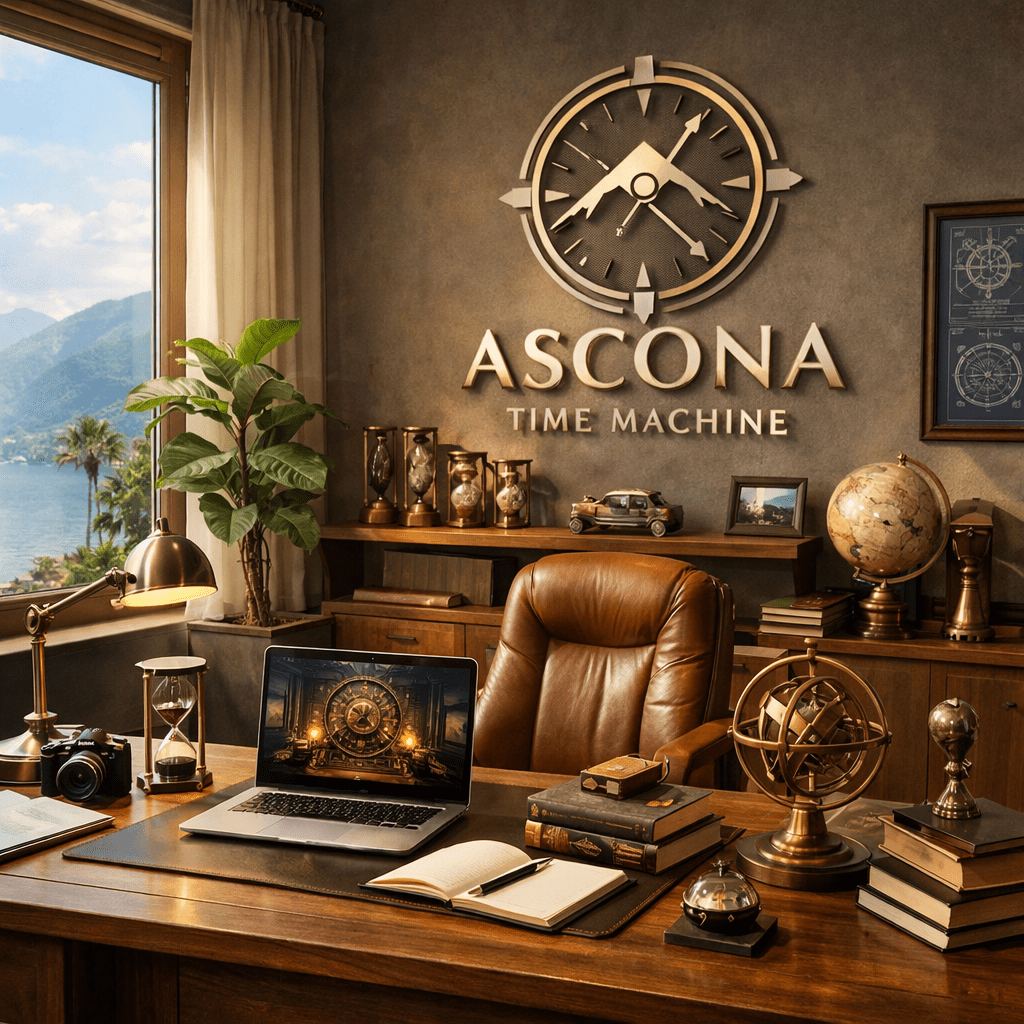
Enter “ASCONA, the Hidden Shore” project.
Submit here to join Ascona Time Machine Project
Project Title: ASCONA TIME MACHINE — A Living Archive of Consciousness, Art and Cultural Networks
Concept Overview
The Ascona Time Machine is a cultural and digital humanities project designed to reconstruct, visualize, and activate the unique intellectual and artistic ecosystem that emerged in Ascona—particularly around Monte Verità—from the late 19th to the mid-20th century.
Rather than a conventional archive, the project proposes a dynamic, multi-layered system where documents, artworks, correspondences, and biographies are interconnected into a living network. The aim is to reveal how ideas, individuals, and movements interacted across time, forming a prototype of a new cultural paradigm centered on consciousness, creativity, and transformation.
Historical Context
Between 1900 and 1970, Ascona became an exceptional convergence point for:
- avant-garde artists
- philosophers and reformers
- psychoanalysts and spiritual thinkers
- dancers, writers, and political utopians
Key figures include:
- Carl Gustav Jung
- Hermann Hesse
- Rudolf Steiner
- Else Lasker-Schüler
- Luigi Pericle
- Nell Walden
These individuals were not isolated figures, but part of a dense relational network involving movements such as Theosophy, Lebensreform, early psychoanalysis, and abstract art.
Project Structure
The Ascona Time Machine consists of three integrated layers:
1. Digital Corpus
A large-scale digitization of:
- manuscripts, letters, diaries
- artworks and symbolic diagrams
- rare books and unpublished materials
The corpus will enable AI-driven analysis of themes, symbols, and conceptual recurrences across thousands of documents.
2. Network Visualization
Using advanced data modeling, the project will map:
- relationships between individuals
- shared concepts (e.g., “inner transformation”, “cosmic order”, “archetypes”)
- geographic and temporal movements
The result is an interactive knowledge graph, where users can explore connections across time and disciplines.
3. Experiential Interface
The project will also exist as a physical and immersive experience, hosted in Ascona:
- exhibitions and guided “time journeys”
- residency programs and fellowships
- conferences linking art, science, and spirituality
Visitors will not simply observe history—they will enter it as a living field.
Methodological Innovation
The Ascona Time Machine integrates:
- Digital Humanities (large-scale archival structuring)
- Artificial Intelligence (pattern recognition, semantic mapping)
- Curatorial Practice (interpretation and narrative design)
- Philosophical Inquiry (consciousness, symbolic systems, meaning)
This approach transforms fragmented historical material into a coherent, navigable intelligence system.
Strategic Vision
The project positions Ascona as:
- a European node of cultural memory and future thinking
- a laboratory for exploring the relationship between art and consciousness
- a prototype for other “Time Machine” initiatives across Europe
It aligns with broader initiatives such as TimeMachine.eu, while maintaining a distinct focus on inner experience, symbolic knowledge, and artistic research.
Expected Impact
- Creation of a globally accessible archive
- New academic research pathways
- Cultural tourism based on depth and meaning
- Reinforcement of Ascona as a historical and contemporary cultural hub
The Ascona Time Machine is not only a reconstruction of the past.
It is an attempt to reactivate a field of thought and perception that remains urgently relevant today.
By connecting archives, technologies, and human experience, the project proposes a fundamental question:
Can we understand the future by reactivating the most conscious moments of our past?

